

In the race to build bigger models and smarter agents, it’s easy to focus on product announcements, benchmark scores, and funding rounds. But in early 2026, one of the most consequential developments in artificial intelligence didn’t come from a lab release.
It came from policymakers and researchers.
The International AI Safety Report 2026 marks a turning point in how governments, labs, and enterprises are thinking about frontier AI risk. It signals that the AI conversation is no longer just about innovation velocity — it is increasingly about systemic risk management at global scale.
For companies building or deploying advanced AI, ignoring this shift would be a strategic mistake.
Why this report is different from earlier AI safety discussions
AI safety has been debated for years. What makes the 2026 report notable is not just its content, but its positioning.
Earlier safety conversations were often:
- academic
- speculative
- or confined to technical research circles
The new wave of international safety work is different. It reflects growing alignment between:
- national governments
- major AI labs
- standards bodies
- and enterprise risk leaders
In practical terms, this means AI safety is moving from research topic to operational requirement.
The core message: frontier AI risk is now treated as a systems problem
One of the most important conceptual shifts reflected in the report is the move away from viewing AI risk as isolated model behavior.
Instead, the emerging view treats advanced AI risk as a full-stack systems challenge.
What that means in practice
Organizations are increasingly expected to evaluate risk across:
- model capabilities
- training processes
- deployment environments
- user interaction patterns
- and downstream misuse scenarios
This broader framing matters because it expands the compliance and governance surface area significantly.
Companies that only evaluate model outputs — without considering infrastructure, access control, and misuse vectors — are likely to fall behind emerging best practices.
The growing concern around capability acceleration
Another key theme in the global safety conversation is the pace of capability growth.
The report reflects rising concern that frontier models are improving along multiple dimensions simultaneously, including:
- reasoning
- coding
- multimodal understanding
- and autonomous task execution
This multi-axis progress creates what policymakers increasingly describe as capability overhang risk — where systems become broadly powerful faster than governance frameworks can adapt.
Why policymakers are paying closer attention
Several forces are driving this heightened scrutiny:
- rapid improvement cycles across major labs
- falling barriers to powerful model access
- expanding open-weight ecosystems
- and increasing enterprise reliance on AI decision support
From a policy standpoint, the question is no longer hypothetical:
How do you maintain safe deployment when capability growth is compounding?
The report’s quiet but important shift toward pre-deployment safeguards
Perhaps the most significant evolution in global AI safety thinking is the emphasis on pre-deployment controls rather than purely reactive monitoring.
For years, much of the industry focused on:
- content filters
- post-hoc moderation
- and reactive patching
The new safety paradigm places more weight on upstream controls.
Emerging best practices highlighted by policymakers
Capability evaluations before release
Advanced models are increasingly expected to undergo structured testing for dangerous capabilities prior to public deployment.
This includes evaluation for:
- autonomous misuse potential
- cybersecurity risks
- bio-related knowledge hazards
- and scalable deception risks
Even if many systems remain far from worst-case scenarios, the direction of travel is clear: evaluation rigor is rising.
Staged rollout strategies
Rather than wide open launches, the report reflects growing support for:
- phased deployments
- controlled access tiers
- and progressive exposure models
These approaches aim to reduce the risk of unexpected behavior at scale.
Enhanced red-teaming expectations
Red-teaming is evolving from an optional best practice into something closer to an industry norm — especially for frontier systems.
Enterprises adopting advanced AI are increasingly expected to demonstrate adversarial testing capacity.
Why enterprises — not just AI labs — should care
One of the biggest misconceptions in the market is that AI safety frameworks only apply to frontier model developers.
That assumption is becoming outdated.
The expanding responsibility chain
Enterprises that:
- fine-tune models
- embed AI into products
- deploy agentic systems
- or provide AI-enabled decision tools
are increasingly part of the AI risk surface.
This is particularly true in regulated sectors such as:
- finance
- healthcare
- critical infrastructure
- and government services
Organizations in these domains are likely to face growing expectations around AI governance maturity.
The compliance convergence already underway
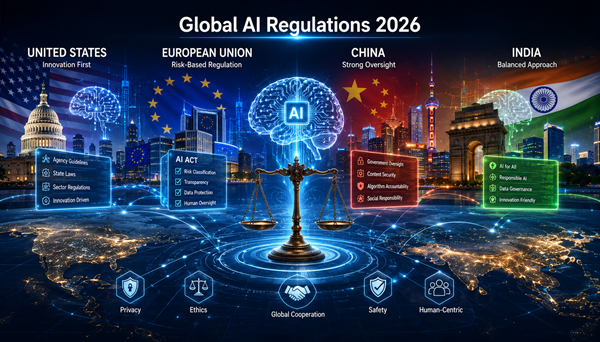
Another key takeaway from the international safety push is the emerging convergence between:
- AI safety frameworks
- AI regulation
- cybersecurity standards
- and enterprise risk management
In practical terms, AI governance is becoming less of a standalone discipline and more of a cross-functional risk domain.
What mature organizations are doing now
Leading companies are beginning to integrate AI risk into existing frameworks such as:
- model risk management
- enterprise risk registers
- security threat modeling
- and software assurance pipelines
This integration trend is likely to accelerate through 2026 and beyond.
The geopolitical undercurrent
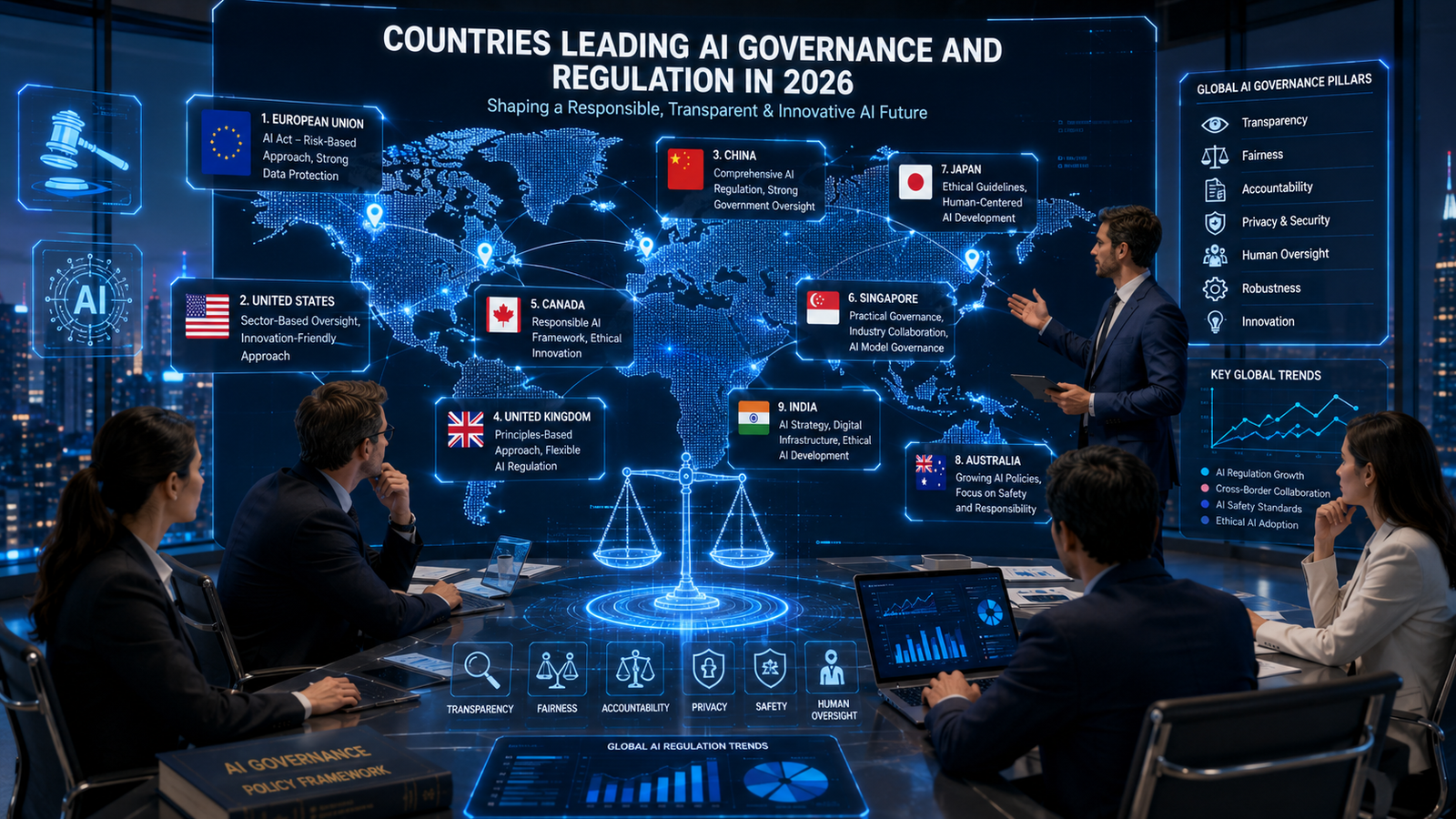
Although framed as a safety initiative, the global coordination around AI risk also has a clear geopolitical dimension.
Governments increasingly view frontier AI as:
- economically strategic
- security-relevant
- and socially transformative
As a result, international safety work is partly about risk reduction and partly about norm-setting in a competitive technological landscape.
Why this matters for global AI companies
Firms operating internationally should expect:
- more cross-border policy alignment
- but also potential regulatory fragmentation
- and rising expectations for transparency
Companies that build governance infrastructure early will have a significant advantage as requirements tighten.
What to watch over the next 12 months
The International AI Safety Report is not a one-off milestone. It is an early signal of a longer trend.
Key developments likely ahead
- more formalized model evaluation standards
- increased government–lab coordination
- rising enterprise due-diligence requirements
- stronger expectations around incident reporting
- and deeper integration of safety into procurement decisions
Each of these will gradually raise the baseline for what counts as “responsible AI deployment.”
Editorial verdict
The most important AI story of 2026 may not be which model scores highest on benchmarks.
It may be how quickly the industry adapts to a world where AI capability and AI governance must scale together.
The International AI Safety Report signals that the era of informal safety norms is ending. What is emerging in its place is a more structured, more global, and more operational approach to managing frontier AI risk.
Companies that treat safety as a side initiative will struggle.
Companies that treat it as core infrastructure will be better positioned for the next phase of the AI economy.










Leave a Reply