

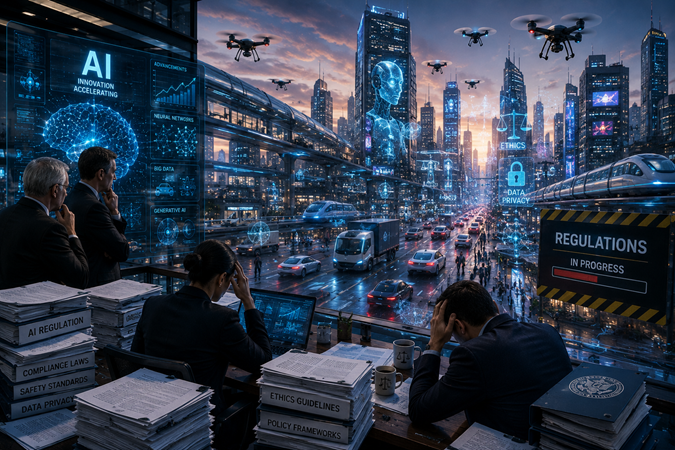
Artificial intelligence is advancing at a pace that governments and regulators around the world are struggling to match.
In 2026, AI systems are evolving faster than many legal frameworks, corporate policies, and public institutions can adapt. New models, autonomous AI agents, generative tools, and enterprise AI platforms are being released at extraordinary speed, while regulators continue debating how these systems should be monitored, controlled, and governed.
What began as a technological breakthrough has rapidly become one of the biggest regulatory challenges of the modern era.
Governments worldwide are now facing urgent questions involving:
- Data privacy
- Cybersecurity
- Deepfakes
- Election interference
- AI-generated misinformation
- Employment disruption
- National security
- Copyright protection
- Autonomous decision-making
At the same time, technology companies are investing billions into AI development because they believe the industry could reshape the global economy over the next decade.
The result is a widening gap between technological innovation and regulatory oversight.
Many experts now warn that AI may be advancing too quickly for traditional legal systems to manage effectively.
Here is why the AI industry is moving faster than regulators can handle — and why governments worldwide are struggling to keep pace.
AI Development Is Accelerating at Unprecedented Speed
One major reason regulators are struggling is the extraordinary speed of AI advancement.
Earlier technological revolutions often unfolded gradually over many years.
Artificial intelligence is evolving much faster.
New AI systems now emerge in rapid cycles involving:
- Larger models
- More powerful reasoning capabilities
- Autonomous AI agents
- Multimodal systems
- Real-time voice interaction
- Video generation
- Enterprise workflow automation
Companies are competing aggressively to release increasingly capable models before competitors gain market advantages.
This creates intense pressure for rapid deployment rather than cautious rollout.
By the time regulators begin analyzing one generation of AI systems, newer and more advanced technologies have often already entered the market.
Governments Move Much Slower Than Technology Companies
Regulatory systems are traditionally designed for slow-moving policy development.
Creating new laws often requires:
- Political negotiation
- Committee reviews
- Public consultations
- Legal analysis
- International coordination
This process can take years.
AI companies, by contrast, can release major software updates within weeks or even days.
Technology firms operate in highly competitive global markets where speed is critical.
Governments often struggle to fully understand technical developments before businesses have already commercialized them.
This creates a structural imbalance between innovation cycles and policymaking speed.
AI Is Affecting Multiple Industries Simultaneously
Unlike earlier technologies that disrupted specific sectors gradually, AI is transforming many industries at the same time.
Artificial intelligence is now being integrated into:
- Healthcare
- Finance
- Education
- Transportation
- Defense
- Media
- Manufacturing
- Cybersecurity
- Government services
Each industry presents different regulatory challenges.
For example:
- Healthcare AI raises medical safety concerns
- Financial AI affects fraud prevention and market stability
- Media AI increases misinformation risks
- Military AI creates national security concerns
Governments must therefore regulate AI across multiple sectors simultaneously — an extremely difficult task.
Generative AI Created an Explosion of New Risks
The rise of generative AI dramatically increased regulatory pressure worldwide.
Modern AI systems can now generate:
- Text
- Images
- Audio
- Videos
- Software code
- Synthetic voices
While these tools offer enormous productivity benefits, they also create major risks involving:
- Deepfake scams
- Election manipulation
- Fake news
- Copyright infringement
- Identity fraud
- AI-generated spam
Deepfake technology has become especially concerning because AI-generated videos and voices are becoming increasingly realistic.
Experts worry that misinformation campaigns could become far more difficult to detect during elections, geopolitical conflicts, or financial crises.
Regulators are still debating how to control these technologies without restricting legitimate innovation.
AI Companies Often Operate Globally
Another major challenge is that AI companies operate internationally.
A single AI platform may:
- Train models in one country
- Host servers in another
- Serve users worldwide
- Collect data across multiple jurisdictions
This creates major legal complications because countries have different laws involving:
- Privacy
- Speech
- Copyright
- National security
- Consumer protection
Governments are increasingly discovering that national regulations may have limited effectiveness against globally distributed AI systems.
International coordination on AI policy remains slow and politically difficult.
Regulators Often Lack Technical Expertise
Many policymakers and regulators lack deep technical knowledge about modern AI systems.
Artificial intelligence involves highly complex fields such as:
- Machine learning
- Neural networks
- Large language models
- Data engineering
- Cloud infrastructure
Technology companies often employ some of the world’s leading AI researchers and engineers.
Governments sometimes struggle to recruit comparable technical talent due to lower salaries and slower bureaucratic environments.
This knowledge gap can make effective regulation extremely difficult.
Some lawmakers have publicly demonstrated misunderstandings about how AI systems function, further raising concerns about regulatory preparedness.
AI Is Advancing Faster Than Existing Legal Frameworks
Most current laws were created before modern generative AI systems existed.
As a result, many legal frameworks do not clearly address:
- AI-generated content ownership
- Algorithmic accountability
- Autonomous AI decisions
- Training data rights
- Synthetic media
- AI liability
For example, courts worldwide are now handling disputes involving:
- Copyright lawsuits against AI companies
- Unauthorized data scraping
- Deepfake misuse
- AI-generated misinformation
Many of these legal questions remain unresolved.
This uncertainty creates major challenges for both businesses and regulators.
Businesses Are Deploying AI Faster Than Compliance Systems Can Adapt
Many companies are adopting AI tools rapidly because they fear falling behind competitors.
Businesses increasingly use AI for:
- Customer support
- Marketing
- Software development
- Financial analysis
- Hiring
- Workflow automation
However, corporate compliance systems often evolve much more slowly.
Organizations frequently struggle to establish clear policies involving:
- Data protection
- AI oversight
- Bias prevention
- Security standards
- Human supervision
Some companies are deploying AI systems before fully understanding associated legal and operational risks.
AI Cybersecurity Risks Are Growing Rapidly
AI is also transforming cybersecurity — for both defenders and attackers.
Cybercriminals increasingly use AI for:
- Automated phishing attacks
- Deepfake fraud
- Social engineering
- Malware generation
- Password cracking
At the same time, security firms are deploying AI-powered defense systems capable of:
- Threat detection
- Network monitoring
- Automated incident response
- Predictive security analysis
This rapidly evolving AI cybersecurity arms race makes regulation even more complicated.
Governments must balance innovation, digital security, and civil liberties simultaneously.
Employment Concerns Are Increasing Political Pressure
One of the biggest long-term concerns surrounding AI involves jobs.
Businesses increasingly use AI to automate:
- Administrative work
- Customer support
- Content creation
- Research tasks
- Software coding
- Operational workflows
Economists remain divided over how AI will affect employment overall.
Some believe AI will primarily augment workers and create new industries.
Others warn that rapid automation could disrupt large segments of the labor market faster than economies can adapt.
Governments are under growing pressure to address:
- Workforce retraining
- Economic inequality
- Digital skills gaps
- Potential job displacement
However, policymakers still lack consensus on how AI-driven labor transformation will unfold.
National Security Concerns Are Intensifying
Artificial intelligence is increasingly viewed as a strategic national security technology.
Governments worry that AI could affect:
- Cyberwarfare
- Military systems
- Intelligence operations
- Critical infrastructure
- Economic competitiveness
Major global powers are investing heavily in AI research and infrastructure.
Some analysts compare the current AI race to earlier geopolitical competitions involving nuclear technology or space exploration.
This creates additional pressure for rapid AI development, sometimes conflicting with calls for stricter regulation.
Different Countries Are Taking Very Different Approaches
Global AI regulation remains fragmented.
Some governments prioritize:
- Innovation and economic growth
- Rapid commercialization
- Technology leadership
Others emphasize:
- Privacy protection
- Consumer safety
- Ethical oversight
- Corporate accountability
This creates inconsistent global standards.
Technology companies must navigate different legal environments across multiple countries simultaneously.
Many experts believe international AI governance frameworks will eventually become necessary, but political coordination remains difficult.
Some Experts Fear Regulation May Already Be Too Late
Some researchers and policymakers worry that AI development has already reached a scale where meaningful regulation may become increasingly difficult.
Open-source AI models, decentralized development, and global competition make centralized control challenging.
Even if governments impose restrictions, AI research may continue advancing through:
- Private companies
- International competitors
- Open-source communities
- Underground cybercriminal networks
This raises difficult questions about whether governments can realistically slow AI progress without harming economic competitiveness.
Why Governments Still Cannot Ignore AI Regulation
Despite the challenges, most experts agree that some form of AI governance is essential.
Without oversight, risks could increase involving:
- Mass misinformation
- Privacy violations
- Algorithmic discrimination
- Autonomous cyberattacks
- Financial instability
- National security threats
Governments worldwide are therefore attempting to create AI policies focused on:
- Transparency
- Safety testing
- Consumer protection
- Human oversight
- Accountability standards
However, the speed of AI innovation continues making comprehensive regulation extremely difficult.
Conclusion
The AI industry is moving faster than regulators can handle because technological innovation is advancing at extraordinary speed while governments remain constrained by slow policymaking systems, legal complexity, and limited technical expertise.
Generative AI, autonomous agents, deepfake systems, enterprise AI platforms, and global AI competition are creating challenges that traditional regulatory frameworks were never designed to manage.
Governments worldwide now face difficult decisions involving:
- Innovation versus oversight
- Economic growth versus safety
- Privacy versus competitiveness
- National security versus open technology development
At the same time, businesses continue deploying AI aggressively because the technology offers enormous strategic and financial advantages.
In 2026, one reality is becoming increasingly difficult to ignore:
Artificial intelligence is advancing so quickly that the world’s legal, political, and regulatory systems may never fully catch up.







Leave a Reply