

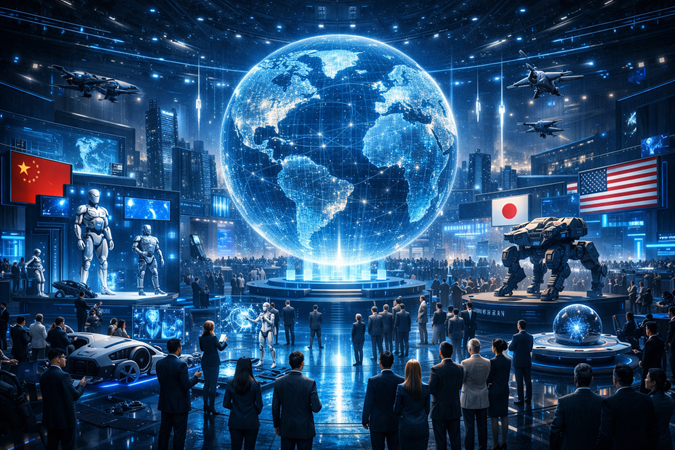
The global artificial intelligence race is entering a dramatically more intense phase.
Major AI announcements this week involving infrastructure, autonomous AI systems, semiconductors, cloud computing, national investment strategies, and enterprise AI platforms are rapidly reshaping how countries and technology companies compete for global influence.
What was once viewed primarily as a software revolution is now becoming a worldwide strategic competition involving:
- Economic power
- National security
- Semiconductor dominance
- Cloud infrastructure
- Cybersecurity
- Scientific leadership
- Workforce transformation
Governments and corporations increasingly believe AI could determine which nations and businesses dominate the next era of global technology.
The scale of investment is enormous.
Technology companies are spending hundreds of billions of dollars building AI data centers, training advanced models, developing AI chips, and deploying autonomous enterprise systems.
At the same time, governments worldwide are accelerating national AI strategies because they fear falling behind geopolitical rivals.
Experts now compare the AI race to earlier global competitions involving nuclear technology, space exploration, and the internet — but moving much faster.
Here are the biggest AI announcements right now that are reshaping global competition in 2026.
Google Expanded Its AI Ecosystem for the “Agentic Era”
One of the most significant AI announcements came from Google, which introduced major updates focused on autonomous AI systems, enterprise AI infrastructure, and next-generation AI chips. :contentReference[oaicite:0]{index=0}
At Cloud Next 2026, Google revealed:
- Gemini Enterprise Agent Platform
- Eighth-generation TPU chips
- Gemma 4 open AI models
- Advanced AI research systems
- AI-powered coding tools
- Deep Research Max analytics
Google described these technologies as foundational infrastructure for the “agentic era” of AI. :contentReference[oaicite:1]{index=1}
The announcements show how AI competition is shifting beyond chatbots toward complete AI ecosystems capable of managing enterprise operations, software development, cloud computing, and large-scale automation.
Google is increasingly positioning AI as the center of its search, productivity, cloud, and enterprise businesses simultaneously.
This intensifies competition with Microsoft, OpenAI, Anthropic, Meta, Amazon, and Chinese AI firms.
The U.S. and China Are Quietly Escalating the AI Race
The geopolitical AI competition between the United States and China is becoming one of the defining technology rivalries of the decade.
Recent reports indicate both governments are now discussing AI guardrails because officials fear the rivalry could escalate dangerously without coordination. :contentReference[oaicite:2]{index=2}
However, despite diplomatic discussions, the AI race itself continues accelerating rapidly.
Both countries increasingly view AI leadership as critical for:
- Economic competitiveness
- Military systems
- Cybersecurity
- Scientific research
- Global technological influence
Stanford’s 2026 AI Index Report found that U.S. and Chinese AI models have repeatedly traded leadership positions since 2025. :contentReference[oaicite:3]{index=3}
The report also showed:
- The U.S. leads in frontier AI model development
- China dominates AI publication volume
- China leads in AI patent output
- China dominates industrial robot deployment
This reflects how AI competition is no longer confined to software models alone.
Instead, nations are competing across infrastructure, manufacturing, robotics, research, and industrial deployment simultaneously.
Massive AI Infrastructure Spending Is Transforming the Industry
The scale of AI infrastructure investment announced recently is staggering.
Industry analysis suggests major technology companies may collectively spend more than $650 billion on AI infrastructure in 2026. :contentReference[oaicite:4]{index=4}
These investments include:
- AI data centers
- Cloud computing infrastructure
- Semiconductor manufacturing
- Networking systems
- Power-intensive compute clusters
The AI race is increasingly becoming an infrastructure competition rather than purely a model competition. :contentReference[oaicite:5]{index=5}
Companies capable of securing:
- Advanced chips
- Energy supply
- Cloud scale
- Data-center capacity
may gain major long-term advantages.
This is why semiconductor firms, cloud providers, networking companies, and energy suppliers are now central to the AI economy.
Meta Is Building Its Own AI Hardware Ecosystem
Meta recently announced an expanded roadmap involving in-house AI chips and AI-enabled wearable devices. :contentReference[oaicite:6]{index=6}
The company revealed:
- New proprietary AI accelerator chips
- Expanded AI smart glasses
- Long-term AI infrastructure partnerships
These announcements show how major technology firms increasingly want control over their own AI hardware ecosystems.
Instead of relying entirely on external semiconductor providers, companies are developing custom AI chips optimized for:
- Training AI models
- Inference workloads
- Consumer AI devices
- Wearable AI systems
This reflects a broader industry shift toward vertically integrated AI ecosystems.
Agentic AI Is Becoming the Next Major Battlefield
One of the most important trends reshaping competition is the rise of “agentic AI.”
Unlike traditional chatbots, agentic AI systems can:
- Interpret goals
- Create plans
- Use external software tools
- Coordinate workflows
- Execute multi-step tasks autonomously
Technology companies are now racing to develop AI systems capable of functioning more like autonomous digital workers.
Google, Microsoft, OpenAI, Anthropic, Meta, and several Chinese firms are aggressively pursuing enterprise AI agent platforms.
Industry analysts increasingly believe agentic AI could become one of the most transformative enterprise technologies of the decade. :contentReference[oaicite:7]{index=7}
The companies that dominate AI agents may eventually control large portions of workplace productivity software and enterprise automation.
India Is Emerging as a Major AI Power
India is increasingly positioning itself as a major player in global AI competition.
At the India AI Impact Summit 2026, government officials and technology companies announced major initiatives involving AI infrastructure, education, and international partnerships. :contentReference[oaicite:8]{index=8}
Announcements included:
- Expansion of India’s sovereign AI infrastructure
- Large-scale GPU investments
- International AI partnerships
- AI education initiatives
- AI-for-development programs
Microsoft reportedly pledged up to $50 billion toward AI development initiatives across lower-income regions by the end of the decade. :contentReference[oaicite:9]{index=9}
India’s growing AI ecosystem reflects a broader shift toward multipolar global AI competition rather than dominance by only the United States and China.
Several experts believe India could become one of the world’s most important AI markets and development hubs over the next decade.
Open AI Model Competition Is Intensifying
The competition involving open AI models is accelerating rapidly.
Google’s Gemma 4, DeepSeek’s latest releases, Meta’s Llama ecosystem, and other open-model initiatives are increasing pressure on proprietary AI systems. :contentReference[oaicite:10]{index=10}
Open models could significantly reshape global AI competition because they allow:
- Faster experimentation
- Lower development barriers
- Broader international adoption
- Independent customization
However, open AI systems also raise concerns involving:
- Security risks
- Cybercrime misuse
- Deepfake generation
- Loss of centralized safeguards
The debate surrounding open versus closed AI ecosystems is becoming increasingly important for both governments and technology companies.
AI Competition Is Expanding Beyond Software
One major shift happening right now is that AI competition is no longer limited to software models.
The industry is now competing across:
- AI chips
- Cloud infrastructure
- Networking systems
- Robotics
- Search engines
- Enterprise ecosystems
- Wearable devices
- Autonomous systems
CES 2026 demonstrated this broader transformation.
Companies including Nvidia, AMD, Intel, LG, Hyundai, Uber, and others announced major AI-focused hardware and robotics initiatives. :contentReference[oaicite:11]{index=11}
This suggests AI may become embedded into nearly every layer of future technology infrastructure.
AI Search Could Reshape Global Information Markets
AI-powered search systems are becoming another major competitive battlefield.
Research published this year found rapid global expansion of AI-generated search systems and AI search overviews. :contentReference[oaicite:12]{index=12}
AI search systems increasingly influence:
- Information discovery
- Digital advertising
- Media traffic
- Consumer behavior
- Public opinion
Some researchers warn that AI search ecosystems may concentrate information power among a small number of dominant technology companies.
This raises major questions involving:
- Competition policy
- Media economics
- Information diversity
- Algorithmic influence
The AI Talent War Is Becoming Extreme
Another major force reshaping global competition is the fight for AI talent.
Frontier AI companies are aggressively competing for:
- Machine-learning researchers
- Infrastructure engineers
- Chip designers
- AI safety experts
- Cloud computing specialists
Some leading AI researchers now command compensation packages comparable to elite athletes or top corporate executives.
Countries increasingly recognize that talent concentration may determine future AI leadership.
This has intensified global competition involving immigration policy, research funding, and university partnerships.
AI Safety Is Becoming Part of Global Power Politics
As AI systems become more powerful, governments are increasingly linking AI safety to geopolitical strategy.
The International AI Safety Report 2026 — backed by more than 30 countries — warned about growing risks involving advanced AI systems. :contentReference[oaicite:13]{index=13}
Concerns now include:
- Autonomous cyberattacks
- Deepfake misinformation
- Biological misuse
- Critical infrastructure risks
- Loss of human oversight
At the same time, governments fear that overly restrictive AI regulation could weaken national competitiveness.
This has created a difficult balancing act between innovation, security, and international influence.
The Global Tech Industry May Never Look the Same
Together, these announcements reveal that AI is becoming much more than a software trend.
Artificial intelligence is rapidly evolving into a foundational layer of:
- Global economic competition
- Cloud computing
- Scientific research
- Military strategy
- Enterprise operations
- Consumer technology
- National infrastructure
The companies and countries that dominate AI infrastructure may gain enormous influence over future technological ecosystems.
Some analysts believe the AI race could ultimately reshape the balance of global economic power itself.
Conclusion
The biggest AI announcements right now show that the global AI race is accelerating far beyond simple chatbot competition.
Major technology companies are building enormous AI ecosystems involving autonomous agents, cloud infrastructure, AI chips, enterprise platforms, search systems, and AI-native devices.
Meanwhile, governments increasingly view artificial intelligence as a strategic national priority tied directly to economic leadership, cybersecurity, military capability, and geopolitical influence.
The competition now extends across:
- Semiconductors
- Data centers
- Cloud computing
- Enterprise AI
- Scientific research
- Global infrastructure
In 2026, one reality is becoming increasingly clear:
The countries and companies leading the AI race today may ultimately shape the structure of the global economy, technology industry, and geopolitical balance for decades to come.







Leave a Reply