


AI tools are no longer niche software used only by tech professionals.
In 2026, millions of users worldwide are actively switching to free AI productivity tools to handle writing, research, coding, planning, design, communication, and everyday work tasks.
What’s driving this shift is simple: modern AI tools now deliver high-quality results without requiring expensive subscriptions.
Many users are discovering that free AI platforms can handle 70–90% of their daily productivity needs, especially for repetitive or time-consuming tasks.
As a result, entire workflows that once required multiple apps, manual effort, and even small teams are now being handled by a few AI tools working together.
Here’s why millions of users are switching — and which free AI productivity tools are leading the change.
Why Millions of Users Are Switching to Free AI Tools
The shift toward free AI tools is happening faster than most experts predicted.
Recent usage data shows AI assistants are now being used at massive scale across search engines, mobile apps, and productivity platforms.
For example, Google’s Gemini ecosystem alone reaches billions of users through Search, Android, and Workspace integrations. ([turn0search0])
Meanwhile, standalone AI apps like ChatGPT and Gemini continue to grow rapidly in daily active usage, making AI one of the fastest-adopted technologies in history.
Key reasons for the shift include:
- Free access to powerful AI models
- Integration into everyday apps like Gmail and Docs
- Time savings in writing and research
- Automation of repetitive tasks
- Easy-to-use interfaces with no technical skills required
For many users, switching to AI tools is not optional anymore — it is becoming part of daily workflow optimization.
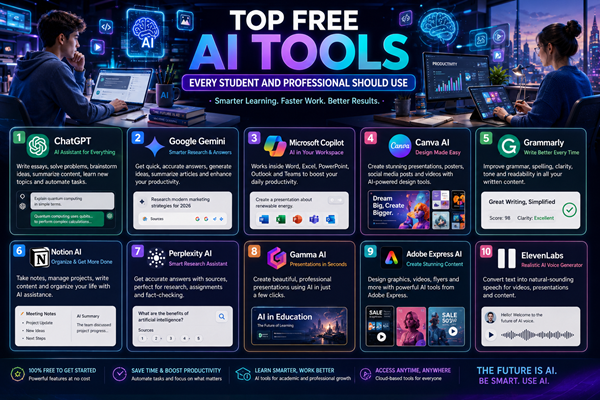
1. ChatGPT — The Most Popular All-Round AI Assistant
ChatGPT remains one of the most widely used free AI tools globally, especially for writing, brainstorming, coding help, and summarization.
Even on the free tier, users can access powerful AI models for everyday productivity tasks. ([turn0search1])
Millions of people use ChatGPT to:
- Write emails and reports
- Summarize long documents
- Generate content ideas
- Fix grammar and rewrite text
- Solve coding problems
Its biggest advantage is versatility — it can handle almost any general productivity task in one interface.
This makes it the first stop for many users switching away from multiple paid tools.
2. Google Gemini — Deep Integration With Daily Workflows
Google Gemini has become one of the fastest-growing AI ecosystems due to its deep integration across Google Search, Gmail, Docs, Android, and Chrome.
Gemini-powered AI features now reach over 1 billion users through Google Search alone, making it one of the most widely distributed AI systems in the world. ([turn0search0])
Users rely on Gemini for:
- Email drafting in Gmail
- Document creation in Google Docs
- Quick answers inside Search
- Research summaries
- Planning and brainstorming tasks
Its biggest advantage is convenience — AI is already built into tools people use every day.
This reduces friction and increases adoption across both personal and professional users.
3. Microsoft Copilot — AI Inside Office Workflows
Microsoft Copilot is transforming productivity inside Word, Excel, PowerPoint, and Outlook.
Although many advanced features are paid, the free version still provides significant value for everyday tasks.
Users commonly use Copilot for:
- Writing documents in Word
- Creating PowerPoint presentations
- Analyzing data in Excel
- Summarizing emails in Outlook
Microsoft reports strong adoption across enterprise environments, although only a small percentage of users currently pay for premium features. :contentReference[oaicite:0]{index=0}
This shows a key trend: AI is being widely used even when users are not directly paying for it.
4. Claude AI — Strong for Writing and Long Context Tasks
Claude is widely known for its ability to handle long documents, structured writing, and detailed reasoning tasks.
Many users prefer it for:
- Long-form writing
- Research summaries
- Document analysis
- Coding assistance
It is especially useful when users need coherent responses across large amounts of text.
Students, analysts, and writers often use Claude alongside other AI tools to improve productivity in content-heavy workflows.
5. Perplexity AI — Fast AI Research Engine
Perplexity AI is becoming a popular alternative to traditional search engines.
Instead of browsing multiple websites manually, users get summarized answers with citations.
It is widely used for:
- Quick research
- Fact checking
- Learning new topics
- Market research
Many users consider it one of the biggest time-saving AI tools because it replaces dozens of search tabs with a single answer interface.
6. Canva AI — Design Without Graphic Skills
Canva AI has made design accessible to non-designers by automating visual creation.
Users can generate:
- Social media posts
- Presentations
- Marketing graphics
- Thumbnails and banners
This removes the need for professional design tools for many small businesses and content creators.
AI-powered templates significantly reduce time spent on visual content creation.
7. Notion AI — All-in-One Workspace Automation
Notion AI combines note-taking, task management, and AI assistance in one platform.
It helps users:
- Summarize notes
- Generate project plans
- Organize tasks
- Write documentation
Teams increasingly use Notion AI to replace multiple productivity apps with a single workspace.
How AI Tools Are Saving Hours Every Week
The biggest impact of free AI tools is time savings.
Users report major reductions in time spent on:
- Email writing
- Research and reading
- Document creation
- Meeting summaries
- Content editing
Even saving 30–60 minutes per day can translate into several hours per week.
This time is often redirected toward higher-value work such as strategy, creativity, or business growth.
Why Free AI Tools Are Becoming “Good Enough”
One of the biggest shifts in 2026 is that free AI tools are no longer low-quality versions of paid software.
Many free versions now offer:
- Advanced AI models
- Multimodal capabilities
- Integration with productivity apps
- Reasonable usage limits for daily work
In many cases, users do not hit free-tier limits during normal usage.
This makes free AI tools practical for students, freelancers, and even small businesses.
The Hidden Trade-Offs Users Should Know
Despite their benefits, free AI tools still have limitations.
Common constraints include:
- Usage caps during peak hours
- Slower response times
- Limited advanced features
- Occasional inaccuracies
AI systems can still make mistakes or generate incorrect information, especially in complex scenarios.
That’s why human review remains essential for important tasks like financial decisions, legal documents, and critical business operations.
The Future of Work Is Becoming AI-Assisted
Experts believe AI tools will soon become standard workplace infrastructure.
Instead of replacing humans entirely, AI is increasingly acting as a productivity multiplier.
Future workflows are expected to include AI for:
- Writing and communication
- Research and analysis
- Automation and scheduling
- Decision support
Companies that adopt AI effectively are already seeing major efficiency gains compared to traditional workflows.
Conclusion
Millions of users are switching to free AI productivity tools because they offer a simple and powerful advantage: more output in less time.
Tools like ChatGPT, Gemini, Copilot, Claude, Perplexity, Canva AI, and Notion AI are transforming how people work across industries.
They are reducing repetitive tasks, improving speed, and enabling individuals to accomplish more without additional resources.
As AI continues to evolve, the gap between free and paid tools is shrinking — making AI productivity accessible to almost everyone.
In 2026, the real competitive advantage is no longer access to AI tools — it is knowing how to use them effectively in daily workflows.









Leave a Reply