

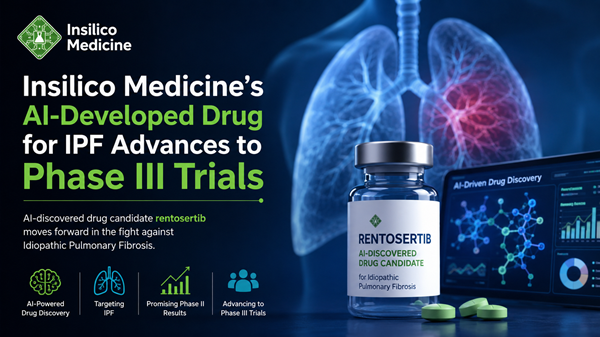
Artificial intelligence continues to make inroads into the pharmaceutical industry, with biotech company Insilico Medicine announcing that its AI-designed drug Rentosertib has advanced to Phase III clinical trials for the treatment of Idiopathic Pulmonary Fibrosis (IPF). The move is considered a major milestone, highlighting how AI is evolving from a research tool into a key driver of real-world drug development.
The late-stage trial places Rentosertib among the most advanced medicines created using generative AI technologies. If successful, the therapy could become one of the first AI-discovered drugs to receive regulatory approval, demonstrating the growing role of artificial intelligence in accelerating medical innovation.
Tackling a Devastating Lung Disease
Idiopathic Pulmonary Fibrosis is a rare but serious condition that causes progressive scarring of the lungs, gradually reducing their ability to supply oxygen to the body. Patients often experience worsening shortness of breath, chronic coughing, and declining lung function over time.
Despite the availability of existing treatments, there is currently no cure for IPF, making the search for more effective therapies a high priority for researchers worldwide.
Rentosertib has been developed to target TNIK (TRAF2 and NCK-interacting kinase), a protein believed to play an important role in the progression of pulmonary fibrosis. Scientists hope that blocking this target could help slow or prevent further lung damage.
AI Played a Central Role in Discovery
Unlike traditional drug development, which can take years to identify promising compounds, Insilico Medicine relied heavily on artificial intelligence throughout the early research process.
The company’s AI platform analyzed large volumes of biological data to identify TNIK as a potential therapeutic target. It then used generative AI models to design molecules capable of interacting with that target, significantly reducing the time needed to move from discovery to laboratory testing.
This AI-assisted approach allows researchers to evaluate thousands of potential drug candidates far more efficiently than conventional methods, helping scientists focus on the most promising options.
Promising Results Led to Phase III
Before advancing to Phase III, Rentosertib successfully completed earlier clinical studies that evaluated both its safety and initial effectiveness in patients with Idiopathic Pulmonary Fibrosis.
The findings suggested that the experimental therapy was generally well tolerated while also showing encouraging signs of slowing disease progression. Those results provided enough evidence for researchers to begin larger studies involving more patients.
Phase III trials are considered one of the final and most important stages of clinical development, as they determine whether a treatment consistently delivers meaningful benefits while maintaining an acceptable safety profile.
Why This Milestone Matters
Only a small percentage of experimental medicines successfully progress to Phase III clinical trials. Reaching this stage is therefore a significant achievement for any pharmaceutical company.
For Insilico Medicine, it also serves as proof that artificial intelligence can help generate drug candidates capable of meeting the rigorous scientific standards required for advanced clinical testing.
Industry experts believe the success of AI-driven drug discovery could help reduce development costs, shorten research timelines, and improve the overall efficiency of bringing new medicines to patients.
AI Is Transforming Pharmaceutical Research
Artificial intelligence is becoming an increasingly valuable tool across the pharmaceutical sector. Modern AI systems can rapidly analyze genetic information, scientific literature, molecular structures, and clinical datasets to uncover patterns that may be difficult for researchers to identify manually.
By combining machine learning with biological research, scientists can identify disease targets more quickly, design potential medicines faster, and improve the chances of discovering successful treatments.
Although laboratory experiments and human clinical trials remain essential, AI is helping streamline many of the early stages of drug development.
What Comes Next?
The ongoing Phase III trial will involve a much larger patient population and will assess whether Rentosertib can safely slow the progression of Idiopathic Pulmonary Fibrosis over a longer period.
Researchers will evaluate key measures such as lung function, disease progression, and overall patient outcomes. If the results are positive, Insilico Medicine plans to seek approval from global health regulators.
A successful outcome could make Rentosertib one of the first AI-designed medicines to reach the market, marking a historic achievement for both biotechnology and artificial intelligence.
A Turning Point for AI in Healthcare
The significance of Rentosertib extends far beyond a single drug. Its progress through late-stage clinical development demonstrates that artificial intelligence has the potential to reshape how new medicines are discovered and developed.
As pharmaceutical companies continue investing in AI-powered research platforms, similar technologies may help accelerate treatments for cancer, neurological disorders, rare diseases, and other complex conditions in the coming years.
While regulatory approval is still dependent on the outcome of the Phase III trial, Rentosertib’s advancement represents another important step toward a future where artificial intelligence plays a central role in delivering life-saving medical innovations.














Leave a Reply