

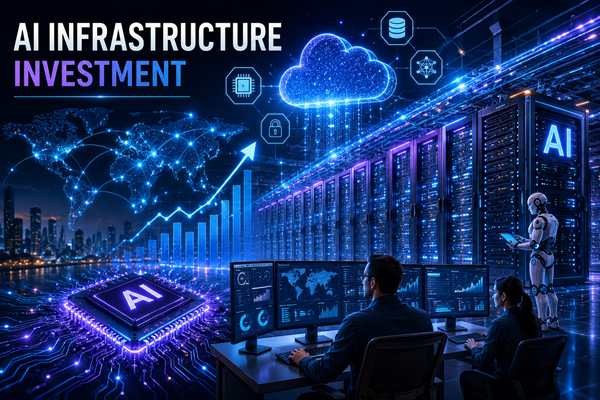
Artificial intelligence is no longer just about chatbots writing emails or image generators creating artwork. Behind every AI application that millions of people use every day lies an invisible layer of technology that makes it all possible. Massive data centers, powerful AI chips, cloud computing platforms, networking equipment, and specialized software are quietly powering the AI revolution.
This hidden foundation is known as AI infrastructure, and it has become one of the hottest investment opportunities in the technology sector. While consumer-facing AI companies often grab the headlines, infrastructure startups are attracting even larger funding rounds because they provide the tools that every AI business depends on.
From venture capital firms to global technology giants, investors are pouring billions of dollars into companies building the backbone of artificial intelligence. The reason is simple: as AI adoption accelerates worldwide, the demand for computing power, storage, networking, and AI development platforms is growing faster than ever before.
Understanding why AI infrastructure startups are receiving record investments can provide valuable insights into where the next wave of technological innovation and business growth is headed.
What Is AI Infrastructure?
Before exploring the investment boom, it is important to understand what AI infrastructure actually means.
AI infrastructure refers to the hardware, software, cloud platforms, networking systems, and development tools required to build, train, deploy, and manage artificial intelligence applications.
Think of AI infrastructure as the highways, power grids, and communication networks of the digital AI economy. Without these foundational technologies, advanced AI models simply cannot function.
Unlike consumer applications, infrastructure companies often operate behind the scenes. Their customers are enterprises, AI startups, governments, healthcare organizations, financial institutions, and research laboratories that require enormous computing resources.
As AI becomes increasingly integrated into everyday business operations, demand for this foundational technology continues to expand at an extraordinary pace.
1. Explosive Growth in AI Computing Demand
Every new AI model requires tremendous computing power.
Training large language models, computer vision systems, robotics platforms, and autonomous driving software involves processing trillions of data points across thousands of high-performance GPUs.
Just a few years ago, these computing requirements were limited to a handful of technology companies. Today, businesses of every size are investing in AI, dramatically increasing demand for cloud computing infrastructure.
This shift has created enormous opportunities for startups offering specialized GPU cloud services, AI supercomputing platforms, and distributed computing technologies.
As enterprises continue adopting generative AI, the need for scalable infrastructure is expected to grow for many years.
2. AI Chips Have Become the New Gold Rush
Semiconductors have become one of the most valuable assets in the AI economy.
Companies developing AI accelerators, custom processors, and specialized machine learning chips are attracting billions in funding because modern AI workloads require hardware specifically designed for artificial intelligence.
Traditional CPUs are no longer sufficient for training today’s sophisticated AI models.
Instead, companies are investing in GPU clusters, AI inference chips, and wafer-scale processors capable of delivering significantly higher performance.
Startups working in this area have become attractive acquisition targets while also positioning themselves for future IPO opportunities.
3. Cloud Infrastructure Is Becoming More Specialized
Cloud computing has evolved dramatically since its early days.
Instead of offering only general-purpose computing services, many startups now provide AI-native cloud infrastructure optimized specifically for machine learning workloads.
These platforms allow businesses to access thousands of GPUs on demand without purchasing expensive hardware themselves.
This flexible business model significantly lowers the barrier to AI adoption while creating predictable recurring revenue for infrastructure providers.
As more organizations move AI development into the cloud, investor confidence in these companies continues to strengthen.
4. Data Has Become the Fuel of Artificial Intelligence
Artificial intelligence is only as good as the data used to train it.
This has created enormous demand for startups specializing in data collection, annotation, storage, governance, and model evaluation.
Businesses increasingly require clean, secure, and accurately labeled datasets to improve AI performance.
Infrastructure companies providing these services have become essential partners for enterprises building AI-powered products.
The growing importance of high-quality data has transformed an overlooked market into one of the fastest-growing segments within artificial intelligence.
5. Enterprise AI Adoption Continues Accelerating
Businesses across healthcare, manufacturing, banking, retail, education, logistics, and cybersecurity are integrating AI into daily operations.
Each new AI implementation increases demand for infrastructure capable of supporting deployment at scale.
Companies require secure computing environments, monitoring systems, model management tools, cybersecurity protection, and automated deployment platforms.
Infrastructure startups solving these challenges are benefiting directly from enterprise digital transformation initiatives.
Rather than depending on consumer trends, many infrastructure businesses generate long-term enterprise contracts that appeal strongly to investors.
6. Governments Are Investing in National AI Infrastructure
Artificial intelligence has become a strategic priority for governments worldwide.
Countries are investing heavily in national AI computing facilities, sovereign cloud platforms, semiconductor manufacturing, and advanced research centers.
These initiatives create substantial opportunities for infrastructure startups capable of supplying technology, software, networking solutions, and specialized hardware.
Government contracts often provide stable long-term revenue while strengthening investor confidence in emerging companies.
7. AI Infrastructure Creates Recurring Revenue
One reason investors favor infrastructure companies is their predictable business models.
Unlike one-time software purchases, many AI infrastructure providers operate subscription-based platforms.
Customers pay monthly or annually for computing power, cloud storage, AI development tools, security monitoring, or managed infrastructure services.
Recurring revenue creates stronger financial stability, making these startups more attractive during fundraising rounds.
Investors generally value businesses with long-term customer relationships and consistent cash flow.
8. AI Infrastructure Benefits Every Industry
Consumer AI applications may rise and fall in popularity, but infrastructure serves the entire AI ecosystem.
Whether companies build medical AI, autonomous vehicles, financial assistants, robotics, cybersecurity software, or educational platforms, they all require computing resources.
This broad customer base reduces dependency on any single market.
Infrastructure companies therefore benefit regardless of which AI applications become dominant in the future.
This diversification significantly lowers business risk while increasing long-term growth potential.
Competition Is Driving Even More Investment
The global race for AI leadership has intensified throughout 2025 and 2026.
Major technology companies continue investing billions in data centers, networking equipment, AI chips, and cloud infrastructure to secure competitive advantages.
At the same time, venture capital firms recognize that innovative startups can often solve specialized infrastructure challenges faster than established corporations.
This combination of corporate spending and venture funding has created unprecedented investment momentum throughout the AI infrastructure ecosystem.
Many startups are now achieving billion-dollar valuations within only a few years of launching.
Challenges Still Remain
Despite impressive growth, AI infrastructure companies face significant obstacles.
Building advanced computing facilities requires enormous capital investment.
Competition for GPUs and semiconductor manufacturing capacity remains intense.
Energy consumption has also become an important concern, with data centers requiring substantial electricity and cooling resources.
Cybersecurity represents another growing challenge as AI infrastructure increasingly supports critical national industries.
Companies capable of solving these problems through innovation will likely become the next generation of market leaders.
What the Future Looks Like
Artificial intelligence is still in the early stages of its global transformation.
As AI expands into robotics, autonomous transportation, healthcare diagnostics, scientific research, financial services, manufacturing, and smart cities, infrastructure demand will continue increasing.
Emerging technologies such as edge AI, quantum computing integration, decentralized AI networks, and energy-efficient processors will further reshape the market.
This evolution creates ongoing opportunities for startups developing the next generation of AI infrastructure.
Investors recognize that today’s infrastructure companies may become tomorrow’s technology giants.
Final Thoughts
The record investments flowing into AI infrastructure startups are driven by more than market excitement. These companies provide the essential technologies that enable every AI application to function efficiently and scale globally.
Whether through advanced chips, GPU cloud services, enterprise AI platforms, data infrastructure, or cybersecurity solutions, infrastructure businesses have positioned themselves at the center of the AI revolution.
As organizations continue integrating artificial intelligence into every aspect of business and society, the demand for reliable, scalable, and secure infrastructure will only continue to grow.
For investors, entrepreneurs, and technology leaders, AI infrastructure represents one of the most important opportunities of the decade. While consumer AI applications may capture public attention, it is the companies building the digital foundation beneath them that are quietly shaping the future of artificial intelligence.









Leave a Reply