

Artificial intelligence is no longer just another technology trend—it has become one of the biggest investment opportunities of the decade. From AI-powered coding assistants and healthcare platforms to personal chatbots and creative tools, startups are attracting billions of dollars from venture capital firms across the globe. Yet one question continues to dominate conversations among investors: Should they back enterprise AI startups or consumer AI startups?
The answer isn’t as straightforward as it once seemed. Enterprise AI companies are generating stable recurring revenue by serving businesses, while consumer AI startups are capturing millions of users with innovative applications. Both markets are expanding rapidly, but they operate very differently, and investors are carefully weighing the risks and rewards before writing large checks.
As we move through 2026, the AI investment landscape is becoming more competitive than ever. Understanding where venture capital is flowing—and why—can provide valuable insights for entrepreneurs, investors, and anyone interested in the future of artificial intelligence.
Understanding the Difference Between Enterprise AI and Consumer AI
Although both categories rely on artificial intelligence, their target audiences, business models, and growth strategies differ significantly.
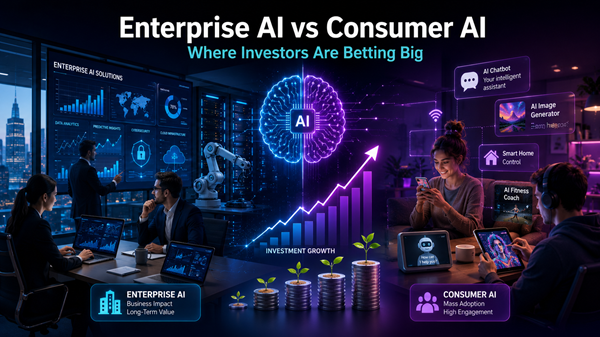
Enterprise AI startups develop software, platforms, and services specifically for businesses. Their customers include corporations, financial institutions, healthcare providers, manufacturers, retailers, and government organizations. These companies typically focus on improving productivity, automating repetitive tasks, strengthening cybersecurity, enhancing customer service, and optimizing operations.
Consumer AI startups, on the other hand, build products designed for everyday users. Their applications include AI chatbots, image generators, writing assistants, education platforms, fitness coaches, language-learning apps, and personal productivity tools. Success often depends on attracting millions of active users rather than signing large corporate contracts.
While both sectors are experiencing impressive growth, the investment dynamics behind each are very different.
Why Enterprise AI Is Winning Investor Confidence
1. Predictable Revenue Creates Long-Term Stability
Enterprise AI companies usually operate on subscription-based business models. Organizations sign annual or multi-year contracts, creating predictable recurring revenue that investors value highly.
This recurring income reduces financial uncertainty and allows businesses to forecast future growth more accurately. Investors often prefer companies with stable cash flows over startups that rely heavily on advertising or one-time purchases.
2. Larger Customer Contracts Mean Higher Revenue
Unlike consumer apps that may generate only a few dollars per user each month, enterprise software contracts can be worth hundreds of thousands—or even millions—of dollars annually.
Large corporations are willing to invest heavily in AI solutions if they improve efficiency, reduce costs, or increase productivity. This enables enterprise startups to scale revenue faster with fewer customers.
3. AI Solves Expensive Business Problems
Companies are adopting AI because it delivers measurable business value. Whether reducing customer support costs, accelerating software development, detecting fraud, or improving supply chain management, enterprise AI often provides clear financial returns.
Investors appreciate businesses where customers can easily calculate return on investment because it makes long-term customer retention much stronger.
4. Switching Costs Create Customer Loyalty
Once businesses integrate AI platforms into their daily operations, changing providers becomes expensive and time-consuming.
This creates high switching costs, making enterprise customers more likely to renew contracts year after year. Strong retention rates are one of the most attractive characteristics venture capital firms seek.
Why Consumer AI Continues to Attract Massive Funding
1. Explosive User Growth Can Create Market Leaders
Consumer AI startups have the ability to reach millions of users within months.
Applications powered by generative AI can spread rapidly through social media, word-of-mouth marketing, and app stores. Companies like ChatGPT demonstrated how quickly AI products can become household names.
Investors understand that products achieving widespread adoption often develop significant competitive advantages.
2. Consumer Brands Can Expand Into Multiple Markets
Successful consumer AI companies rarely remain focused on one product.
Many begin with a chatbot or creative application before expanding into productivity tools, education, business software, subscriptions, advertising, or enterprise solutions.
This flexibility creates multiple long-term revenue opportunities.
3. AI Personalization Drives Engagement
Modern AI systems continuously learn from user interactions.
The better these systems understand individual preferences, the more valuable they become. Personalized recommendations, customized learning experiences, and intelligent assistants encourage users to spend more time within the platform.
Higher engagement often translates into stronger monetization opportunities.
4. Global Distribution Has Never Been Easier
Cloud computing, smartphone adoption, and digital marketplaces allow consumer AI startups to launch globally from day one.
A startup developed by a small team can attract millions of users across multiple countries without opening physical offices or building complex distribution networks.
This scalability remains one of the strongest attractions for venture investors.
Where Venture Capital Is Investing the Most in 2026
Although consumer AI continues receiving significant attention, recent funding trends suggest enterprise AI startups are attracting a larger share of institutional investment.
Several factors explain this shift.
Businesses are actively increasing AI spending because they see measurable productivity gains. Enterprise software companies often achieve higher profit margins, stronger customer retention, and more predictable financial performance than consumer applications.
Meanwhile, consumer AI remains highly competitive.
Thousands of startups are launching similar products, making differentiation increasingly difficult. Customer acquisition costs continue rising while subscription fatigue limits pricing power.
This does not mean investors are avoiding consumer AI. Instead, they are becoming more selective, favoring companies with unique technology, strong brand recognition, or exceptional user engagement.
Industries Driving Enterprise AI Growth
Enterprise AI adoption is accelerating across nearly every major industry.
Healthcare organizations are using AI to improve diagnostics, automate administrative workflows, and accelerate drug discovery.
Financial institutions rely on AI for fraud detection, risk management, compliance monitoring, and customer support.
Manufacturing companies employ predictive maintenance, quality control automation, and intelligent robotics to improve operational efficiency.
Retail businesses use AI for demand forecasting, inventory optimization, recommendation engines, and personalized shopping experiences.
Cybersecurity firms continue integrating AI to identify threats faster than traditional security systems.
These expanding applications provide enterprise AI startups with enormous addressable markets.
Consumer AI Is Becoming More Specialized
The consumer AI market is also evolving rapidly.
Rather than competing directly with general-purpose AI assistants, many startups now focus on highly specialized solutions.
AI tutors personalize education for students.
Fitness coaches create customized workout plans.
Travel assistants organize entire vacations.
Financial assistants help individuals manage investments and budgets.
Creative tools support video editing, music production, graphic design, and content creation.
Specialization allows startups to serve specific audiences more effectively while reducing direct competition.
The Biggest Risks Investors Continue to Watch
Both enterprise and consumer AI startups face meaningful challenges.
Enterprise AI companies often experience longer sales cycles because corporate purchasing decisions involve multiple stakeholders.
Consumer AI startups must continuously attract and retain users in an increasingly crowded market.
Rapid advances in foundation models also create uncertainty.
Startups relying entirely on third-party AI models may struggle if larger technology companies release similar features directly.
Regulatory developments surrounding privacy, copyright, cybersecurity, and responsible AI continue shaping investment decisions worldwide.
Investors now evaluate governance and compliance almost as carefully as technological innovation.
Which Category Has Greater Long-Term Potential?
The answer largely depends on investment strategy.
Enterprise AI appears positioned for more predictable, sustainable growth because businesses continue increasing digital transformation spending regardless of consumer trends.
Consumer AI offers greater upside for companies capable of building globally recognized platforms with millions of loyal users.
Some of today’s most valuable AI companies may ultimately succeed by serving both markets simultaneously.
Many startups initially launch consumer products before expanding into enterprise solutions, while enterprise companies increasingly develop user-friendly consumer offerings.
The line separating these categories continues becoming less distinct every year.
Final Thoughts
The debate between enterprise AI startups and consumer AI startups is not about determining a single winner. Instead, it reflects two different paths toward creating long-term value in one of the world’s fastest-growing industries.
Enterprise AI continues attracting significant investor confidence because of recurring revenue, higher contract values, and measurable business outcomes. Consumer AI remains equally exciting for investors seeking explosive user growth, brand recognition, and global scalability.
As artificial intelligence reshapes every sector of the economy, both categories will continue generating breakthrough companies, innovative products, and investment opportunities. For entrepreneurs, understanding these differences can help shape smarter business strategies. For investors, recognizing where capital is flowing—and why—may provide an important advantage as the AI revolution enters its next phase.









Leave a Reply