

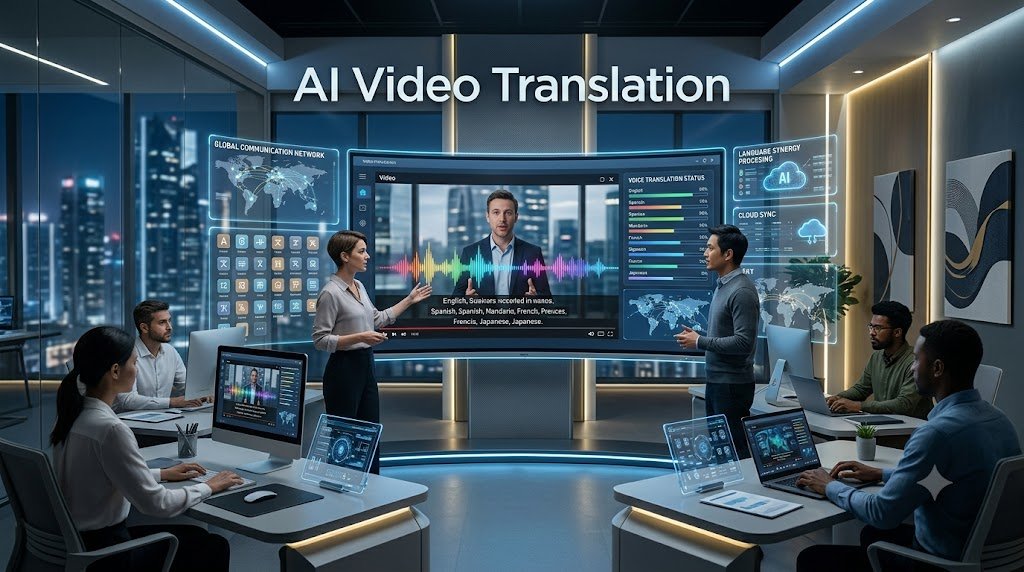
How Artificial Intelligence Is Breaking Language Barriers in Video Content
A video created in one language no longer has to stay limited to one audience.
A YouTube creator in India can now reach viewers in Europe, a startup in the United States can market products across Asia, and global companies can train employees worldwide without recording separate videos for every language. The technology making this possible is AI video translation.
For years, translating video content was expensive, slow, and heavily dependent on professional translators, voice actors, and manual editing. Businesses often had to choose between spending large amounts of money or limiting their content to a smaller audience.
Artificial intelligence has completely changed this process.
Modern AI video translation tools can automatically translate speech, generate subtitles, clone voices, synchronize lip movements, and adapt content for international audiences within minutes. As video continues becoming the dominant format for communication, marketing, education, and entertainment, AI-powered translation has become an essential tool for creators and companies looking to expand globally.
In 2025 and 2026, AI video translation is moving beyond simple subtitles. It is becoming a complete localization solution that helps brands create authentic multilingual experiences.
Why AI Video Translation Is Becoming Essential
The internet has created a global audience, but language remains one of the biggest barriers to reaching it.
A creator may produce an excellent educational video, product review, or entertainment series, yet millions of potential viewers may never discover it because they cannot understand the original language.
AI video translation solves this challenge by allowing creators and organizations to quickly adapt their content for different regions.
Companies are using AI translation for international marketing campaigns, customer support videos, employee training programs, product demonstrations, and corporate communications. Meanwhile, content creators are using these tools to increase audience reach, improve engagement, and build global communities.
The ability to publish content in multiple languages is no longer limited to large corporations with huge budgets. AI has made professional-level localization accessible to individuals and smaller businesses as well.
What Makes AI Video Translation Different From Traditional Translation?
Traditional video translation often involves several separate processes. A video must first be transcribed, then translated, recorded in another language, edited, and synchronized with the original footage.
This workflow can take days or even weeks.
AI video translation combines many of these steps into one automated process. Advanced platforms use speech recognition technology to understand spoken words, natural language processing to translate meaning, and voice synthesis to recreate speech in another language.
Some tools can even analyze facial movements and adjust lip synchronization so translated speech appears more natural.
The result is faster production, lower costs, and a more realistic viewing experience.
Key Features to Look for in AI Video Translation Tools
Choosing the right AI video translation platform depends on the needs of the creator or organization.
The most effective tools offer accurate speech recognition, support for multiple languages, natural AI voices, automatic subtitles, voice cloning, speaker identification, and video editing capabilities.
For companies, security and workflow integration are equally important. Enterprise users often require solutions that support large content libraries, team collaboration, API access, and compliance standards.
Creators may prioritize ease of use, affordability, social media compatibility, and fast publishing options.
1. HeyGen: AI Translation With Realistic Voice and Lip Sync
HeyGen has become one of the most popular AI video translation platforms among creators and businesses.
The platform allows users to translate videos into multiple languages while preserving the speaker’s voice and facial expressions. Its AI-powered lip-sync technology helps create a more natural experience by adjusting mouth movements to match translated speech.
Content creators use HeyGen for social media videos, educational content, advertisements, and international audience growth.
Businesses are also adopting the platform for marketing videos, training materials, and customer communication.
Its combination of voice cloning and realistic avatars has made it one of the leading tools in AI-powered video localization.
2. ElevenLabs: Advanced AI Voice Translation
ElevenLabs is widely recognized for its highly realistic AI voice technology.
The platform focuses on creating natural-sounding translated speech while preserving the characteristics and emotion of the original speaker’s voice.
For creators who want their personality and communication style to remain consistent across languages, ElevenLabs offers a powerful solution.
Companies can use the technology for podcasts, training videos, audiobooks, advertisements, and global media projects.
As AI voice quality continues improving, tools like ElevenLabs are helping reduce the gap between human voice recordings and synthetic speech.
3. Rask AI: Built for Global Content Localization
Rask AI specializes in translating and localizing videos for international audiences.
The platform supports multiple languages and is designed for businesses, educators, and content creators who regularly produce multilingual content.
One of its major advantages is automation. Users can upload videos, select target languages, and generate translated versions without managing complicated editing workflows.
Companies creating online courses, product tutorials, and international marketing campaigns often use Rask AI to expand their reach efficiently.
4. Descript: AI-Powered Editing and Translation
Descript combines video editing with AI transcription and translation features.
The platform allows users to edit videos by modifying text transcripts, making content creation significantly faster.
Creators can remove mistakes, generate captions, translate content, and prepare videos for different platforms through a single workflow.
For podcasters, educators, and marketing teams, Descript provides a convenient solution for managing video production and localization together.
5. VEED AI: Simple Translation for Social Media Creators
VEED AI has gained popularity among social media creators because of its easy-to-use video editing environment.
The platform provides AI subtitles, translation, automatic captions, and online editing tools designed for platforms such as YouTube, Instagram, and TikTok.
Creators who need fast turnaround times often prefer tools like VEED because they combine editing and translation without requiring advanced technical knowledge.
6. Synthesia: Enterprise Video Translation Solution
Synthesia focuses heavily on business communication and corporate training.
The platform allows companies to create AI-generated presenters and translate videos into multiple languages without hiring additional production teams.
Large organizations use Synthesia for employee onboarding, compliance training, sales presentations, and internal communication.
Its enterprise-focused features make it particularly useful for companies operating across multiple countries.
How Businesses Are Using AI Video Translation
Companies across industries are finding new ways to use AI video translation technology.
Global brands are translating advertisements to connect with regional customers.
Software companies are localizing product demonstrations for international users.
Educational platforms are translating courses to reach students worldwide.
Healthcare organizations are adapting informational videos for diverse communities.
The biggest advantage is scalability. A company can create one high-quality video and quickly transform it into multiple language versions.
This allows organizations to communicate globally without dramatically increasing production costs.
How Content Creators Benefit From AI Translation
For creators, audience growth is one of the biggest advantages of AI video translation.
A creator who produces content in English can potentially reach viewers who speak Spanish, French, Hindi, Japanese, Arabic, and many other languages.
Translated videos can improve search visibility, increase watch time, and create new monetization opportunities.
Many creators are discovering that language expansion can be one of the fastest ways to grow beyond their original audience.
The Future of AI Video Translation
AI video translation is expected to become even more advanced in the coming years.
Future systems will likely deliver more accurate emotional translation, better cultural adaptation, improved voice realism, and deeper understanding of context.
Instead of simply translating words, AI will increasingly adapt content based on regional preferences, humor, cultural references, and audience expectations.
Real-time translation could also become common, allowing live events, meetings, webinars, and online conferences to reach global audiences instantly.
Choosing the Right AI Video Translation Tool
The best AI video translation software depends on specific goals.
Creators looking for quick social media localization may prefer simple editing platforms.
Businesses requiring professional multilingual communication may need enterprise-grade solutions with security, workflow automation, and collaboration features.
Before selecting a platform, users should evaluate language support, translation accuracy, voice quality, pricing, integration options, and scalability.
The right tool should not only translate words but also preserve the message, emotion, and identity behind the content.
Final Thoughts
AI video translation is transforming how people and businesses communicate across languages. What once required expensive production teams can now be achieved quickly with intelligent automation.
From YouTube creators expanding their global audience to multinational companies improving communication with customers and employees, AI-powered translation is becoming a powerful growth tool.
As artificial intelligence continues improving, video localization will become faster, more natural, and more accessible. Organizations and creators that adopt these technologies early will have a major advantage in building global connections through video.





Leave a Reply