

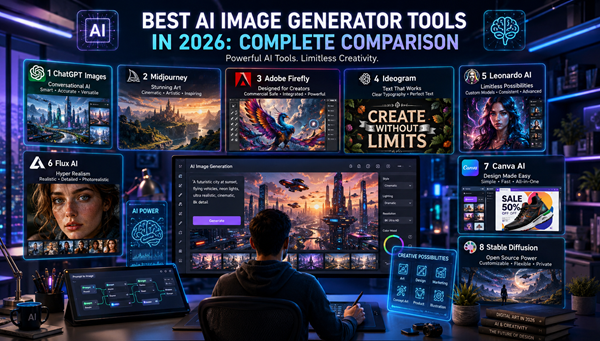
Whether you’re a blogger, digital marketer, business owner, designer, content creator, or student, AI image generators have become indispensable creative companions. But with dozens of platforms now competing for attention, choosing the right one isn’t as simple as picking the most popular name.
Some AI image generators excel at photorealism. Others focus on artistic illustrations, branding, anime, logo creation, or commercial design workflows. Pricing, editing capabilities, speed, licensing, and customization options also vary significantly.
This complete comparison of the best AI image generator tools in 2026 explores the leading platforms, their strengths, ideal users, advantages, limitations, and what makes each one stand out. By the end of this guide, you’ll know exactly which AI image generator deserves a place in your creative toolkit.
1. Why AI Image Generators Have Become Essential in 2026
AI-generated visuals are no longer a novelty—they’re becoming the standard across industries.
Marketing agencies create advertising creatives in minutes instead of days. E-commerce businesses generate professional product photos without expensive studio shoots. Authors design book covers instantly. Game developers prototype characters rapidly. Even educators and students use AI illustrations to make learning materials more engaging.
The biggest advantage isn’t replacing creativity—it’s accelerating it.
Modern AI image generators understand natural language with impressive accuracy. Instead of spending hours drawing or editing, creators can describe a scene like:
“A futuristic smart city at sunset with flying electric vehicles, cinematic lighting, ultra-realistic, 8K.”
Within moments, AI produces multiple professional-quality variations.
The best platforms now support image editing, inpainting, outpainting, style transfer, background replacement, object removal, character consistency, and even video generation, making them complete creative suites rather than simple text-to-image tools.
2. ChatGPT Images (GPT Image Generation)
Among the biggest breakthroughs in 2026 is ChatGPT’s integrated image generation capability. Rather than simply creating images from text prompts, it understands conversations, making image creation feel natural and interactive.
Users can ask for adjustments like changing lighting, adding objects, modifying colors, improving realism, or altering artistic styles without rewriting the entire prompt. This conversational workflow dramatically reduces trial and error.
One of its strongest features is excellent prompt understanding. Even long, detailed descriptions produce highly accurate results. It also handles typography, diagrams, infographics, and complex scenes better than many competitors.
For professionals creating marketing assets, presentations, educational visuals, social media content, or concept art, ChatGPT offers one of the smoothest experiences available today.
Best suited for content creators, educators, marketers, entrepreneurs, bloggers, and business professionals who need both text and image creation in one platform.
3. Midjourney
For years, Midjourney has remained one of the most respected names in AI art, and its 2026 version continues to impress with breathtaking artistic quality.
Its images often resemble professional digital paintings or cinematic movie stills. Lighting, composition, textures, and mood are consistently exceptional.
Designers frequently choose Midjourney for fantasy worlds, architecture, fashion concepts, luxury branding, editorial artwork, and creative campaigns where visual impact matters more than strict realism.
Although beginners may experience a slight learning curve due to advanced prompt techniques, the artistic payoff is often worth the effort.
Midjourney remains one of the best choices for creative professionals seeking gallery-quality artwork.
4. Adobe Firefly
Adobe Firefly has become a favorite among professional designers because it integrates directly with Photoshop, Illustrator, and Adobe Express.
Unlike many AI image generators, Firefly is designed with commercial use in mind. Businesses appreciate its emphasis on copyright-safe training data, making it an attractive option for brands and agencies.
Firefly also excels at generating editable design elements rather than only complete images. Users can create backgrounds, textures, icons, typography effects, and marketing assets while continuing their work inside Adobe’s creative ecosystem.
Its seamless workflow significantly reduces production time for professionals already using Adobe software.
5. Ideogram
One of the biggest challenges for AI image generators has traditionally been creating readable text inside images.
Ideogram changed that.
Its typography capabilities are among the best available in 2026, making it especially useful for posters, advertisements, social media graphics, book covers, presentations, packaging, and promotional materials.
Businesses that frequently create marketing visuals with embedded text often find Ideogram more reliable than many competing platforms.
Beyond typography, it also produces impressive illustrations, realistic images, and branding concepts with strong attention to composition.
6. Leonardo AI
Leonardo AI has evolved into one of the most versatile AI creative platforms available today.
Originally popular among game developers, it now serves designers, digital artists, product creators, advertisers, and animation studios.
Leonardo stands out because it provides extensive customization options. Users can train custom models, maintain consistent characters, generate assets for games, create concept art, and refine outputs using advanced editing tools.
Its flexibility makes it particularly valuable for large creative projects where consistency matters more than one-off image generation.
For professionals building visual brands or fictional worlds, Leonardo AI offers remarkable creative control.
7. Flux AI
Flux AI has quickly emerged as one of the strongest competitors in the AI image generation market.
Its biggest strength lies in realism.
Portraits generated with Flux often feature convincing facial expressions, natural lighting, realistic skin textures, and highly detailed environments. Product photography and commercial lifestyle imagery also look impressively authentic.
Many creators appreciate Flux because it balances speed with image quality, making it suitable for marketing teams that need high-volume image production without sacrificing realism.
As adoption continues to grow throughout 2026, Flux is becoming one of the industry’s most talked-about AI image generators.
8. Canva AI
Canva has transformed from a simple graphic design platform into a complete AI-powered creative workspace.
Its AI image generation tools integrate directly into presentations, posters, social media posts, resumes, flyers, infographics, and marketing materials.
The biggest advantage is convenience.
Users don’t need to switch between multiple platforms. Images generated inside Canva can immediately be edited using drag-and-drop design tools.
Small businesses, students, educators, and social media managers particularly benefit from this streamlined workflow.
Although Canva may not always produce the most artistic images, its simplicity makes it one of the easiest AI image generators to use.
9. Stable Diffusion
Stable Diffusion continues to attract developers, researchers, and advanced users because of its open-source nature.
Unlike many cloud-based services, Stable Diffusion allows complete customization. Users can install models locally, fine-tune them, train specialized versions, and integrate AI image generation into their own applications.
Its massive community regularly releases new models optimized for anime, architecture, fashion, product photography, portraits, gaming assets, and scientific illustrations.
For organizations requiring maximum flexibility and data privacy, Stable Diffusion remains one of the strongest choices available.
10. Which AI Image Generator Is Best for Different Users?
There is no single “best” AI image generator because different users have different creative goals.
Professional designers often prefer Midjourney because of its cinematic quality and artistic excellence.
Businesses focused on commercial branding usually choose Adobe Firefly thanks to its enterprise-friendly licensing and Adobe integration.
Content creators appreciate ChatGPT Images because they can brainstorm ideas, write content, and generate visuals within one conversation.
Marketing teams frequently rely on Ideogram for text-heavy graphics.
Game developers and concept artists often select Leonardo AI because of its extensive customization capabilities.
Developers and researchers continue choosing Stable Diffusion for its open-source flexibility.
Meanwhile, beginners and small businesses frequently gravitate toward Canva AI because of its ease of use.
Ultimately, the right platform depends on whether your priority is realism, artistic quality, editing capabilities, branding, workflow integration, or customization.
11. The Future of AI Image Generation
The pace of innovation in AI image generation shows no signs of slowing.
During 2026, image generators are becoming multimodal creative assistants capable of understanding conversations, generating videos, editing existing images, maintaining character consistency, and producing entire marketing campaigns from simple prompts.
Future systems will likely offer real-time collaboration, improved 3D scene generation, personalized artistic styles, and seamless integration with business software, making AI an everyday creative partner rather than just a design tool.
Instead of replacing human imagination, these tools are expanding what’s possible. Designers now spend less time on repetitive tasks and more time refining ideas, experimenting with concepts, and delivering better creative experiences.
For individuals and businesses alike, mastering AI image generation is quickly becoming an essential digital skill. Those who embrace these tools today will be better equipped to create compelling visual content faster, more affordably, and with greater creative freedom in the years ahead.



Leave a Reply