

Artificial intelligence has rapidly evolved from simple chatbots into intelligent systems capable of reasoning, planning, and completing complex tasks. In 2026, businesses are no longer satisfied with AI that only answers questions or generates text. They expect AI to retrieve company documents, analyze real-time data, interact with business software, update databases, schedule meetings, write code, and automate complete workflows.
While modern Large Language Models (LLMs) are incredibly powerful, they have one significant limitation: they cannot naturally access live business systems or external applications on their own. Without additional connections, an AI model only knows what it learned during training and whatever information the user provides in a prompt. It cannot automatically retrieve the latest sales report from a company database, update a CRM record, search a private knowledge base, or create a task in a project management platform.
Traditionally, developers solved this problem by creating custom integrations for every application. If an AI assistant needed to connect with Google Drive, Slack, GitHub, Notion, Salesforce, Jira, or a company database, each integration had to be built, tested, maintained, and updated separately. As organizations adopted more AI tools and software platforms, managing these individual integrations became increasingly expensive and difficult.
This growing challenge led to the development of the Model Context Protocol (MCP)—an open standard designed to simplify how AI models communicate with external tools and data sources.
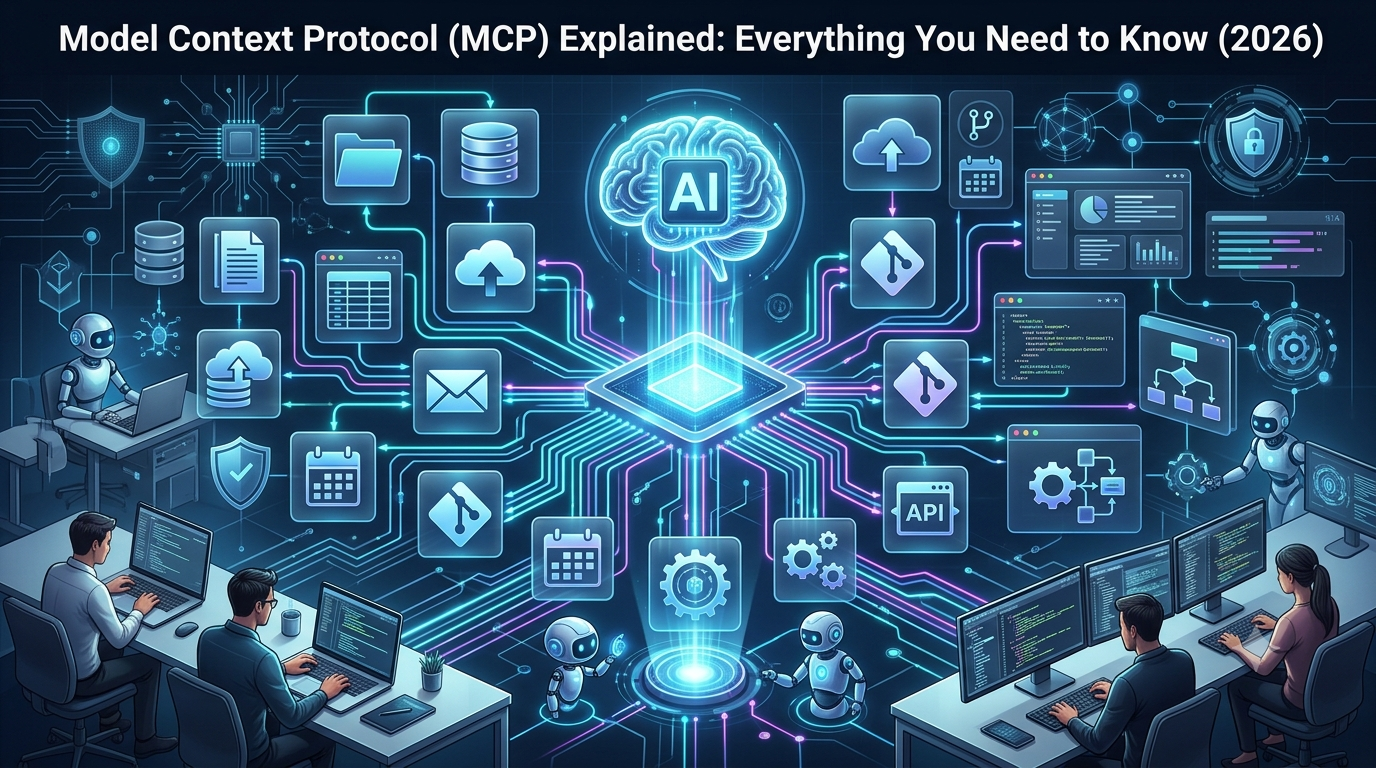
Instead of creating a unique connection for every application, MCP provides a standardized communication method that allows AI assistants and AI agents to securely interact with files, APIs, databases, enterprise software, cloud platforms, and countless other digital resources.
Many technology companies now consider MCP one of the most important developments in the AI ecosystem because it helps transform AI from a standalone conversational tool into an intelligent system capable of performing real-world work.
Some experts describe MCP as being similar to a universal connector for AI applications. Just as a common charging standard allows different devices to communicate through a consistent interface, MCP provides AI models with a common language for accessing external tools and information regardless of where that information is stored.
As AI agents continue to become more autonomous, protocols like MCP will play an increasingly important role in enterprise automation, software development, research, customer support, healthcare, finance, and countless other industries.
In this comprehensive beginner’s guide, you’ll learn what Model Context Protocol is, why it was created, how it works, its architecture, benefits, real-world applications, security considerations, best practices, limitations, and why many experts believe MCP will become a foundational technology for the future of AI.
What Is Model Context Protocol (MCP)?
Model Context Protocol (MCP) is an open protocol that enables AI models to securely communicate with external applications, databases, APIs, file systems, and software tools using a standardized interface.
Rather than requiring developers to build custom integrations for every service, MCP provides a common framework that allows AI systems to discover available tools, retrieve information, and perform actions across different platforms.
In simple terms, MCP acts as a bridge between an AI model and the outside world.
Without MCP, an AI assistant might only be able to answer questions based on its training data or information typed into a conversation.
With MCP, that same AI assistant can securely access live documents, search internal company knowledge bases, retrieve customer information, update spreadsheets, interact with development tools, schedule meetings, execute approved workflows, and much more.
This dramatically expands what AI systems can accomplish while reducing development complexity for organizations building AI-powered applications.
Why Was Model Context Protocol Created?
To understand the importance of MCP, it helps to understand the challenges developers faced before it existed.
Modern organizations rely on dozens or even hundreds of software applications. A single company might use cloud storage, CRM platforms, project management software, databases, communication tools, financial systems, developer platforms, and internal knowledge bases every day.
If an AI assistant needed access to all these systems, developers traditionally had to create separate integrations for each one.
For example, an AI assistant might require individual integrations for:
- Google Drive
- Slack
- GitHub
- Notion
- Microsoft 365
- Salesforce
- Jira
- PostgreSQL
- Internal databases
- Email platforms
Every integration came with its own authentication methods, API documentation, permission models, maintenance requirements, and security considerations.
As more applications were added, complexity increased dramatically.
This created several common problems:
- Development became slower.
- Maintenance costs increased.
- Security became harder to manage.
- Integrations often broke when APIs changed.
- Scaling AI applications became increasingly difficult.
Model Context Protocol was designed to solve these problems by introducing one consistent communication standard.
Instead of teaching AI how to communicate differently with every application, developers can use MCP to provide a standardized interface across multiple systems.
This makes AI development faster, more scalable, easier to maintain, and more secure.
Why MCP Matters in the Age of AI Agents
The rapid rise of AI agents has made protocols like MCP more important than ever.
Unlike traditional chatbots, AI agents are designed to complete tasks rather than simply answer questions. To accomplish meaningful work, these agents need access to business systems, external software, documents, APIs, and live information.
Imagine asking an AI agent to prepare a weekly sales report.
Instead of simply describing how to create the report, the agent could retrieve sales data from a database, analyze spreadsheets, generate charts, summarize key insights, draft an executive report, and email it to the management team.
Without standardized access to external systems, this level of automation would require dozens of custom integrations.
MCP provides a consistent way for AI agents to discover tools, retrieve information, and perform approved actions while following organizational security policies.
As AI agents become increasingly common across enterprises, MCP is expected to become one of the core technologies supporting intelligent automation.
How Does Model Context Protocol Work?
At a high level, MCP enables secure communication between an AI application and external systems.
Although implementations may differ, most MCP interactions follow a similar workflow.
Step 1: A User Makes a Request
Everything begins with a user assigning a task.
For example:
“Summarize yesterday’s sales performance from our internal reporting system and email the results to the sales manager.”
Instead of immediately generating an answer, the AI first determines whether additional information is required.
Step 2: The AI Understands What It Needs
The language model analyzes the request and identifies the external resources necessary to complete the task.
It may determine that it needs access to:
- Sales database
- Analytics dashboard
- Email platform
Rather than guessing, it prepares to retrieve live information.
Step 3: MCP Finds the Right Tools
The AI communicates through MCP to discover available tools and resources.
These may include company databases, cloud storage, CRM systems, APIs, business applications, development platforms, or internal documentation.
Because these systems all follow the same protocol, the AI does not need separate communication logic for every application.
Step 4: External Systems Respond
The requested information is securely retrieved and returned through the MCP connection.
Access permissions determine exactly what information the AI is allowed to receive.
This ensures organizations maintain control over sensitive business data.
Step 5: The AI Performs Reasoning
The language model combines retrieved information with its reasoning abilities.
Instead of merely displaying raw data, it analyzes trends, summarizes findings, identifies insights, and prepares meaningful outputs.
Step 6: The Final Result Is Delivered
After processing all available information, the AI returns a complete response or performs an approved action.
This could include creating reports, updating records, writing emails, generating documentation, scheduling meetings, or completing other business workflows.
Core Architecture of Model Context Protocol
Although MCP is designed to simplify communication, several components work together behind the scenes.
1. MCP Host
The MCP Host is the AI application that users interact with directly.
Examples include AI assistants, coding tools, enterprise chat platforms, business copilots, and productivity applications.
The host receives user requests and coordinates communication with external systems.
2. MCP Client
The MCP Client acts as the communication layer between the AI application and available MCP servers.
It sends requests, receives responses, manages protocol communication, and ensures information flows correctly between different components.
3. MCP Server
The MCP Server exposes tools, resources, and services that AI applications can access.
Organizations may deploy multiple MCP servers depending on the systems they want AI to interact with.
For example, separate MCP servers may provide access to customer databases, cloud storage, financial systems, HR platforms, or software repositories.
4. Resources
Resources represent the information AI models can retrieve.
Examples include documents, spreadsheets, files, databases, internal knowledge bases, reports, images, and structured datasets.
These resources provide the context AI needs to produce accurate, relevant responses.
5. Tools
Unlike resources, tools allow AI to perform actions.
A tool might enable an AI assistant to send emails, update spreadsheets, execute database queries, generate reports, search repositories, create tickets, or manage project tasks.
Tools transform AI from an information provider into an active participant capable of completing work.
6. Prompts
Some MCP implementations also expose reusable prompts that guide AI behavior for specific tasks.
Organizations can create standardized prompts that help AI follow company policies, workflows, and documentation standards.
7. Transport Layer
The transport layer is responsible for moving information securely between the MCP client and MCP server. It defines how requests and responses travel across different environments, whether the AI is communicating with a local application on a computer or a remote cloud service.
A standardized transport mechanism ensures reliable communication while allowing developers to build AI applications that work consistently across different platforms.
8. Authentication and Authorization
Security is one of the most important aspects of MCP.
Before an AI model can access external resources, it must be properly authenticated and authorized. Organizations define exactly which tools, documents, and systems an AI can access.
This prevents unauthorized access and helps protect sensitive business information.
Local MCP Servers vs Remote MCP Servers
One of the strengths of MCP is its flexibility. Organizations can deploy MCP servers locally or host them remotely in the cloud, depending on their requirements.
A local MCP server runs on the same computer or within a private network. It is commonly used by developers working with local files, databases, development environments, or internal tools. Local deployments provide lower latency and greater control over sensitive information.
A remote MCP server is hosted on a cloud platform or enterprise infrastructure. It allows AI assistants to securely access online services, enterprise applications, cloud storage, customer databases, and shared business resources from different locations.
Many organizations use a combination of both, allowing AI agents to work with local development environments while also accessing approved cloud services.
MCP vs Traditional API Integrations
Before MCP, every application required its own custom integration. Each API had different authentication methods, request formats, and maintenance requirements.
MCP simplifies this process by introducing a common communication standard.
| Traditional API Integration | Model Context Protocol (MCP) |
|---|---|
| Separate integration for every application | One standardized communication protocol |
| Different authentication methods | Consistent communication model |
| Higher development effort | Faster implementation |
| Difficult to maintain | Easier long-term maintenance |
| Limited interoperability | Works across many compatible systems |
| Harder to scale | Designed for growing AI ecosystems |
For organizations building AI-powered software, this significantly reduces development complexity while improving consistency.
MCP vs Function Calling
Function calling allows an AI model to invoke predefined functions created by developers. While useful, it usually works within a single application or environment.
MCP extends this idea by creating a universal framework that enables AI to discover and interact with tools from many different systems using a consistent protocol.
Function calling focuses on executing individual functions.
MCP focuses on creating an ecosystem where AI can securely communicate with multiple tools, resources, and applications without custom integrations for each one.
MCP vs Retrieval-Augmented Generation (RAG)
Many beginners assume MCP replaces Retrieval-Augmented Generation (RAG), but the two technologies solve different problems.
RAG helps AI retrieve relevant information from knowledge bases before generating an answer. It improves factual accuracy by providing additional context.
MCP goes much further.
It not only retrieves information but also enables AI to interact with external software and perform actions.
For example, RAG can retrieve a company’s HR policy and summarize it.
An MCP-enabled AI assistant can retrieve the HR policy, update employee records, create onboarding documents, schedule orientation meetings, and notify managers—all through connected enterprise systems.
Rather than competing, MCP and RAG often work together. RAG supplies better knowledge, while MCP enables real-world actions.
Why MCP Is Important for AI Agents
AI agents are designed to accomplish goals rather than simply answer prompts. To achieve those goals, they need access to external systems.
Imagine an AI marketing agent responsible for launching a new campaign.
It may need to:
- Read previous campaign reports.
- Analyze website traffic.
- Retrieve advertising performance.
- Generate new content.
- Update project boards.
- Send emails to the marketing team.
- Schedule campaign reviews.
Without MCP, developers would need separate integrations for every platform involved.
With MCP, the AI agent communicates through a standardized interface, making complex automation significantly easier to build and maintain.
This is one of the main reasons MCP has become closely associated with the rapid growth of AI agents.
Real-World Applications of MCP
The practical value of MCP extends across almost every industry.
Business Productivity
Employees can use AI assistants to retrieve reports, summarize meetings, search internal documentation, prepare presentations, and automate administrative work.
Customer Support
Support teams can allow AI assistants to access customer histories, ticketing systems, product documentation, and knowledge bases, enabling faster and more personalized responses.
Software Development
Developers can build AI coding assistants that search repositories, review code, generate documentation, create pull requests, execute approved development tools, and assist with debugging.
Healthcare
Healthcare organizations can connect AI systems with approved medical documentation, appointment systems, research databases, and clinical resources while maintaining regulatory compliance.
Financial Services
Banks and financial institutions can use MCP-enabled AI to retrieve financial reports, monitor compliance information, analyze transactions, and assist with internal operations.
Education
Educational institutions can build AI tutors capable of accessing learning materials, assignments, student resources, and institutional knowledge bases to deliver more personalized learning experiences.
Legal Services
Law firms can connect AI assistants to approved document repositories, case files, legal research databases, and contract management systems, improving productivity while maintaining controlled access.
Benefits of Model Context Protocol
MCP provides advantages for developers, businesses, and end users alike.
First, it simplifies development by reducing the need for countless custom integrations. Developers can spend more time building valuable AI experiences instead of maintaining API connections.
Second, MCP enables AI to work with real-time information rather than relying only on historical training data. This leads to more relevant and accurate responses.
Third, organizations gain greater flexibility because AI systems can interact with multiple applications through a consistent communication framework.
Another important benefit is scalability. As companies adopt additional software platforms, they can continue expanding their AI capabilities without rebuilding every integration from scratch.
Finally, users benefit from AI assistants that can actually complete meaningful work instead of simply generating text.
Security Considerations
Since MCP allows AI to access external systems, security must remain a top priority.
Organizations should implement strong authentication mechanisms to verify every connection between AI applications and external resources.
Role-based access control helps ensure AI only interacts with approved systems and performs authorized actions.
The principle of least privilege should always be followed. AI should receive only the minimum permissions necessary to complete assigned tasks.
Encryption should protect data while it is stored and while it is transmitted between systems.
Organizations should also maintain detailed logs of AI activities to support monitoring, auditing, troubleshooting, and regulatory compliance.
Regular security reviews help identify vulnerabilities before they become serious risks.
Best Practices for Using MCP
Organizations planning to adopt MCP should begin with clearly defined business objectives instead of attempting to automate everything at once.
Developers should design focused MCP servers that expose only the tools genuinely required for specific workflows.
Permissions should remain as limited as possible, and every integration should include proper validation and error handling.
Monitoring AI activity helps organizations understand how tools are being used while identifying opportunities for optimization.
It is also important to document available tools, maintain version compatibility, and regularly review security policies as AI capabilities continue evolving.
Common Mistakes to Avoid
Although MCP simplifies AI integrations, poor implementation can still create challenges.
One common mistake is exposing too many tools to AI without carefully defining access permissions. This increases both security risks and unnecessary complexity.
Another mistake is assuming AI should have unrestricted access to business systems. Organizations should always require explicit approval for sensitive operations.
Ignoring logging and monitoring can also make troubleshooting difficult and reduce visibility into how AI systems interact with enterprise resources.
Finally, treating MCP as a replacement for good software architecture is a mistake. MCP provides standardized communication, but developers still need well-designed applications, secure infrastructure, and responsible governance.
Who Should Learn Model Context Protocol?
MCP is becoming valuable knowledge for a wide range of professionals.
Software developers can build more capable AI-powered applications.
AI engineers can create intelligent agents capable of interacting with enterprise software.
Product managers can better understand how AI products integrate with existing business systems.
IT administrators can prepare organizations for enterprise AI deployments.
Business leaders can evaluate how AI automation fits into their digital transformation strategies.
Students and technology enthusiasts can gain an early understanding of one of the most important standards shaping the future of artificial intelligence.
The Future of Model Context Protocol
The adoption of AI agents continues to accelerate across industries, and with that growth comes an increasing need for standardized communication between AI models and software systems.
Future versions of MCP are expected to support a wider range of enterprise applications, cloud platforms, developer tools, robotics systems, and Internet of Things (IoT) devices.
As interoperability improves, organizations will be able to connect AI with thousands of existing applications more efficiently than ever before.
MCP is also expected to play an important role in multi-agent ecosystems, where specialized AI agents collaborate while securely sharing tools, resources, and context.
Although MCP is still evolving, many experts believe it could become one of the foundational standards supporting the next generation of enterprise AI—much as common internet protocols enabled the growth of the modern web.
Conclusion
Model Context Protocol (MCP) represents a major step forward in the evolution of artificial intelligence. Rather than forcing developers to build countless custom integrations, MCP provides a standardized and secure way for AI models to communicate with external tools, applications, databases, APIs, and business systems.
For developers, it simplifies AI integration and reduces long-term maintenance. For businesses, it enables scalable automation and better use of existing software investments. For users, it creates AI assistants and AI agents that can retrieve live information, interact with enterprise applications, and complete meaningful real-world tasks instead of simply generating text.
As organizations increasingly adopt AI agents, enterprise copilots, and intelligent automation, protocols like MCP will become essential infrastructure for connecting AI with the digital tools people use every day. Understanding MCP today will help developers, business leaders, and technology professionals prepare for a future where AI systems collaborate seamlessly with software, data, and business processes.




Leave a Reply