

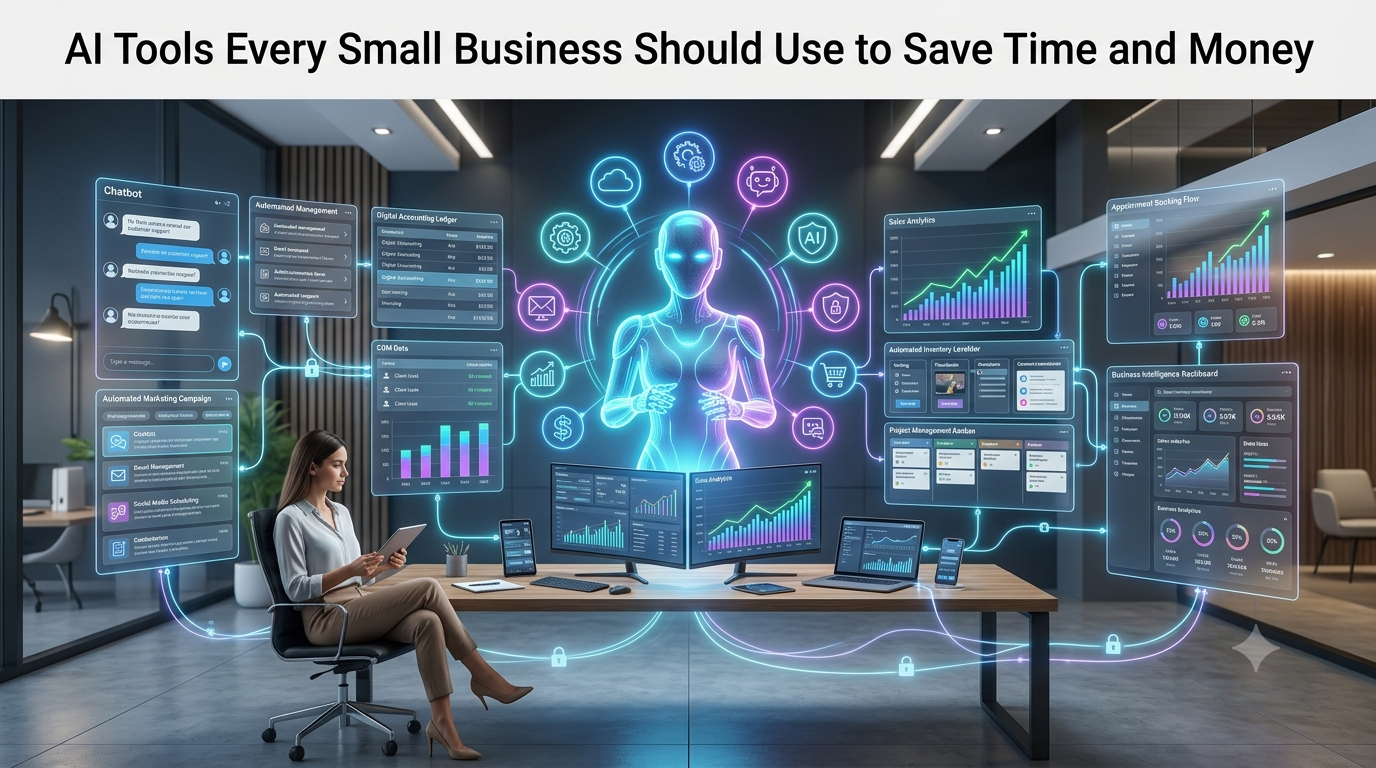
Running a small business has never been easy. Whether you’re a startup founder, freelancer, local shop owner, consultant, or e-commerce entrepreneur, every day involves balancing dozens of responsibilities. You might spend the morning answering customer emails, the afternoon creating social media content, and the evening reviewing invoices or preparing reports. While these tasks are essential, they also consume valuable time that could be spent growing your business.
This is where artificial intelligence (AI) is changing the game.
In 2026, AI is no longer a futuristic technology reserved for large corporations with dedicated IT teams. Thanks to rapid advancements in generative AI, workflow automation, and AI agents, small businesses now have access to affordable tools that automate repetitive work, improve customer service, streamline operations, and boost productivity without requiring technical expertise.
From writing emails and creating marketing campaigns to analyzing financial data and managing customer relationships, AI tools can now assist with almost every aspect of running a business. Many of these solutions integrate seamlessly with software that businesses already use, making AI adoption easier than ever.
The biggest advantage isn’t replacing employees—it’s helping small teams accomplish more in less time. A business owner who once needed separate tools and specialists for content writing, graphic design, customer support, bookkeeping, and scheduling can now handle many of these tasks with AI assistance.
However, choosing the right AI tools can be overwhelming. Hundreds of platforms claim to increase productivity, but not every solution is worth your time or budget.
This comprehensive guide explores the best AI tools every small business should use in 2026, explains how they work, compares their strengths, highlights real-world business use cases, and helps you build an AI-powered workflow that saves both time and money.
Why AI Matters More Than Ever for Small Businesses
Small businesses often operate with limited staff, tighter budgets, and fewer resources than larger organizations. Every hour spent on repetitive administrative work is an hour that could have been invested in acquiring customers, improving products, or expanding the business.
Artificial intelligence helps solve this challenge by acting as a digital assistant that automates routine tasks while supporting better decision-making.
Instead of manually responding to repetitive customer inquiries, AI chatbots can provide instant answers around the clock. Instead of spending hours drafting marketing emails or blog posts, AI writing assistants can generate professional first drafts within minutes. Financial tools powered by AI can automatically categorize expenses, forecast cash flow, and detect unusual transactions without requiring constant oversight.
Perhaps the biggest shift in 2026 is that AI is becoming embedded directly into the software businesses already use. Microsoft 365, Google Workspace, CRM platforms, accounting software, and project management tools increasingly include built-in AI features that reduce the need to switch between multiple applications.
This integration makes AI practical even for businesses with little technical knowledge.
How AI Helps Small Businesses Save Time and Money
The true value of AI isn’t simply automation—it’s enabling business owners and employees to focus on work that creates revenue.
Consider a small marketing agency. Instead of spending several hours creating a content calendar, writing social media posts, designing graphics, summarizing meetings, and preparing client reports manually, AI can complete much of this work in a fraction of the time.
Similarly, an online store can use AI to generate product descriptions, answer customer questions, recommend products, analyze purchasing trends, and automate follow-up emails without hiring additional staff.
Across different industries, AI delivers benefits such as:
- Faster customer response times
- Lower operational costs
- Improved marketing performance
- Better financial management
- Increased employee productivity
- Smarter business insights
- More consistent customer experiences
Rather than replacing human expertise, AI amplifies it.
How to Choose the Right AI Tool
Before subscribing to multiple AI platforms, identify the tasks that consume the most time in your business.
Ask yourself questions such as:
- Which repetitive tasks slow down my team?
- Where do we frequently make mistakes?
- Which processes require the most manual effort?
- Can AI automate these workflows?
- Will the software integrate with our existing tools?
- Is the pricing reasonable for our business size?
Starting with one or two high-impact AI tools often produces better results than trying to automate everything at once.
Categories of AI Tools Every Small Business Should Consider
Instead of thinking about AI as a single product, it’s more useful to view it as a collection of specialized assistants.
Some AI tools focus on writing and communication, while others specialize in accounting, customer support, marketing, analytics, or workflow automation.
The following tools represent some of the best options available for small businesses in 2026.
1. ChatGPT – Best Overall AI Business Assistant
For many businesses, ChatGPT has become the first AI tool they use every day.
Rather than serving a single purpose, it acts as an all-in-one business assistant capable of writing emails, creating proposals, brainstorming marketing campaigns, generating blog articles, summarizing documents, preparing reports, analyzing spreadsheets, creating SOPs, and even assisting with coding tasks.
Small businesses appreciate ChatGPT because it adapts to different roles instead of requiring separate software for every activity.
Whether you’re drafting customer responses, planning a product launch, or creating employee training material, ChatGPT dramatically reduces the time required to produce high-quality work.
Best for: Content creation, customer communication, planning, documentation, brainstorming, research, and productivity.
Pricing: Free plan available with premium subscription options.
2. Microsoft Copilot – Best for Microsoft 365 Users
Businesses already using Microsoft Word, Excel, Outlook, Teams, and PowerPoint can significantly improve productivity with Microsoft Copilot.
Instead of manually creating presentations or analyzing spreadsheets, Copilot can summarize meetings, draft professional emails, generate reports, analyze financial data, and build presentations directly inside familiar Microsoft applications.
Its deep integration makes it especially valuable for businesses that rely heavily on the Microsoft ecosystem.
Best for: Office productivity, reporting, spreadsheets, presentations, and collaboration.
3. Google Gemini – Best for Google Workspace Businesses
Organizations using Gmail, Google Docs, Sheets, Drive, Calendar, and Meet can benefit from Google Gemini’s built-in AI capabilities.
Gemini assists with writing emails, summarizing documents, organizing information, generating presentations, analyzing spreadsheet data, and creating meeting summaries.
Instead of opening separate AI applications, employees receive intelligent assistance directly within Google Workspace, making everyday work faster and more efficient.
Businesses that already rely on Google’s ecosystem often find Gemini to be one of the easiest AI solutions to adopt.
4. Canva AI – Best for Marketing and Design
Professional graphic design no longer requires years of experience.
Canva AI enables business owners to create social media graphics, advertisements, brochures, presentations, logos, product mockups, posters, and marketing materials using simple prompts.
Its Magic Design, Magic Write, image generation, and background editing features allow even non-designers to produce polished visuals quickly.
For startups with limited marketing budgets, Canva AI often replaces the need for outsourcing everyday design work.
5. Grammarly – Best for Professional Communication
Clear communication builds trust with customers.
Grammarly uses AI to improve grammar, spelling, clarity, sentence structure, tone, and readability across emails, reports, proposals, blog posts, and website content.
Businesses that frequently communicate with clients benefit from maintaining a consistent professional tone without spending extra time proofreading every document.
6. Notion AI – Best for Knowledge Management and Project Organization
As businesses grow, information becomes scattered across documents, emails, spreadsheets, and messaging platforms.
Notion AI helps centralize company knowledge while assisting with meeting notes, documentation, project planning, task management, brainstorming, and workflow organization.
Instead of searching through multiple files, teams can quickly locate information and generate summaries using AI.
For startups and remote teams, Notion AI becomes a valuable internal knowledge hub.
7. HubSpot AI – Best for Sales, CRM, and Marketing Automation
Managing customer relationships manually becomes increasingly difficult as businesses grow.
HubSpot’s AI capabilities help businesses qualify leads, automate email campaigns, personalize customer interactions, generate marketing content, forecast sales performance, and streamline CRM management.
Instead of simply storing customer information, the platform actively recommends actions that improve sales performance and customer engagement.
Its automation features are especially useful for growing businesses that want to scale without dramatically increasing headcount.
9. Zapier AI – Best for Workflow Automation
One of the biggest challenges for small businesses is switching between multiple applications throughout the day. Customer inquiries may arrive through Gmail, orders through Shopify, invoices through QuickBooks, leads through Facebook Ads, and project updates inside Slack or Trello. Manually moving information between these tools wastes valuable time and often leads to errors.
Zapier AI helps solve this problem by connecting thousands of business applications and automating repetitive workflows without requiring coding knowledge. Instead of employees manually copying data from one platform to another, AI-powered workflows can complete these actions automatically.
For example, when a customer fills out a contact form on your website, Zapier can instantly create a CRM record, notify your sales team in Slack, schedule a follow-up task, send a personalized email, and update your marketing database. All of this happens within seconds.
Recent AI features also allow users to describe the workflow they want in plain English. Rather than building complex automation manually, you can simply tell the AI your goal, and it will generate the workflow for you.
Small businesses commonly use Zapier AI for lead management, customer onboarding, invoice processing, appointment scheduling, social media publishing, internal notifications, and document organization.
The biggest advantage is scalability. Once an automation is configured, it continues working around the clock, allowing even a small team to operate like a much larger organization.
10. Jasper AI – Best AI Tool for Marketing Content
Consistently producing high-quality marketing content is difficult for small businesses that lack dedicated content teams. Writing blog posts, newsletters, advertisements, social media captions, landing pages, and email campaigns often takes hours each week.
Jasper AI is designed specifically for marketing teams and business owners who want to create persuasive, brand-consistent content more efficiently. Unlike general-purpose AI assistants, Jasper includes templates, workflows, and optimization features tailored for marketing.
Businesses can use Jasper to create SEO-friendly blog articles, product descriptions, Google Ads, Facebook advertisements, email sequences, promotional campaigns, and website copy. It also supports multiple languages, making it useful for companies serving international audiences.
One of Jasper’s biggest strengths is maintaining a consistent brand voice. Businesses can train the platform using their existing content so future marketing materials match their preferred tone and style.
Combined with human editing and fact-checking, Jasper can dramatically reduce the time required to produce professional marketing content while helping maintain quality across every communication channel.
11. Claude – Best for Long Documents and Business Analysis
Businesses regularly work with lengthy documents such as contracts, financial reports, research papers, policy manuals, employee handbooks, and technical documentation. Reading and analyzing hundreds of pages manually can consume significant time.
Claude has become one of the strongest AI assistants for processing long-context documents. It can review extensive reports, summarize complex information, identify important sections, compare multiple documents, and answer questions about uploaded files.
For consultants, legal professionals, HR teams, researchers, and executives, this capability can save several hours every week. Instead of reading an entire document from beginning to end, users can ask targeted questions and receive organized explanations.
Claude is also widely used for brainstorming business strategies, reviewing proposals, drafting policies, improving business communication, and analyzing market research.
Its ability to understand lengthy conversations and maintain context makes it especially valuable for knowledge-intensive businesses.
12. Fireflies.ai – Best AI Meeting Assistant
Meetings are essential for collaboration, but taking notes while actively participating can be difficult. Important decisions and action items are often forgotten or documented inconsistently.
Fireflies.ai automatically records meetings, generates transcripts, summarizes discussions, identifies key decisions, and creates action items for participants.
Whether meetings occur through Zoom, Google Meet, Microsoft Teams, or other platforms, Fireflies helps businesses maintain accurate records without assigning someone to take notes manually.
Sales teams can review client conversations, managers can track project discussions, HR departments can document interviews, and remote teams can revisit meeting summaries whenever needed.
Instead of spending another hour writing follow-up notes, employees receive organized summaries almost immediately after the meeting ends.
13. Tidio AI – Best Customer Support Chatbot
Customers increasingly expect businesses to provide quick responses regardless of business hours. Hiring a 24-hour support team isn’t realistic for most small businesses.
Tidio combines live chat with AI-powered customer support to answer frequently asked questions, qualify leads, recommend products, and resolve common issues automatically.
For example, an online clothing store can instantly answer questions about shipping policies, order tracking, return procedures, payment methods, or product availability. More complex requests can be transferred to a human representative when necessary.
The AI continuously learns from previous interactions, helping improve response quality over time.
Businesses that respond quickly often experience higher customer satisfaction, increased conversions, and fewer abandoned purchases.
14. Midjourney – Best AI Image Generation Tool
Visual content has become essential for digital marketing. Businesses need attractive graphics for websites, advertisements, social media, presentations, blogs, email campaigns, and product promotions.
Hiring designers for every marketing asset can become expensive, especially for startups and small businesses.
Midjourney enables users to create professional-quality images from simple text descriptions. Marketing teams use it for concept art, advertising visuals, product mockups, blog illustrations, social media graphics, packaging ideas, and branding inspiration.
Rather than replacing graphic designers, Midjourney often accelerates the creative process by generating initial concepts that designers can refine further.
This significantly reduces production time while expanding creative possibilities.
15. ElevenLabs – Best AI Voice Generator
Video marketing, online courses, podcasts, customer support systems, and product demonstrations increasingly require professional voiceovers.
Hiring voice actors for every project may not always fit a small business budget.
ElevenLabs produces realistic AI-generated voices capable of narrating training materials, YouTube videos, marketing campaigns, explainer videos, advertisements, and educational content.
Businesses can generate voiceovers in multiple languages and accents while maintaining natural pronunciation and emotional expression.
This makes it easier to create multilingual marketing campaigns and educational content without extensive recording equipment.
Bonus AI Tools Worth Considering
Although the tools above satisfy most business needs, several additional AI platforms deserve attention depending on your industry and workflow.
For project management, platforms such as ClickUp AI and Asana AI help organize tasks, prioritize work, and generate project updates automatically.
For e-commerce businesses, Shopify Magic assists with product descriptions, customer communication, and store management.
Sales teams may benefit from Gong, which analyzes customer conversations and provides coaching insights to improve sales performance.
Businesses handling creative content may also explore Adobe Firefly for AI-assisted graphic design and image editing.
Developers can improve productivity using GitHub Copilot, which accelerates software development by suggesting code, explaining functions, and identifying potential issues.
Rather than trying every AI tool available, businesses should choose platforms that directly address their biggest operational challenges.
How to Choose the Right AI Tools for Your Business
The growing number of AI platforms makes it tempting to subscribe to multiple services immediately. However, adopting too many tools at once often increases complexity instead of improving productivity.
The first step is identifying repetitive tasks that consume the most employee time. Customer support, marketing, accounting, scheduling, content creation, and administrative work are common areas where AI provides immediate value.
Next, evaluate how well each tool integrates with your existing software. An AI platform that connects seamlessly with your CRM, accounting software, communication tools, and project management system will usually deliver greater long-term benefits.
Scalability is another important consideration. Choose tools that can grow alongside your business rather than requiring complete replacement after a few years.
Finally, prioritize security, compliance, customer support, ease of use, and transparent pricing before making long-term commitments.
Best AI Tool Combinations for Different Small Businesses
Different industries benefit from different AI ecosystems.
A local marketing agency may combine ChatGPT, Canva AI, Jasper, Grammarly, Notion AI, and Zapier to create campaigns, manage projects, automate reporting, and communicate with clients.
An online retail business could use Shopify Magic, ChatGPT, Midjourney, Tidio, QuickBooks AI, and Google Gemini to manage products, support customers, create advertisements, and monitor finances.
Professional service firms such as consultants, accountants, and law offices often benefit from Claude, Microsoft Copilot, Fireflies.ai, Notion AI, and Grammarly for documentation, meetings, reporting, and client communication.
Restaurants, clinics, and appointment-based businesses may combine Google Gemini, Canva AI, Tidio, Zapier, and QuickBooks AI to automate bookings, marketing, billing, and customer service.
Choosing complementary tools instead of overlapping platforms helps reduce software costs while maximizing productivity.
Common Mistakes Small Businesses Make with AI
Many companies assume AI will completely replace employees. In reality, AI works best when it supports human expertise rather than replacing judgment and creativity.
Another common mistake is using AI-generated content without reviewing it. Business communications, financial reports, contracts, customer emails, and marketing materials should always be checked for accuracy before publication.
Businesses also sometimes purchase multiple AI subscriptions without measuring return on investment. Instead, track how much time each tool saves, whether productivity improves, and whether customer satisfaction increases.
Ignoring employee training is another obstacle. Even the most powerful AI software provides limited value if team members don’t understand how to use it effectively.
Finally, businesses should avoid sharing confidential information with AI platforms unless appropriate security policies and privacy controls are in place.
What’s Next for AI in Small Businesses?
AI is evolving rapidly from simple assistants into intelligent business partners capable of managing increasingly complex workflows.
Future AI platforms will not only answer questions but also plan projects, coordinate across multiple software applications, predict customer behavior, optimize inventory, monitor financial performance, personalize marketing campaigns, and recommend strategic business decisions.
Multimodal AI will combine text, voice, images, video, and structured business data within a single interface, allowing owners to interact naturally with their entire business.
AI agents are also expected to play a larger role by completing multi-step tasks independently while keeping business owners informed through real-time reports and recommendations.
Small businesses that begin adopting AI today will likely find it easier to compete with larger organizations as these technologies continue to mature.
Conclusion
Artificial intelligence has become one of the most valuable investments a small business can make in 2026. From writing emails and creating marketing campaigns to automating workflows, managing finances, supporting customers, and analyzing business data, AI tools enable smaller teams to achieve more with fewer resources.
Platforms such as ChatGPT, Microsoft Copilot, Google Gemini, Canva AI, Grammarly, Notion AI, HubSpot AI, QuickBooks AI, Zapier AI, Jasper, Claude, Fireflies.ai, Tidio, Midjourney, and ElevenLabs each solve different business challenges while reducing repetitive work and improving efficiency.
The most successful businesses won’t be the ones using the greatest number of AI tools. They’ll be the ones choosing the right solutions, integrating them thoughtfully into everyday operations, and combining AI-powered efficiency with human creativity, expertise, and customer relationships.
As AI continues to advance, adopting the right tools today can help small businesses save time, reduce costs, improve productivity, and build a stronger foundation for sustainable long-term growth.



Leave a Reply