

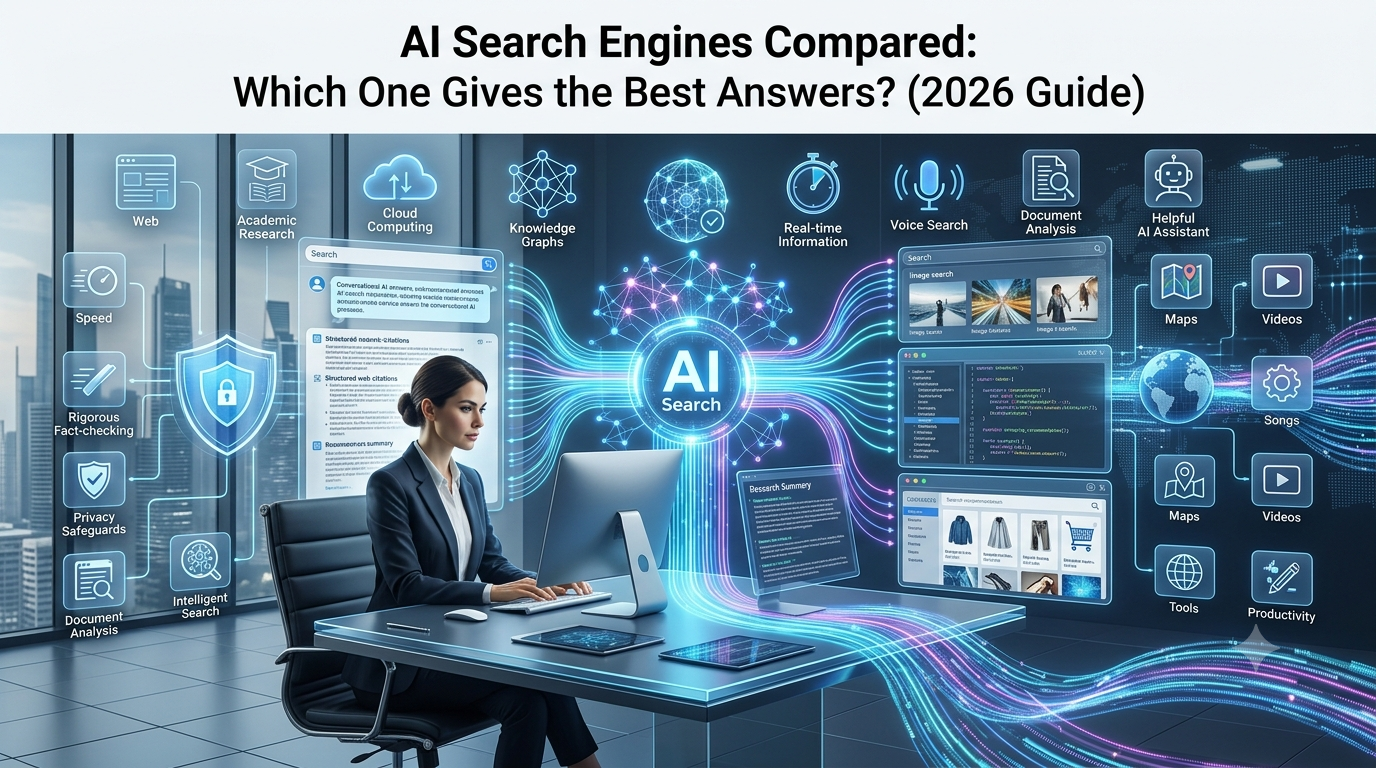
The way people search for information is changing faster than ever. For more than two decades, traditional search engines have been the primary gateway to the internet, helping users discover websites by matching keywords with relevant pages. While this approach has worked well, it often requires opening multiple tabs, comparing different sources, and manually finding the answer.
In 2026, artificial intelligence has fundamentally changed the search experience. Instead of simply displaying a list of links, AI search engines understand natural language questions, analyze information from multiple sources, summarize complex topics, and generate direct answers within seconds. They can explain concepts, compare products, perform research, answer follow-up questions, and even help users complete tasks rather than just find information.
Whether you’re a student researching a project, a marketer analyzing competitors, a developer looking for technical solutions, or a business professional gathering market insights, AI-powered search engines can save significant time while improving the quality of research.
The rapid growth of AI search has also intensified competition among technology companies. Platforms like Perplexity AI, Google Gemini, ChatGPT Search, Microsoft Copilot, Brave Search, You.com, Grok, and others each offer unique strengths. Some focus on providing highly accurate answers with citations, while others excel at conversational research, privacy, enterprise productivity, or real-time information.
However, choosing the right AI search engine isn’t always easy. Each platform has different capabilities, limitations, and ideal use cases.
This comprehensive guide compares the best AI search engines in 2026, explains how they work, highlights their strengths and weaknesses, and helps you determine which AI search engine gives the best answers for your specific needs.
What Is an AI Search Engine?
An AI search engine is a search platform that combines traditional web search technology with artificial intelligence to provide intelligent, conversational answers instead of simply displaying a ranked list of webpages.
Unlike conventional search engines that rely heavily on keyword matching, AI search engines understand the meaning and intent behind a user’s question. They can interpret natural language, retrieve information from multiple sources, analyze that information, and generate easy-to-understand responses.
For example, instead of searching for:
“best laptops under $1,500”
you could ask:
“Which laptop is best for video editing, gaming, and programming under $1,500, and why?”
Rather than showing dozens of links, an AI search engine can compare specifications, summarize expert reviews, explain trade-offs, and recommend suitable options while often providing links to its sources.
This conversational approach makes research faster, simpler, and more interactive.
How Do AI Search Engines Work?
AI search engines combine several advanced technologies to deliver intelligent answers.
1. Large Language Models (LLMs)
At the core of most AI search engines are Large Language Models (LLMs). These models understand natural language, recognize context, and generate human-like responses.
Instead of matching keywords, they interpret the user’s intent and produce coherent explanations.
2. Traditional Search Indexes
AI search engines still rely on traditional search infrastructure to discover webpages, news articles, documents, and online resources.
This allows them to retrieve current information rather than relying only on training data.
3. Retrieval-Augmented Generation (RAG)
One of the biggest innovations behind modern AI search is Retrieval-Augmented Generation (RAG).
Before generating an answer, the AI retrieves relevant information from trusted online sources. It then combines this information with its reasoning capabilities to create an accurate and up-to-date response.
RAG helps reduce outdated responses and improves factual accuracy.
4. Natural Language Processing (NLP)
Natural Language Processing enables AI search engines to understand conversational questions, identify context, and maintain follow-up discussions without requiring users to rephrase their queries repeatedly.
5. Continuous Reasoning
Many AI search engines can compare multiple sources, evaluate conflicting information, summarize lengthy documents, and explain complex topics in a simple and structured way.
This creates an experience that feels more like interacting with a knowledgeable research assistant than using a traditional search engine.
AI Search Engines vs Traditional Search Engines
Although AI search engines are growing rapidly, traditional search engines still play an important role. Understanding the difference helps users choose the right tool for different situations.
Traditional search engines primarily display webpages ranked according to algorithms that evaluate relevance, authority, and other ranking signals. Users must visit multiple websites, compare information, and determine which sources are trustworthy.
AI search engines take a different approach. Instead of asking users to do the research themselves, they gather information from multiple sources, analyze it, and provide a summarized answer. Many also allow users to ask follow-up questions, creating an ongoing conversation.
Traditional search remains valuable when users want to explore original websites, compare many sources manually, or find highly specific pages. AI search, on the other hand, is ideal for understanding topics quickly, researching complex questions, comparing products, or receiving concise explanations.
Rather than replacing traditional search, AI search is complementing it by making information easier to understand and faster to access.
AI Search Engines vs AI Chatbots
Many people assume AI search engines and AI chatbots are the same, but they serve different purposes.
AI chatbots such as ChatGPT are designed primarily for conversation, writing assistance, brainstorming, coding, and creative tasks. While many chatbots now include web search capabilities, their primary purpose is generating intelligent responses.
AI search engines focus on discovering, retrieving, and summarizing information from the web. They emphasize source verification, citations, and current information.
For example, if you need help writing a business proposal, an AI chatbot may be the better choice.
If you need to compare the latest smartphones released this month with verified sources, an AI search engine is generally more suitable.
Many modern platforms now combine both capabilities, making the distinction increasingly smaller.
Why AI Search Engines Are Becoming So Popular
The popularity of AI search engines continues to grow because they significantly reduce the time required to research information.
Instead of opening ten browser tabs, users receive organized summaries that combine insights from multiple trusted sources.
Professionals can perform market research faster.
Students can understand difficult concepts more easily.
Developers can troubleshoot programming issues without reading lengthy documentation.
Businesses can analyze competitors, monitor trends, and gather insights more efficiently.
The ability to ask follow-up questions also creates a much more natural research experience than repeatedly entering new keyword searches.
As AI models continue improving, search is evolving from information discovery into intelligent problem-solving.
How We Compared the Best AI Search Engines
To provide a balanced comparison, the AI search engines in this guide are evaluated using several important criteria.
The first factor is answer accuracy. An AI search engine should generate reliable, relevant, and well-structured responses.
The second factor is source transparency. Platforms that clearly cite their sources make it easier for users to verify information.
The third factor is real-time web access. Since information changes constantly, the ability to retrieve current data is essential.
Another important factor is research capability. Some platforms perform much better when handling long-form research questions, technical topics, or detailed comparisons.
We also considered ease of use, privacy, speed, integration with other productivity tools, and the overall quality of the user experience.
No single AI search engine excels in every category, which is why different tools are recommended for different types of users.
1. Perplexity AI – Best Overall AI Search Engine
Perplexity AI has established itself as one of the leading AI search engines in 2026 because it combines conversational AI with transparent, citation-based web search.
Instead of presenting users with a collection of blue links, Perplexity provides well-organized answers supported by references to the original sources. Users can easily verify information, continue asking follow-up questions, and explore related topics without restarting their search.
Its research-focused design makes it especially valuable for professionals, students, journalists, marketers, and business analysts who need trustworthy information rather than quick summaries.
Another standout feature is its ability to organize complex research into structured explanations. Whether you’re comparing AI tools, learning a technical subject, or conducting market research, Perplexity performs exceptionally well.
Its Deep Research capabilities further improve long-form investigations by analyzing numerous sources before producing a comprehensive answer.
Perplexity is particularly strong for academic learning, business research, fact-checking, software comparisons, and technical documentation.
Its only notable limitation is that some advanced research features are available only through paid plans.
Overall, if your primary goal is obtaining accurate answers backed by reliable sources, Perplexity AI remains one of the strongest AI search engines available today.
2. Google Gemini – Best AI Search Engine for Everyday Users
Google Gemini has become one of the most widely used AI search experiences because it combines Google’s massive search infrastructure with advanced generative AI. Instead of acting as a standalone chatbot, Gemini is deeply integrated into Google’s ecosystem, allowing users to search the web, analyze documents, summarize emails, and interact with services like Gmail, Google Drive, Docs, Maps, and YouTube.
One of Gemini’s biggest strengths is its access to Google’s constantly updated search index. This enables it to provide fresh information for many queries while also understanding images, PDFs, spreadsheets, and videos. Its multimodal capabilities make it useful for both personal and professional tasks.
For everyday searches such as travel planning, shopping comparisons, restaurant recommendations, and current events, Gemini delivers a smooth experience because it combines AI-generated responses with Google’s traditional search results. Users can continue asking follow-up questions, refine their searches, and receive increasingly personalized answers.
Gemini is particularly useful for students, office professionals, content creators, and businesses already using Google Workspace. Because it integrates seamlessly with Google’s productivity tools, users can move from searching for information to creating documents, presentations, or spreadsheets without switching platforms.
However, like every AI system, Gemini occasionally summarizes information incorrectly or oversimplifies complex topics. Users should still verify important facts, especially for legal, medical, or financial decisions.
3. ChatGPT Search – Best for Conversational Research and Learning
ChatGPT Search combines OpenAI’s conversational AI capabilities with live web search, creating an experience that feels less like using a search engine and more like working with a knowledgeable research assistant.
Unlike traditional search engines that expect users to repeatedly enter keywords, ChatGPT Search allows users to have natural conversations. You can ask a question, receive a detailed explanation, request a simpler version, compare alternatives, or ask follow-up questions without losing context.
This conversational approach makes ChatGPT Search particularly valuable for learning complex subjects, writing content, brainstorming ideas, researching business strategies, explaining technical concepts, and planning projects.
Content creators also benefit because ChatGPT Search can transform research into outlines, summarize multiple sources, generate ideas, and help organize information before writing begins.
Another major advantage is its ability to explain why something is true rather than simply providing a short answer. This makes it especially useful for students, educators, marketers, and professionals who want deeper understanding rather than quick facts.
Although ChatGPT Search provides access to current web information, users should still review cited sources for high-stakes decisions.
4. Microsoft Copilot – Best AI Search Engine for Businesses
Microsoft Copilot has evolved into one of the strongest AI search platforms for workplace productivity. Rather than focusing only on internet search, Copilot connects web information with business documents, emails, spreadsheets, presentations, calendars, and enterprise knowledge.
For organizations already using Microsoft 365, Copilot becomes much more than a search engine. Employees can search company documents, summarize meetings, analyze reports, generate presentations, draft emails, and retrieve information across multiple Microsoft applications.
This makes Copilot particularly valuable for managers, analysts, consultants, finance professionals, sales teams, and enterprise organizations.
Its integration with Microsoft Edge also creates a seamless browsing experience, allowing users to summarize webpages, compare information, and generate content directly while browsing.
For businesses looking to improve productivity through AI, Copilot remains one of the strongest options available.
5. Brave Search AI – Best AI Search Engine for Privacy
Privacy has become an increasingly important concern as AI systems process more personal information. Brave Search AI addresses this challenge by combining AI-powered search with strong privacy protections.
Unlike many search platforms that rely heavily on user tracking, Brave focuses on minimizing data collection while still providing AI-generated summaries and conversational search features.
Another advantage is Brave’s independent search index, reducing its dependence on external search providers.
Brave Search is particularly suitable for journalists, researchers, security professionals, and privacy-conscious users who want AI assistance without extensive tracking.
Although its AI features continue to improve, they may not always match the research depth of Perplexity or ChatGPT Search.
6. You.com – Best AI Search Engine for Productivity
You.com combines AI-powered search with productivity-focused tools. Instead of functioning only as a search engine, it integrates multiple AI assistants that help users research information, generate content, analyze documents, and complete work more efficiently.
Its customizable interface allows users to tailor the search experience to different workflows, making it attractive for professionals, entrepreneurs, writers, and developers.
For users who want AI search and productivity features within a single platform, You.com provides an efficient solution.
7. Grok Search – Best for Real-Time Trending Information
Grok has gained popularity because of its ability to provide responses based on current discussions and rapidly changing topics.
Unlike many AI search engines that focus mainly on traditional web content, Grok is particularly useful for understanding breaking news, viral discussions, technology trends, and public conversations.
Journalists, marketers, and social media professionals often find Grok valuable when monitoring emerging topics and public sentiment.
However, because real-time discussions may include opinions alongside facts, users should always verify important information using trusted sources.
8. Phind – Best AI Search Engine for Developers
Developers have unique search needs. Instead of looking for general information, they often need programming solutions, documentation, debugging assistance, and technical explanations.
Phind specializes in this area by providing AI-powered answers designed specifically for software engineers.
It performs particularly well for explaining code, comparing frameworks, solving programming problems, and finding technical documentation.
For developers, Phind often provides faster and more focused answers than general-purpose AI search engines.
9. Kagi AI – Best Premium AI Search Experience
Kagi takes a different approach from advertising-supported search engines. It emphasizes high-quality search results, privacy, and a distraction-free experience.
Rather than optimizing for advertisements, Kagi focuses on providing relevant information and allowing users greater control over their search experience.
Its AI capabilities further improve research by summarizing content and helping users discover authoritative sources.
Kagi is particularly attractive for professionals who value search quality over free services supported by advertising.
10. DuckDuckGo AI Search – Best for Simple Private Searches
DuckDuckGo continues expanding its AI capabilities while maintaining its privacy-first philosophy.
Users who want straightforward AI-generated summaries without extensive personalization often appreciate its simple interface.
Although it may not provide the advanced research capabilities found in Perplexity or ChatGPT Search, it remains an excellent choice for everyday private searching.
Which AI Search Engine Gives the Best Answers?
The answer depends on what you’re trying to accomplish.
For research, academic work, and detailed analysis, Perplexity AI consistently provides some of the most trustworthy answers because it cites sources and encourages verification.
For everyday internet searches, Google Gemini offers excellent results due to Google’s extensive search ecosystem and multimodal capabilities.
If your goal is learning, brainstorming, or understanding complicated topics through conversation, ChatGPT Search provides one of the best experiences available.
Business users who work extensively within Microsoft 365 will benefit most from Microsoft Copilot, while users prioritizing privacy should consider Brave Search AI or DuckDuckGo AI.
There is no single AI search engine that dominates every category. The best choice depends on your workflow, priorities, and the type of information you search for most frequently.
Best AI Search Engine by Use Case
Students generally benefit most from Perplexity AI, ChatGPT Search, and Google Gemini because these platforms simplify difficult topics, summarize research, and explain concepts clearly.
Researchers often prefer Perplexity because of its transparent citations, source verification, and ability to handle long-form research questions.
Content creators and bloggers frequently rely on ChatGPT Search for brainstorming, content planning, outlining articles, and understanding search intent, while using Perplexity to verify facts and gather reliable sources.
Developers usually achieve the best results with Phind for technical questions, while ChatGPT Search and Perplexity are excellent for broader programming research and documentation.
Business professionals often choose Microsoft Copilot because of its integration with enterprise software, while marketers appreciate Perplexity and Gemini for competitor research and market analysis.
Users who prioritize online privacy generally find Brave Search AI, DuckDuckGo AI, and Kagi to be the strongest choices.
How AI Search Is Changing SEO
AI search engines are changing how websites attract visitors. Instead of relying only on traditional rankings, businesses now need content that AI systems can understand, summarize, and cite.
Websites with original research, expert insights, clear structure, factual accuracy, and strong authority are more likely to appear in AI-generated answers.
This means SEO is evolving beyond keywords. High-quality content, trustworthy sources, structured data, and topical authority are becoming even more important as AI search adoption grows.
Challenges of AI Search Engines
Despite their impressive capabilities, AI search engines still have limitations.
AI systems occasionally generate inaccurate information or misunderstand context. Not every platform provides transparent citations, and even those that do should not be considered perfect.
Some AI search engines require premium subscriptions for advanced research capabilities, while others may prioritize speed over depth.
Privacy also remains an important consideration, especially when AI platforms process sensitive personal or business information.
Users should continue verifying critical information before making important decisions.
The Future of AI Search
The future of AI search extends far beyond answering questions.
Over the next few years, AI search engines are expected to evolve into intelligent assistants capable of completing tasks, booking travel, comparing products, analyzing financial information, preparing reports, organizing research, and interacting directly with other software applications.
AI agents will likely become integrated with search platforms, allowing users to delegate entire research projects rather than simply asking individual questions.
Voice interaction, multimodal understanding, personalized recommendations, and enterprise integrations will further transform the search experience.
Instead of asking, “Where can I find this information?” users will increasingly ask, “Can you solve this problem for me?”
Conclusion
AI search engines have transformed the way people access information in 2026. Rather than forcing users to sift through countless webpages, they provide intelligent answers, summarize complex topics, compare products, explain difficult concepts, and support ongoing conversations.
Each platform has its own strengths. Perplexity AI excels in research and source transparency, Google Gemini integrates seamlessly with Google’s ecosystem, ChatGPT Search offers exceptional conversational learning, Microsoft Copilot enhances workplace productivity, Brave Search prioritizes privacy, and specialized platforms like Phind and Kagi serve niche audiences.
Choosing the best AI search engine ultimately depends on your goals. Researchers may value citations, students may prioritize explanations, businesses may need productivity integrations, and privacy-conscious users may prefer platforms with minimal tracking.
As artificial intelligence continues to evolve, search engines will become increasingly intelligent, personalized, and action-oriented. Understanding the strengths of each platform today will help you choose the right AI search tool for your needs and stay ahead in the rapidly changing future of online search.








Leave a Reply