

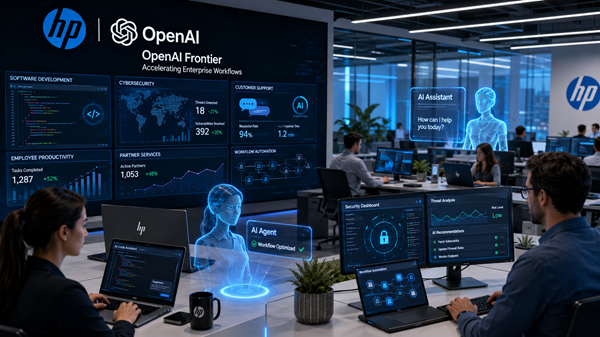
Artificial intelligence is rapidly moving from experimental projects to essential business infrastructure, and HP is taking another major step in that direction. The technology company has announced an expanded collaboration with OpenAI to accelerate enterprise workflows using advanced AI models and intelligent agents. The initiative reflects a broader shift across industries, where organizations are embedding AI into everyday operations to improve productivity, strengthen security, and deliver better customer experiences.
Rather than using AI for isolated tasks, HP is building a more connected ecosystem where intelligent assistants can support software developers, automate routine business processes, improve cybersecurity, and help employees complete complex work more efficiently. The announcement highlights how enterprise AI is evolving from simple chatbots into powerful business tools capable of transforming large organizations.
Why HP Is Expanding Its AI Partnership
Businesses worldwide are facing increasing pressure to innovate while controlling operational costs. As workloads become more complex and digital transformation accelerates, AI has become a strategic investment rather than an optional technology.
HP’s expanded collaboration with OpenAI focuses on integrating advanced AI capabilities into enterprise workflows. The company aims to reduce repetitive manual work, accelerate software development, improve internal collaboration, and enhance decision-making through AI-powered automation.
This move demonstrates HP’s commitment to creating an AI-first workplace where employees can focus on high-value tasks while intelligent systems handle routine processes.
AI-Powered Software Development
One of the most significant applications of the partnership is software engineering. Development teams spend countless hours reviewing code, identifying bugs, writing documentation, and maintaining applications. AI can significantly reduce these workloads.
With OpenAI-powered tools, developers can generate code suggestions, detect vulnerabilities earlier, automate documentation, and receive contextual recommendations during development. These capabilities shorten development cycles while improving software quality.
Instead of replacing developers, AI acts as a collaborative assistant, helping engineering teams work faster and with greater accuracy.
Enhancing Cybersecurity Operations
Cybersecurity remains one of the biggest challenges for modern enterprises. As cyber threats become more sophisticated, security teams must respond quickly to vulnerabilities and suspicious activities.
AI enables faster detection of potential risks by analyzing large volumes of security data in real time. It can prioritize alerts, recommend remediation steps, and assist analysts in investigating incidents more efficiently.
By reducing the time required to identify and resolve security issues, organizations can strengthen their overall security posture while minimizing business disruption.
Improving Employee Productivity
Modern workplaces involve numerous repetitive tasks, including creating reports, summarizing meetings, searching internal documents, responding to emails, and managing project information.
AI assistants can automate many of these daily activities, allowing employees to spend more time on strategic thinking, innovation, and customer engagement.
Instead of replacing human expertise, AI complements employees by reducing administrative burdens and providing instant access to relevant information when needed.
Better Customer Experiences
Customer expectations continue to rise as businesses compete on speed, personalization, and service quality. AI enables organizations to deliver faster and more consistent support across multiple channels.
Intelligent virtual assistants can answer common questions, guide users through troubleshooting steps, summarize previous interactions, and escalate complex issues to human representatives when necessary.
This combination of automation and human support helps improve response times while maintaining a personalized customer experience.
The Growing Importance of AI Agents
A key trend emerging from HP’s strategy is the adoption of AI agents. Unlike traditional chatbots that simply respond to prompts, AI agents can understand objectives, plan tasks, retrieve information, and complete multi-step workflows with minimal supervision.
For enterprises, this means AI can assist with project management, documentation, compliance checks, workflow automation, data analysis, and cross-functional collaboration.
As AI agents become more capable, they are expected to play an increasingly important role in digital workplaces.
Benefits for Enterprise Organizations
Organizations investing in enterprise AI can expect several advantages.
Operational efficiency improves as repetitive tasks are automated, allowing employees to focus on higher-value responsibilities. Development teams can release software faster with fewer errors, while security teams gain stronger protection through AI-assisted threat detection.
Customer support becomes more responsive, internal collaboration improves, and decision-makers gain faster access to actionable insights derived from organizational data.
These benefits collectively help businesses become more agile and competitive.
Challenges Businesses Must Address
Despite its advantages, enterprise AI adoption requires careful planning.
Organizations must establish clear governance policies to ensure AI systems are used responsibly. Protecting sensitive data, maintaining regulatory compliance, and preventing inaccurate AI-generated outputs remain essential priorities.
Businesses also need to invest in employee training so teams understand how to work effectively alongside AI technologies. Successful implementation depends on combining advanced technology with human oversight.
What This Means for the Enterprise AI Market
HP’s expanded collaboration with OpenAI reflects a broader industry trend toward integrating AI into core business operations. Rather than viewing AI as a standalone tool, leading organizations are embedding intelligent capabilities across software development, cybersecurity, customer service, and workplace productivity.
This shift signals that enterprise AI is entering a new phase of maturity, where businesses prioritize scalable, secure, and practical AI solutions that deliver measurable operational value.
As more organizations adopt similar strategies, AI-powered workflows are likely to become a standard feature of modern enterprises rather than a competitive advantage available to only a few.
Looking Ahead
The expansion of HP’s AI strategy demonstrates how quickly artificial intelligence is becoming an integral part of enterprise operations. By combining OpenAI’s advanced models with HP’s business expertise, the company aims to streamline workflows, empower employees, strengthen security, and enhance customer experiences.
For organizations evaluating their own AI strategies, the message is clear: the future of business will increasingly depend on intelligent systems that augment human capabilities rather than replace them. Companies that invest thoughtfully in AI today will be better positioned to adapt, innovate, and compete in the rapidly evolving digital economy.





Leave a Reply