

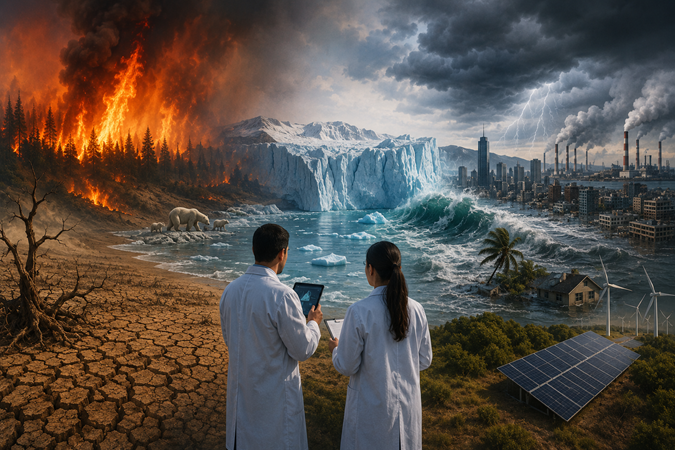
Climate Change in 2026: 7 Environmental Threats Scientists Are Most Worried About
In 2026, climate change is no longer discussed as a distant threat. It is unfolding in real time — through record heatwaves, collapsing ecosystems, rising seas, deadly floods, megadroughts, and growing fears that parts of Earth’s climate system may be approaching irreversible tipping points.
Scientists are increasingly concerned that humanity is entering a phase where environmental disruption becomes nonlinear. In simple terms: the damage may no longer happen slowly. It could accelerate rapidly and unpredictably.
The world has already warmed dangerously close to the 1.5°C threshold scientists have warned about for years. What worries researchers most in 2026 is not just warming itself, but the interaction of multiple environmental crises happening simultaneously: collapsing biodiversity, destabilizing oceans, worsening food insecurity, freshwater shortages, and increasingly extreme weather events.
Below are the seven environmental threats scientists say deserve the world’s immediate attention.
1. Climate Tipping Points Are Getting Dangerously Close
For decades, climate change was understood as gradual warming. Today, scientists fear the planet may be nearing “tipping points” — critical thresholds where ecosystems or climate systems suddenly shift into a new and potentially irreversible state.
These tipping points are among the biggest scientific concerns in 2026 because they can amplify warming even if humans later reduce emissions.
Several major systems are now under close observation:
- Greenland ice sheet melting
- West Antarctic ice collapse
- Amazon rainforest dieback
- Arctic permafrost thaw
- Coral reef collapse
- Weakening Atlantic Ocean circulation
Scientists are especially worried about cascading effects. One tipping event can trigger another.
For example:
- Melting Greenland ice adds freshwater into the Atlantic.
- That weakens major ocean circulation systems.
- Changing rainfall patterns stress the Amazon rainforest.
- A dying Amazon absorbs less carbon dioxide.
- Global warming accelerates further.
This is why climate researchers increasingly describe the Earth system as interconnected rather than isolated. The concern is no longer theoretical. Scientists now believe some tipping processes may already be underway.
2. Extreme Heat Is Becoming a Global Public Health Emergency
Heatwaves have evolved from uncomfortable weather events into one of the deadliest climate-related threats on Earth.
In 2026, scientists are warning that extreme heat may soon outpace society’s ability to adapt in many regions.
The problem is not simply higher temperatures. It is the combination of heat, humidity, urban infrastructure, and prolonged exposure.
Some regions are now experiencing conditions approaching dangerous “wet-bulb temperatures,” where the human body can no longer cool itself efficiently through sweating.
The impacts are already severe:
- Increased heat-related deaths
- Reduced agricultural productivity
- Strain on power grids
- Water shortages
- Lower worker productivity
- Greater wildfire risk
- Expansion of disease-carrying insects
Cities are especially vulnerable because asphalt and concrete trap heat, creating “urban heat islands.”
In parts of South Asia, the Middle East, and Africa, outdoor labor is becoming increasingly dangerous during summer months. Farmers, construction workers, and factory employees face rising health risks from prolonged exposure.
Climate researchers also warn that extreme heat worsens inequality. Wealthier communities can often afford cooling systems and resilient infrastructure, while poorer populations face disproportionate risks.
In 2026, heat is no longer viewed as just another weather hazard. Scientists increasingly classify it as a systemic global threat affecting health, labor, food production, migration, and economic stability.
3. The Atlantic Ocean Circulation System Could Weaken Dramatically
One of the most alarming scientific concerns in 2026 is the weakening of the Atlantic Meridional Overturning Circulation, often called the AMOC.
The AMOC functions like a massive conveyor belt in the Atlantic Ocean, transporting warm water northward and helping regulate global climate patterns.
If it weakens significantly — or collapses — the consequences could be enormous.
Scientists warn that major AMOC disruption could lead to:
- Severe winters in parts of Europe
- Disrupted monsoon systems
- Food production instability
- Rising sea levels along North America’s east coast
- Stronger storms
- Changes in marine ecosystems
The system is vulnerable because melting Greenland ice injects large amounts of freshwater into the Atlantic, interfering with ocean circulation patterns.
Researchers stress that a total collapse is not considered imminent, but even substantial weakening could destabilize weather systems across multiple continents.
In 2026, the AMOC has become one of the clearest examples of how climate change is not only about warmer temperatures — it is about destabilizing the systems that make Earth’s climate relatively predictable.
4. Biodiversity Loss Is Accelerating Faster Than Expected
Scientists increasingly describe biodiversity collapse as a parallel crisis to climate change.
The two problems are deeply connected.
Climate change destroys habitats through heat, drought, flooding, ocean warming, and ecosystem disruption. At the same time, biodiversity loss weakens nature’s ability to absorb carbon and stabilize ecosystems.
Researchers warn that Earth may be entering a sixth mass extinction event driven largely by human activity.
Species across land and ocean ecosystems are under pressure:
- Coral reefs are bleaching and dying
- Arctic species are losing habitat
- Forest ecosystems face wildfire and pest outbreaks
- Marine food chains are shifting
- Pollinator populations continue to decline
Coral reefs are among the most threatened ecosystems. Scientists warn that warm-water coral reefs may already be approaching irreversible tipping points.
The consequences go beyond environmental concerns.
Biodiversity supports:
- Food systems
- Fisheries
- Pollination
- Medicine
- Freshwater systems
- Coastal protection
- Economic livelihoods
When ecosystems weaken, human societies become more vulnerable too.
Climate scientists now argue that protecting biodiversity is not separate from climate action — it is essential to climate stability itself.
5. Wildfires Are Becoming Larger, Hotter, and More Unpredictable
Wildfires have become one of the most visible symbols of climate change.
From Canada and California to Australia, Greece, and the Amazon, fire seasons are becoming longer and more destructive.
Scientists say climate change intensifies wildfire conditions in several ways:
- Higher temperatures dry vegetation faster
- Droughts increase fuel availability
- Earlier snowmelt extends fire seasons
- Stronger winds accelerate fire spread
The result is a new generation of megafires that burn hotter, move faster, and are harder to control.
Wildfires also create dangerous feedback loops.
Forests normally absorb carbon dioxide, helping slow climate change. But when forests burn:
- Massive carbon emissions enter the atmosphere
- Air quality deteriorates
- Ecosystems struggle to recover
- Carbon storage capacity declines
Smoke pollution from wildfires is now recognized as a major public health issue, contributing to respiratory and cardiovascular illness far from fire zones.
Scientists are especially worried about boreal forests and tropical rainforests, which are critical carbon sinks.
If repeated fires prevent forests from recovering fully, these ecosystems could shift permanently into degraded states — worsening global warming.
6. Ocean Systems Are Under Severe Stress
The world’s oceans absorb more than 90% of excess heat generated by greenhouse gas emissions.
For decades, oceans have acted as a planetary buffer against runaway warming.
But scientists warn that this buffering capacity comes at enormous ecological cost.
Ocean systems in 2026 face multiple simultaneous threats:
- Marine heatwaves
- Ocean acidification
- Oxygen depletion
- Coral bleaching
- Fisheries disruption
- Rising sea levels
Ocean acidification is particularly concerning because excess carbon dioxide dissolves into seawater, altering ocean chemistry and threatening shell-forming organisms and coral reefs.
Meanwhile, warming waters hold less oxygen, creating expanding “dead zones” where marine life struggles to survive.
Marine ecosystems are already shifting rapidly.
Fish populations are migrating toward cooler waters, disrupting food systems and coastal economies that depend on predictable fisheries.
Scientists also warn that warmer oceans intensify hurricanes and tropical storms by providing more energy to developing weather systems.
In many ways, the oceans are sending clear signals that the climate system is under stress.
The concern in 2026 is that marine ecosystems may be approaching thresholds beyond which recovery becomes increasingly difficult.
7. Food and Water Security Are Becoming Climate Casualties
Perhaps the most immediate human threat from climate change is growing instability in food and water systems.
Agriculture depends heavily on stable weather patterns. Climate change is disrupting those patterns worldwide.
Farmers now face increasing uncertainty from:
- Extreme heat
- Drought
- Flooding
- Soil degradation
- Water shortages
- Changing rainfall patterns
- Pest expansion
Scientists warn that crop yields for staples like wheat, rice, and maize could decline significantly in vulnerable regions as temperatures rise further.
At the same time, water stress is worsening globally.
Mountain glaciers — crucial freshwater sources for hundreds of millions of people — are melting rapidly. Snowpack declines are altering river systems that agriculture depends on.
Some regions are swinging between opposite extremes:
- Long droughts
- Sudden flooding
- Unpredictable rainfall
This volatility makes long-term planning increasingly difficult for governments and food producers.
Food insecurity is also linked to political instability and migration pressures.
Climate researchers now warn that environmental disruption could increasingly become a driver of humanitarian crises and geopolitical tensions throughout the coming decades.
Why Scientists Are More Alarmed in 2026 Than Ever Before
The scientific concern surrounding climate change in 2026 is not based on a single disaster or isolated event.
It is based on convergence.
Multiple environmental systems are deteriorating simultaneously:
- Atmosphere
- Oceans
- Forests
- Ice sheets
- Freshwater systems
- Biodiversity
- Agricultural systems
Researchers are especially worried because many risks interact with one another.
Extreme heat worsens droughts. Droughts worsen wildfires. Wildfires release carbon. Ocean warming intensifies storms. Ecosystem collapse reduces resilience.
The result is a more volatile and unpredictable planet.
Scientists stress that humanity still has agency. The future is not predetermined.
Rapid emissions reductions, renewable energy expansion, ecosystem restoration, climate adaptation, and stronger international cooperation can still reduce long-term risks.
But the window for preventing the most dangerous outcomes is narrowing quickly.
The central message from climate science in 2026 is increasingly urgent:
The era of gradual climate change is ending. The era of accelerating climate disruption may already be here.




Leave a Reply