

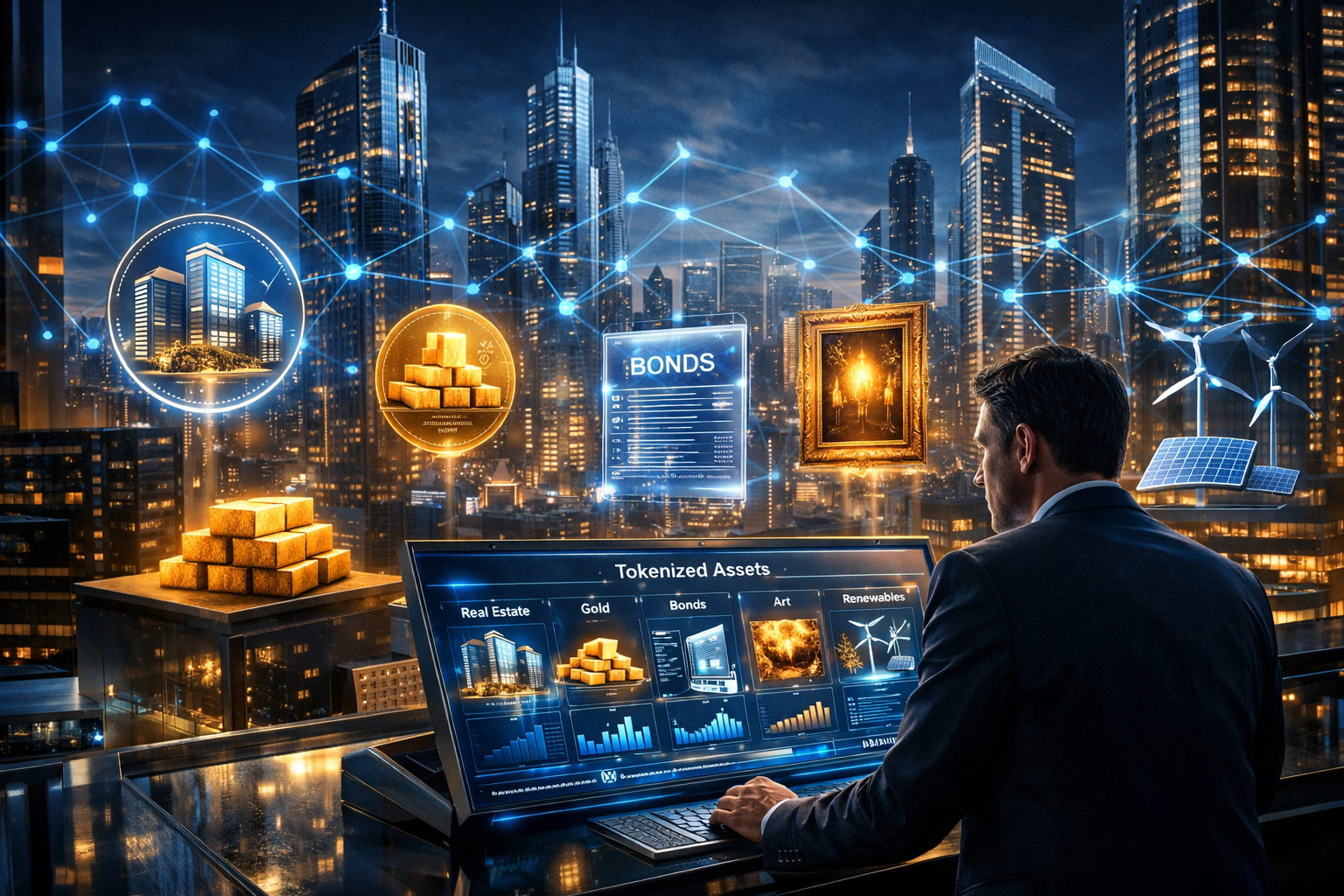
The financial world is undergoing one of the biggest transformations since the invention of online banking. For decades, investing in premium real estate, valuable artwork, private equity, government bonds, or infrastructure projects was often limited to wealthy individuals and large institutions. Today, blockchain technology is changing that reality through a concept known as Real-World Asset (RWA) tokenization.
From global banks to fintech startups, organizations across the world are investing billions of dollars into tokenizing physical and financial assets. Industry experts predict that the tokenized asset market could be worth trillions of dollars over the next decade, making it one of the fastest-growing sectors in digital finance.
But what exactly is tokenization of real-world assets? Why is it receiving so much attention in 2025 and 2026? More importantly, how could it reshape investing, ownership, and financial markets for everyday people?
Let’s explore everything you need to know.
Understanding Real-World Asset Tokenization
Real-world asset tokenization is the process of converting ownership rights of physical or traditional financial assets into digital tokens that exist on a blockchain.
Think of these digital tokens as secure certificates of ownership. Instead of relying on stacks of paperwork or centralized databases, ownership is recorded on a decentralized blockchain network, making transactions faster, more transparent, and significantly easier to manage.
These tokens can represent complete ownership of an asset or just a fraction of it. This means someone no longer needs millions of dollars to invest in premium commercial real estate or fine art. They may only need a few hundred dollars to purchase a fractional share through tokenized assets.
As blockchain infrastructure matures, tokenization is becoming one of the strongest bridges between traditional finance and decentralized finance.
How Does Tokenization of Real-World Assets Work?
Although the technology sounds complex, the overall process is surprisingly straightforward.
1. Identifying the Asset
The first step involves selecting an asset that will be tokenized. This asset could be residential property, commercial buildings, government bonds, private equity, gold reserves, luxury watches, fine art collections, renewable energy projects, intellectual property, invoices, or even agricultural land.
The chosen asset undergoes legal verification and valuation to ensure ownership rights are clear.
2. Creating the Digital Representation
Once verified, blockchain developers create digital tokens that legally represent ownership of the asset.
Each token contains predefined ownership rights, transfer conditions, compliance rules, and other important information using smart contracts.
3. Smart Contract Integration
Smart contracts automate much of the administrative work involved in ownership.
Instead of requiring lawyers, brokers, or manual paperwork for every transaction, smart contracts automatically execute transfers, distribute income, process dividends, and enforce compliance whenever predefined conditions are met.
This dramatically reduces costs and delays.
4. Token Distribution
The digital tokens are then offered to investors through regulated platforms or private marketplaces.
Investors purchase these tokens using fiat currency or cryptocurrencies depending on the platform’s regulations.
5. Secondary Market Trading
One of the biggest advantages of tokenization is liquidity.
Unlike traditional investments that may require months to sell, tokenized assets can often be traded much faster through approved digital marketplaces, depending on local regulations.
Why Is Tokenization Becoming So Popular?
The popularity of real-world asset tokenization isn’t driven by hype alone. It solves several long-standing problems that have existed in traditional finance for decades.
1. Fractional Ownership Opens New Opportunities
Imagine owning part of a luxury apartment in New York, a solar power plant in Europe, or a warehouse in Singapore without purchasing the entire asset.
Tokenization allows assets to be divided into thousands of digital shares, making investments far more accessible.
This democratization of investing is perhaps the biggest reason behind the industry’s rapid growth.
2. Better Liquidity
Many traditional assets are difficult to sell quickly.
Commercial real estate, private equity investments, collectibles, and infrastructure projects often require months of negotiations before ownership changes hands.
Tokenization introduces a more efficient marketplace where ownership interests can potentially be traded much faster.
3. Increased Transparency
Every transaction recorded on a blockchain creates an immutable record.
Investors can verify ownership history, transaction timestamps, and asset movement without depending entirely on centralized databases.
This transparency helps reduce fraud while improving investor confidence.
4. Lower Transaction Costs
Traditional asset transfers involve lawyers, banks, brokers, custodians, auditors, and multiple intermediaries.
Smart contracts automate many of these responsibilities, reducing administrative expenses and making investment opportunities more efficient.
5. Global Investment Access
Blockchain removes geographical barriers.
An investor in India may eventually purchase fractional ownership in European commercial real estate, American treasury products, or Asian renewable energy projects without facing many traditional cross-border complications.
Types of Real-World Assets That Can Be Tokenized
One of the most exciting aspects of RWA tokenization is its versatility.
Real Estate
Residential homes, office buildings, shopping malls, warehouses, hotels, and vacation properties are among the most commonly tokenized assets today.
Real estate tokenization allows investors to diversify portfolios without purchasing entire properties.
Precious Metals
Gold and silver have always been considered safe-haven investments.
Tokenization allows investors to own digital representations backed by physical precious metals stored in secure vaults.
Government Bonds
Governments and financial institutions are increasingly exploring tokenized bonds to simplify issuance and improve settlement efficiency.
Fine Art
Historically, artwork from famous artists was reserved for elite collectors.
Tokenization enables multiple investors to collectively own valuable paintings and sculptures.
Private Equity
Startups and private companies can tokenize ownership interests, creating new fundraising opportunities while expanding investor participation.
Carbon Credits
As sustainability becomes increasingly important, tokenized carbon credits are emerging as a transparent solution for environmental markets.
Real-World Examples in 2025 and 2026
The concept is no longer experimental.
Major financial institutions have already launched tokenization initiatives.
BlackRock continues expanding its blockchain-based investment products, demonstrating growing institutional confidence in tokenized finance.
JPMorgan has significantly expanded blockchain settlement systems for institutional transactions, reducing settlement times for selected financial products.
Franklin Templeton has introduced blockchain-enabled investment funds that showcase how traditional asset management can integrate distributed ledger technology.
Several governments across Asia, Europe, and the Middle East are also piloting tokenized government bonds and digital securities as part of broader financial modernization efforts.
These developments show that tokenization has moved beyond theory into practical implementation.
Challenges That Still Exist
Despite its enormous promise, tokenization is not without challenges.
Regulatory Uncertainty
Different countries have different rules regarding digital assets.
Governments continue updating securities laws, taxation frameworks, and investor protection policies to accommodate blockchain-based ownership.
Technology Risks
Although blockchain is highly secure, vulnerabilities in smart contract programming can still create risks if contracts are not thoroughly audited.
Cybersecurity remains an essential priority.
Market Education
Many investors still associate blockchain exclusively with cryptocurrencies.
Educating users about the difference between speculative crypto assets and tokenized real-world assets remains an important industry challenge.
Standardization
Multiple blockchain platforms currently use different technical standards.
Greater interoperability will improve adoption across global financial systems.
Why Businesses Are Paying Attention
Businesses see tokenization as more than just a technological innovation.
Real estate developers can raise capital from a broader investor base.
Banks can reduce settlement costs.
Investment firms can offer new products.
Governments can improve transparency in public asset management.
Manufacturing companies can tokenize invoices and supply chain assets.
Renewable energy companies can attract global investors more efficiently.
In many ways, tokenization is creating entirely new business models that were previously impossible using conventional financial infrastructure.
The Future of Real-World Asset Tokenization
Most experts believe the next decade will witness rapid expansion in tokenized finance.
Artificial intelligence, blockchain, decentralized identity systems, and smart contracts are expected to work together to create faster, safer, and more intelligent financial ecosystems.
As regulations mature and institutional participation grows, everyday investors may eventually interact with tokenized assets without even realizing blockchain powers the underlying technology.
Buying property shares, investing in government bonds, financing renewable energy projects, or owning pieces of valuable artwork could become as simple as purchasing stocks through a mobile investment app.
Rather than replacing traditional finance, tokenization is gradually enhancing it by making markets more accessible, transparent, and efficient.
Final Thoughts
Real-world asset tokenization represents one of the most important innovations shaping the future of finance. By converting ownership rights into blockchain-based digital tokens, this technology removes barriers that have historically limited investment opportunities to a small group of wealthy participants.
Although regulatory and technological challenges remain, momentum continues to build as financial institutions, governments, and technology companies invest heavily in tokenized ecosystems. The ability to enable fractional ownership, improve liquidity, automate transactions, reduce operational costs, and expand global access makes tokenization a compelling solution for the next generation of investing.
As we move through 2026 and beyond, tokenized real-world assets are likely to become an increasingly familiar part of everyday finance. Investors who understand this shift today will be better prepared for tomorrow’s digital economy, where ownership is more flexible, markets are more connected, and opportunities are available to far more people than ever before.


Leave a Reply