

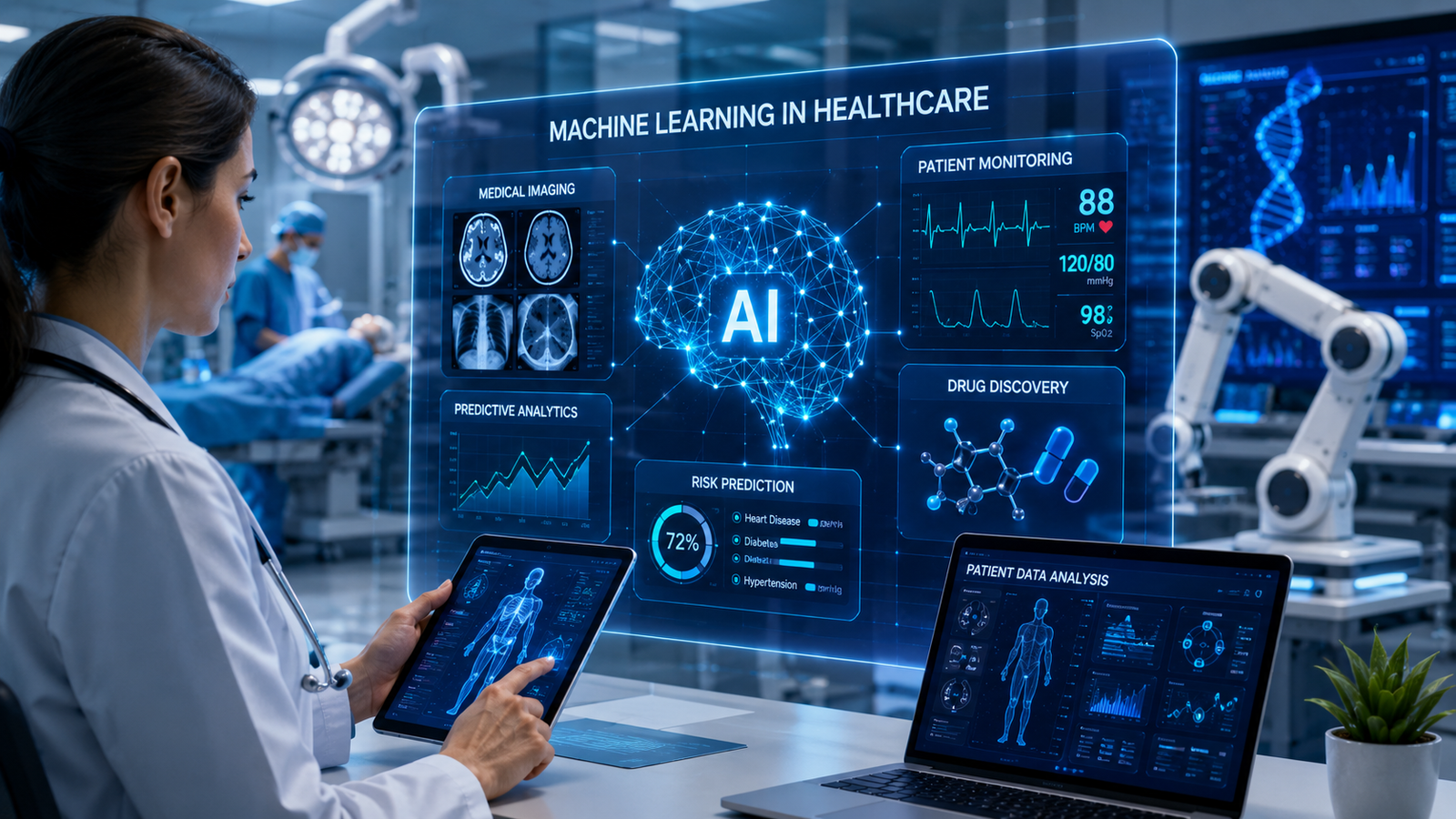
Healthcare has always been driven by one simple goal—helping people live longer, healthier lives. Yet for decades, doctors, hospitals, and researchers have faced enormous challenges, from diagnosing diseases early to managing overwhelming amounts of medical data. Today, machine learning is changing that reality in remarkable ways.
Imagine a future where an AI system can detect cancer before symptoms appear, predict a patient’s risk of heart disease using years of medical records, or help doctors develop personalized treatment plans within minutes. That future is no longer science fiction. In 2026, machine learning has become one of the most powerful technologies reshaping modern healthcare.
Instead of replacing doctors, machine learning is giving healthcare professionals smarter tools to make faster decisions, improve diagnostic accuracy, reduce medical errors, and provide more personalized care. Hospitals around the world are increasingly integrating intelligent systems into their daily operations, allowing clinicians to spend less time on repetitive tasks and more time caring for patients.
As healthcare continues its digital transformation, understanding how machine learning is revolutionizing medicine has never been more important. Let’s explore the biggest ways this technology is improving patient care in 2026 and beyond.
1. Early Disease Detection Is Saving More Lives
One of the greatest strengths of machine learning is its ability to recognize patterns that humans might overlook.
Medical images, laboratory reports, genetic information, and patient histories contain enormous amounts of data. Machine learning algorithms analyze these datasets within seconds, identifying subtle indicators of diseases long before they become obvious.
Hospitals now use AI-powered diagnostic systems to detect breast cancer, lung cancer, diabetic retinopathy, skin cancer, Alzheimer’s disease, and cardiovascular conditions with impressive accuracy.
The earlier a disease is identified, the greater the chances of successful treatment. By supporting physicians with highly accurate predictions, machine learning is helping save countless lives.
Real-World Impact
Healthcare providers can begin treatment earlier, reduce complications, and significantly improve long-term patient outcomes.
2. Personalized Treatment Plans Are Becoming the New Standard
No two patients respond to treatment in exactly the same way.
Machine learning analyzes medical histories, genetic profiles, lifestyle habits, medication records, and diagnostic results to recommend treatment options tailored to individual patients.
Instead of following generalized treatment guidelines alone, physicians can make decisions based on personalized insights generated through AI.
This approach has become especially valuable in cancer treatment, where selecting the most effective therapy often depends on complex genetic and biological factors.
In 2026, personalized medicine is rapidly becoming one of healthcare’s most promising advancements.
3. Medical Imaging Is Becoming More Accurate
Radiologists examine thousands of medical images every year.
Even experienced professionals may occasionally miss tiny abnormalities hidden within complex scans.
Machine learning assists radiologists by highlighting suspicious regions in X-rays, CT scans, MRIs, ultrasounds, and pathology slides.
Rather than replacing medical experts, AI serves as a second set of highly attentive eyes, helping clinicians make more confident decisions.
This partnership between doctors and intelligent systems improves diagnostic accuracy while reducing workload.
4. Drug Discovery Is Accelerating
Developing new medicines traditionally requires years of research and billions of dollars in investment.
Machine learning is dramatically shortening this timeline.
AI models analyze enormous biological datasets, identify promising drug candidates, predict molecular interactions, and simulate clinical outcomes before laboratory testing even begins.
Pharmaceutical companies increasingly rely on machine learning to accelerate research for cancer therapies, rare diseases, neurological disorders, and infectious illnesses.
During global health emergencies, faster drug discovery can save millions of lives.
Why This Matters
Machine learning enables researchers to bring innovative treatments to patients more quickly while reducing development costs.
5. Predictive Analytics Is Preventing Medical Emergencies
Hospitals generate vast amounts of patient information every day.
Machine learning transforms this data into valuable predictions.
By continuously monitoring vital signs, laboratory results, previous admissions, and medical histories, AI systems can identify patients at risk of severe complications before emergencies occur.
For example, hospitals now use predictive analytics to detect sepsis, anticipate cardiac events, monitor ICU patients, and identify individuals likely to require urgent intervention.
Early warnings allow healthcare teams to respond faster, improving patient survival rates.
6. Virtual Health Assistants Are Improving Patient Support
Patients increasingly expect healthcare to be available whenever they need it.
Machine learning powers intelligent virtual assistants capable of answering medical questions, scheduling appointments, reminding patients to take medication, and monitoring chronic conditions.
These digital assistants reduce administrative workloads while providing patients with continuous support outside hospital visits.
For elderly individuals and patients managing long-term illnesses, AI-powered assistants have become valuable healthcare companions.
As conversational AI improves throughout 2026, these systems continue becoming more natural and reliable.
7. Wearable Devices Are Revolutionizing Preventive Care
Smartwatches and wearable health monitors now collect enormous amounts of real-time health data.
Machine learning analyzes heart rate, blood oxygen levels, sleep patterns, activity levels, stress indicators, and other physiological signals to identify potential health concerns.
Instead of waiting for routine medical appointments, patients receive alerts when unusual patterns appear.
Healthcare providers can monitor chronic conditions remotely while encouraging healthier lifestyles through personalized recommendations.
This shift from reactive healthcare to preventive healthcare is one of machine learning’s greatest achievements.
8. Administrative Tasks Are Becoming More Efficient
Healthcare professionals often spend significant time completing paperwork rather than treating patients.
Machine learning automates appointment scheduling, insurance processing, medical coding, documentation, billing, transcription, and record management.
By reducing administrative burdens, hospitals improve efficiency while allowing physicians to dedicate more attention to patient care.
Healthcare organizations also benefit from lower operational costs and faster service delivery.
9. AI Is Strengthening Hospital Operations
Modern hospitals are increasingly complex organizations.
Machine learning helps optimize staffing schedules, manage hospital beds, forecast patient admissions, monitor medical equipment, and improve resource allocation.
During periods of high patient demand, intelligent systems assist administrators in making data-driven decisions that improve overall healthcare delivery.
Efficient hospital management ultimately benefits both medical professionals and patients.
10. Ethical AI Is Becoming a Healthcare Priority
As machine learning becomes more deeply integrated into medicine, ethical responsibility has become increasingly important.
Healthcare organizations are investing in transparent AI systems that prioritize patient privacy, fairness, accountability, and data security.
Doctors remain responsible for final medical decisions, while machine learning provides valuable decision support rather than replacing clinical expertise.
Governments and healthcare regulators are also introducing stronger guidelines to ensure AI technologies are used safely and responsibly.
In 2026, trustworthy machine learning is just as important as powerful machine learning.
Why Machine Learning Matters More Than Ever
Healthcare is facing enormous challenges, including aging populations, rising medical costs, physician shortages, and increasing demand for personalized care.
Machine learning offers practical solutions to many of these challenges by improving efficiency, accelerating research, enhancing diagnostics, and supporting better clinical decisions.
Importantly, AI is not replacing healthcare professionals. Instead, it allows doctors, nurses, researchers, and administrators to focus on the human aspects of medicine while intelligent systems handle data-intensive tasks.
Patients also benefit from faster diagnoses, improved treatments, reduced waiting times, and more proactive healthcare experiences.
The Future of Machine Learning in Healthcare Beyond 2026
The future of healthcare will be defined by collaboration between human expertise and artificial intelligence. As machine learning models continue evolving, they will become even better at predicting diseases, discovering treatments, monitoring patient health, and supporting complex medical decisions.
Future hospitals may rely on AI to coordinate entire care pathways, while wearable devices continuously monitor health and alert physicians before serious illnesses develop. Personalized medicine will become increasingly precise, ensuring that treatments are tailored to each individual’s unique biology and lifestyle.
Despite these remarkable advances, empathy, ethical judgment, and human compassion will remain at the heart of medicine. Machine learning is not replacing healthcare professionals—it is empowering them with smarter tools to deliver safer, faster, and more effective care.
The healthcare systems that successfully embrace machine learning today will be better prepared to meet tomorrow’s challenges while improving the lives of millions of patients around the world.


Leave a Reply