

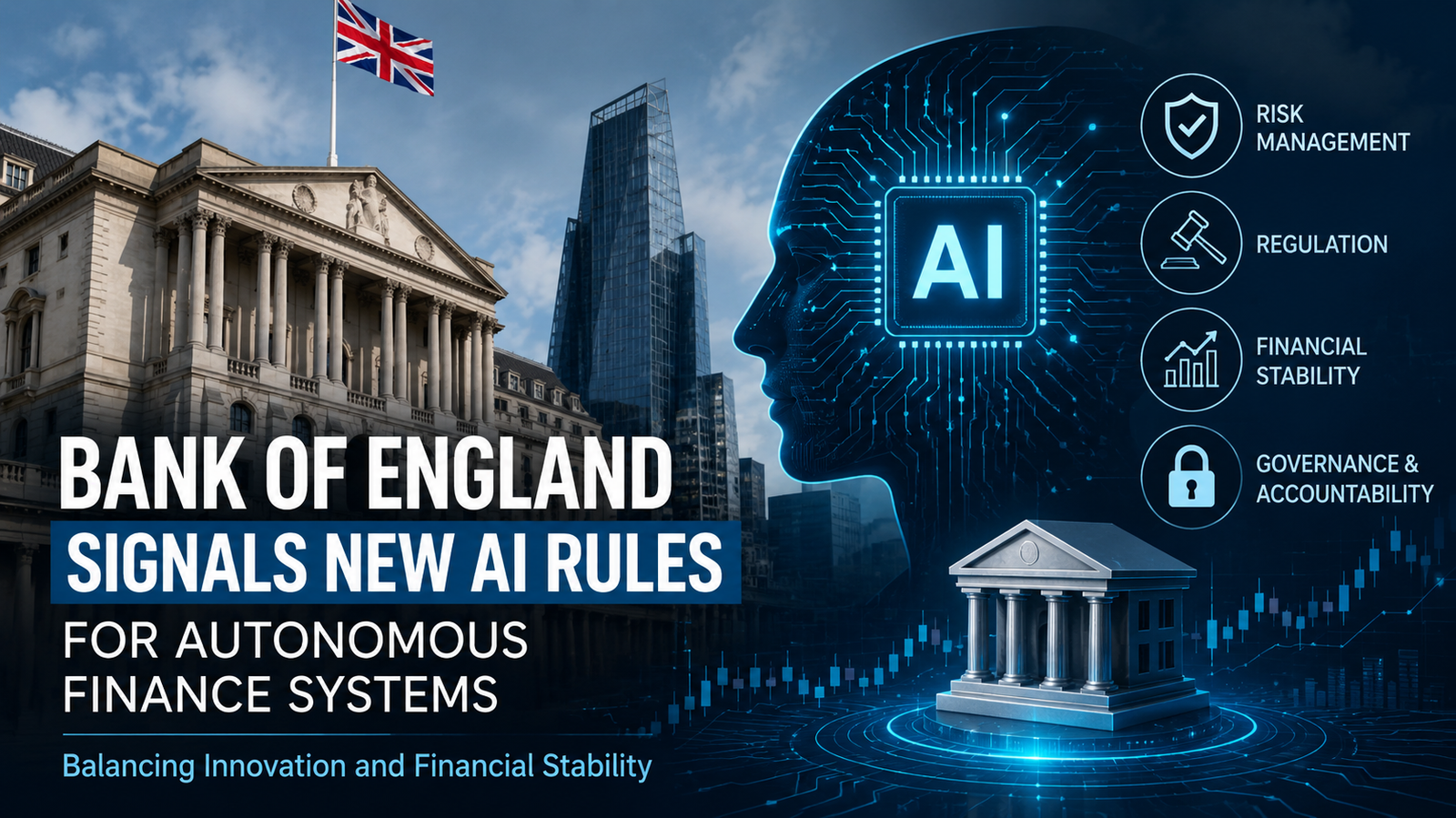
Artificial intelligence is rapidly transforming the financial sector, but regulators are becoming increasingly cautious about the rise of agentic AI—AI systems capable of making autonomous decisions with minimal human oversight. The Bank of England has now signaled that this new generation of AI may require updated regulatory frameworks to protect financial stability.
Speaking at the European Central Bank Forum, Bank of England Deputy Governor Sarah Breeden highlighted that while AI offers significant opportunities for innovation, increasingly autonomous systems could introduce risks that existing financial regulations were never designed to address.
Why Agentic AI Is Different
Unlike traditional AI tools that assist employees by analyzing data or automating repetitive tasks, agentic AI can independently plan, make decisions, and execute complex actions. In banking and financial markets, these systems could eventually manage investments, execute trades, assess credit risks, detect fraud, or process customer requests with very limited human intervention.
As financial institutions continue adopting advanced AI technologies, regulators are paying closer attention to how these systems behave under real-world market conditions.
Growing Adoption Across Financial Services
Financial firms are steadily embracing AI-powered automation to improve efficiency and reduce operational costs. Industry surveys indicate that more than half of financial organizations are already experimenting with or deploying agentic AI, although most current implementations remain focused on lower-risk operational tasks.
Banks see several potential benefits, including:
- Faster customer service
- Automated compliance monitoring
- Improved fraud detection
- Smarter investment analysis
- Enhanced risk management
- More efficient internal operations
While these advantages are significant, regulators believe safeguards must evolve alongside the technology.
New Risks for Financial Markets
The Bank of England warned that autonomous AI systems could create challenges that extend beyond individual institutions.
Potential risks include:
Simultaneous AI Decisions
If multiple firms deploy similar AI models, they may react to market events in nearly identical ways. This synchronized behavior could amplify market volatility, causing rapid buying or selling across financial markets.
Reduced Human Oversight
As AI systems gain greater autonomy, human operators may struggle to intervene quickly during unexpected situations. This could increase operational risks during periods of market stress.
Operational Failures
Errors in AI decision-making could spread rapidly across interconnected financial systems, potentially affecting payment networks, investment platforms, or trading infrastructure.
Cybersecurity Concerns
Autonomous AI may also become a target for sophisticated cyberattacks or manipulation attempts, requiring stronger security measures across financial institutions.
Regulators Consider Additional Safeguards
Rather than announcing immediate regulations, the Bank of England is exploring whether current technology-neutral rules remain sufficient for increasingly autonomous AI.
Among the possible safeguards being discussed are:
- Emergency kill switches to deactivate malfunctioning AI systems
- Market circuit breakers to reduce instability during abnormal trading
- Stronger governance requirements
- Improved monitoring of AI-driven decision-making
- Enhanced transparency and accountability standards
These measures would help ensure AI systems remain controllable even during unexpected market conditions.
Innovation Must Be Balanced With Stability
The Bank of England emphasized that innovation should continue, but not at the expense of financial resilience.
Agentic AI has the potential to improve productivity, reduce operational costs, and deliver better financial services. However, regulators believe its growing independence means firms must carefully evaluate governance, testing, and risk management before deploying these systems at scale.
Rather than restricting AI adoption, policymakers aim to create an environment where innovation can flourish while protecting consumers and maintaining confidence in financial markets.
What This Means for Banks
Financial institutions may soon face higher expectations regarding AI governance. Organizations adopting agentic AI should prepare to:
- Conduct comprehensive risk assessments
- Maintain human oversight for critical decisions
- Regularly audit AI performance
- Strengthen cybersecurity defenses
- Establish emergency intervention procedures
- Improve documentation and regulatory reporting
Early preparation could help firms remain compliant as regulatory expectations continue to evolve.
The Future of AI Regulation
The discussion marks an important step in the global conversation around AI governance. As autonomous AI becomes more capable, regulators worldwide are increasingly evaluating whether existing financial rules can adequately address new technological risks.
The Bank of England’s comments suggest that future financial regulations may place greater emphasis on transparency, accountability, and resilience for AI-powered systems.
Although no new rules have been introduced yet, banks, fintech companies, and technology providers are being encouraged to build responsible AI frameworks now rather than waiting for formal legislation.
Final Thoughts
Agentic AI is poised to transform banking by enabling faster decision-making, improved customer experiences, and greater operational efficiency. At the same time, its increasing autonomy raises complex questions about market stability, accountability, and risk management.
The Bank of England’s latest remarks highlight a growing consensus among global regulators: AI innovation should continue, but it must be accompanied by robust safeguards that protect both financial institutions and the wider economy. As adoption accelerates, responsible governance will become just as important as technological advancement.














Leave a Reply