

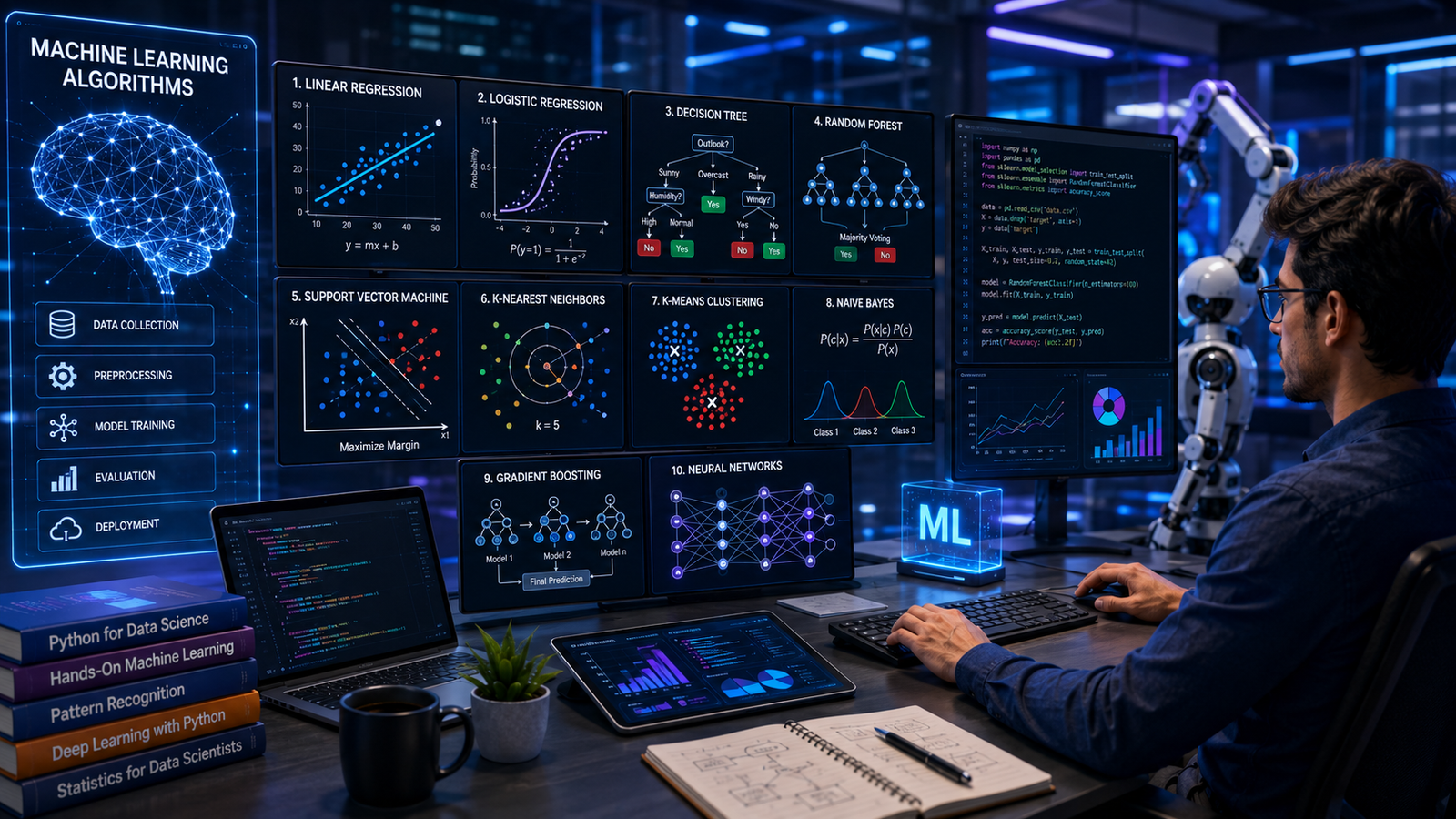
Machine learning has become the backbone of modern artificial intelligence, powering everything from recommendation engines and fraud detection systems to self-driving cars and medical diagnostics. As organizations continue investing heavily in AI, the demand for skilled data scientists has reached an all-time high. But while learning programming languages and data visualization tools is important, understanding machine learning algorithms is what truly separates a beginner from a capable data scientist.
Every successful machine learning project begins with choosing the right algorithm. The effectiveness of a predictive model depends not only on the quality of the data but also on selecting an algorithm that best fits the problem. Whether you’re predicting house prices, identifying fraudulent transactions, classifying customer feedback, or building intelligent recommendation systems, machine learning algorithms provide the mathematical foundation that makes these applications possible.
In 2026, machine learning continues evolving rapidly, but several core algorithms remain essential because of their reliability, flexibility, and widespread industry adoption. If you’re planning a career in data science or artificial intelligence, mastering these algorithms will prepare you for real-world projects across finance, healthcare, retail, manufacturing, cybersecurity, and many other industries.
Let’s explore the top machine learning algorithms every aspiring and professional data scientist should know.
1. Linear Regression
Linear Regression is often the first algorithm beginners encounter, and for good reason. Despite its simplicity, it remains one of the most widely used predictive models in business analytics.
This algorithm predicts continuous numerical values by identifying relationships between input variables and an output variable. Companies use linear regression for sales forecasting, demand prediction, stock market analysis, and property price estimation.
Understanding linear regression also teaches important concepts such as feature relationships, model evaluation, and prediction accuracy. Even experienced data scientists frequently rely on this algorithm because it provides highly interpretable results.
Where It’s Used
Real estate pricing, business forecasting, marketing analytics, financial modeling, and economic research all make extensive use of linear regression.
2. Logistic Regression
Although its name includes the word “regression,” Logistic Regression is primarily a classification algorithm.
Instead of predicting numerical values, it determines probabilities for categories such as yes or no, fraud or legitimate, spam or not spam, and disease or healthy.
Healthcare organizations use logistic regression for disease prediction, banks apply it to loan approval systems, and cybersecurity platforms employ it to detect suspicious activities.
Its speed, simplicity, and interpretability make it one of the most valuable classification algorithms for beginners and professionals alike.
3. Decision Tree
Decision Trees mimic human decision-making by asking a sequence of logical questions before reaching a conclusion.
Imagine a doctor diagnosing an illness by asking about symptoms one step at a time. Decision Trees work in much the same way.
They are easy to visualize and understand, making them especially useful when explainability is important.
Businesses frequently use decision trees for customer segmentation, credit approval, employee performance analysis, and medical diagnosis.
Why Data Scientists Love It
Decision Trees require minimal data preparation while producing highly interpretable decision paths.
4. Random Forest
Random Forest improves upon Decision Trees by combining multiple trees into a single, more accurate model.
Rather than relying on one decision tree that may overfit the data, Random Forest generates numerous trees and combines their predictions.
This significantly improves accuracy and reduces the risk of incorrect predictions.
Random Forest has become one of the most reliable machine learning algorithms for structured datasets and is widely used in healthcare, banking, insurance, manufacturing, and e-commerce.
Its balance between performance and simplicity explains why it remains popular in 2026.
5. Support Vector Machine (SVM)
Support Vector Machine excels when dealing with complex classification problems.
Instead of simply separating categories, SVM identifies the optimal boundary that maximizes the distance between different classes.
This makes it highly effective for image recognition, handwriting recognition, facial identification, medical diagnosis, and bioinformatics.
Although newer deep learning models have gained popularity, SVM remains valuable for many medium-sized datasets where computational efficiency matters.
6. K-Nearest Neighbors (KNN)
K-Nearest Neighbors follows a remarkably intuitive principle.
It predicts the category of a new data point by examining the categories of its closest neighboring examples.
If most nearby examples belong to one class, the new observation is assigned to that same category.
KNN performs well in recommendation systems, image classification, document categorization, and customer behavior analysis.
Because of its simplicity, it remains one of the best algorithms for learning the fundamentals of supervised machine learning.
7. K-Means Clustering
Unlike previous algorithms, K-Means is an unsupervised learning algorithm.
Instead of predicting predefined labels, it automatically groups similar data points into clusters based on shared characteristics.
Retail companies use K-Means to segment customers, marketers analyze consumer behavior, and researchers organize complex datasets without prior labeling.
Learning K-Means introduces data scientists to unsupervised learning, an increasingly important field in modern AI.
Common Applications
Customer segmentation, anomaly detection, recommendation systems, market research, and social media analysis frequently rely on clustering algorithms.
8. Naive Bayes
Naive Bayes is a probability-based algorithm that remains surprisingly powerful despite its mathematical simplicity.
It calculates the probability that a piece of information belongs to a particular category based on previous observations.
Email providers use Naive Bayes for spam detection, news platforms classify articles, and sentiment analysis systems evaluate customer opinions using this algorithm.
Its speed and efficiency make it particularly valuable when working with large text datasets.
9. Gradient Boosting Algorithms
Gradient Boosting represents one of the most successful approaches in modern machine learning competitions.
Algorithms such as XGBoost, LightGBM, and CatBoost build predictive models sequentially, continuously correcting errors made by previous models.
These algorithms frequently achieve exceptional performance on structured business datasets.
Financial institutions, insurance providers, online retailers, and technology companies often rely on gradient boosting to solve complex prediction problems.
In 2026, mastering at least one boosting algorithm has become an essential skill for aspiring data scientists.
10. Neural Networks and Deep Learning
Deep learning has transformed artificial intelligence by enabling machines to recognize images, understand speech, translate languages, generate content, and drive autonomous systems.
Artificial Neural Networks simulate interconnected neurons inspired by the human brain, allowing machines to learn highly complex patterns from enormous datasets.
Modern applications including voice assistants, autonomous vehicles, medical imaging, robotics, and generative AI all rely heavily on deep learning architectures.
Although neural networks require greater computational resources and larger datasets, they remain among the most influential machine learning technologies today.
Why Understanding Algorithms Matters More Than Memorizing Code
Many beginners focus heavily on learning programming syntax while overlooking the importance of algorithm selection.
In reality, successful data scientists spend far more time understanding business problems, preparing datasets, selecting appropriate algorithms, evaluating model performance, and interpreting results than writing complex code.
Knowing when to use Random Forest instead of Logistic Regression or K-Means instead of Decision Trees often determines the success of a machine learning project.
Strong algorithm knowledge also enables professionals to explain model behavior to business stakeholders, an increasingly valuable skill as AI adoption expands across industries.
Choosing the Right Algorithm for Every Project
No single machine learning algorithm works best for every problem.
Regression algorithms perform well when predicting numerical values, while classification algorithms handle categorical outcomes. Clustering techniques discover hidden structures within unlabeled datasets, and deep learning models excel at solving highly complex problems involving images, language, and speech.
Experienced data scientists frequently compare multiple algorithms before selecting the one that delivers the best combination of accuracy, speed, interpretability, and scalability.
The ability to make informed decisions based on data characteristics is one of the defining qualities of successful AI professionals.
Final Thoughts
Machine learning algorithms are the engines that power today’s intelligent systems. While new AI technologies continue emerging at an incredible pace, these foundational algorithms remain essential because they solve real-world problems across nearly every industry.
Whether you’re beginning your journey in data science or preparing for advanced AI roles, mastering these ten algorithms will provide a strong technical foundation that supports future learning in deep learning, generative AI, computer vision, natural language processing, and predictive analytics.
The best way to truly understand these algorithms is not by reading about them but by applying them to real datasets. Every project you complete strengthens your analytical thinking, improves your coding skills, and prepares you for solving meaningful business challenges.
As artificial intelligence continues transforming industries throughout 2026 and beyond, data scientists who deeply understand machine learning algorithms will remain among the most valuable professionals in the global technology workforce.






Leave a Reply