

Artificial intelligence is no longer just transforming businesses—it is reshaping how governments think about security, privacy, innovation, and human rights. From AI-powered healthcare and autonomous vehicles to generative chatbots and financial decision-making, AI has become deeply integrated into everyday life. But with rapid innovation comes an equally pressing question: Who regulates artificial intelligence, and how?
The answer depends on where you are in the world.
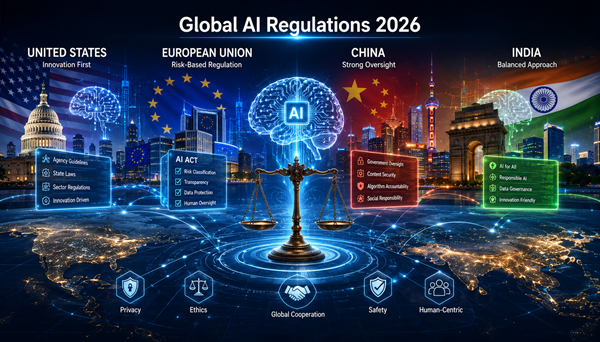
While the United States prioritizes innovation, the European Union focuses on risk-based regulation. China emphasizes state oversight and social responsibility, whereas India is taking a balanced approach that encourages AI innovation without imposing heavy regulations too early.
These different strategies are creating a global regulatory landscape that businesses, developers, startups, and investors must understand. Whether you’re building AI products, investing in AI companies, or simply interested in the future of technology, knowing how major economies regulate artificial intelligence has never been more important.
Why AI Regulation Matters More Than Ever
Artificial intelligence has incredible potential to improve lives, but it also introduces complex challenges. AI systems can generate misinformation, reinforce bias, make incorrect decisions, threaten cybersecurity, or misuse personal data. Governments worldwide are therefore working to establish rules that encourage innovation while protecting citizens.
The challenge lies in striking the right balance.
If regulations are too strict, innovation may slow, discouraging startups and investment. If regulations are too weak, society may face serious ethical, legal, and security risks. Every country is trying to find its own solution to this delicate balancing act.
1. United States: Innovation Comes First
The United States remains the global leader in AI research, venture capital investment, and frontier AI development. Home to companies such as OpenAI, Google, Microsoft, Anthropic, NVIDIA, and Meta, the country has largely favored an innovation-first approach.
Rather than introducing one comprehensive national AI law, the U.S. continues to rely on executive orders, agency guidelines, state-level legislation, and sector-specific regulations.
A Flexible Regulatory Model
Instead of regulating AI as a single technology, different government agencies oversee AI depending on where it is used.
Healthcare AI falls under health regulators.
Financial AI is supervised through financial agencies.
Consumer protection remains the responsibility of the Federal Trade Commission.
State governments are also introducing their own AI legislation, creating a dynamic but sometimes fragmented regulatory environment.
The Strengths and Challenges
This flexibility encourages startups and attracts investment. Companies can innovate rapidly without navigating extensive regulatory approval processes.
However, critics argue that inconsistent rules across states may create compliance challenges and leave important ethical issues unresolved.
2. European Union: Building the World’s Most Comprehensive AI Rulebook
The European Union has taken a very different path.
Rather than focusing primarily on innovation, the EU emphasizes trust, transparency, and citizen protection through its landmark AI Act.
The legislation establishes one of the world’s first comprehensive legal frameworks dedicated specifically to artificial intelligence.
A Risk-Based Classification System
Instead of treating every AI application equally, the EU classifies AI according to risk.
Low-risk applications face relatively few obligations.
High-risk systems used in healthcare, education, employment, banking, law enforcement, and critical infrastructure must meet extensive compliance requirements before deployment.
Certain AI applications considered unacceptable, including some forms of biometric surveillance and social scoring, face significant restrictions or outright bans.
Impact on Global Businesses
The AI Act reaches far beyond Europe.
Companies developing AI products for European customers must comply regardless of where they are headquartered.
This makes the EU’s regulatory model globally influential, much like GDPR reshaped international privacy standards.
3. China: Strong Government Oversight and AI Accountability
China has rapidly become one of the world’s largest AI innovators while simultaneously implementing some of the strictest AI governance policies.
Rather than allowing unrestricted development, Chinese authorities require companies to ensure AI systems align with national security, public interest, and social stability.
Rules for Generative AI
China has introduced detailed regulations governing generative AI platforms.
Developers must evaluate AI-generated content, prevent harmful information, protect user data, and maintain transparency regarding AI-generated outputs.
Companies are expected to conduct security assessments before launching certain AI services.
Regulating AI Companions
During 2025 and 2026, China also expanded oversight into emotionally interactive AI systems.
New rules require AI companion platforms to reduce emotional dependency, improve transparency, protect minors, and remind users they are interacting with artificial intelligence rather than humans.
These measures reflect China’s proactive approach to emerging AI technologies.
4. India: Encouraging Innovation While Building Responsible AI
India occupies a unique position in the global AI landscape.
Rather than immediately introducing strict AI legislation, the government has focused on encouraging innovation while gradually developing governance frameworks.
India aims to become both a major AI developer and one of the world’s largest AI adoption markets.
A Balanced Regulatory Philosophy
Indian policymakers recognize that premature regulation could slow startup growth and reduce international competitiveness.
Instead, India has emphasized responsible AI principles, digital public infrastructure, data governance, and sector-specific guidance while monitoring international regulatory developments.
Government initiatives continue supporting AI adoption across healthcare, agriculture, education, financial services, manufacturing, and public administration.
Looking Ahead
Industry experts expect India to introduce more comprehensive AI governance as adoption accelerates.
Future regulations will likely balance consumer protection with continued innovation rather than copying either the European or Chinese models entirely.
Comparing the Four Global AI Approaches
Although every country supports AI development, their regulatory priorities differ significantly.
The United States encourages rapid technological advancement through flexible oversight.
The European Union prioritizes ethics, transparency, and consumer protection.
China combines rapid innovation with extensive government supervision.
India seeks a middle path that promotes both innovation and responsible development.
These contrasting philosophies demonstrate that there is currently no universal blueprint for AI regulation.
How AI Regulations Affect Businesses
For multinational companies, navigating AI regulations is becoming increasingly complex.
An AI product launched globally may need different compliance procedures for Europe, separate documentation for China, distinct privacy practices for the United States, and localized governance measures for India.
Organizations must therefore build flexible compliance strategies capable of adapting to multiple legal frameworks simultaneously.
Companies investing in explainable AI, robust cybersecurity, responsible data governance, and transparent model development are likely to find compliance easier across jurisdictions.
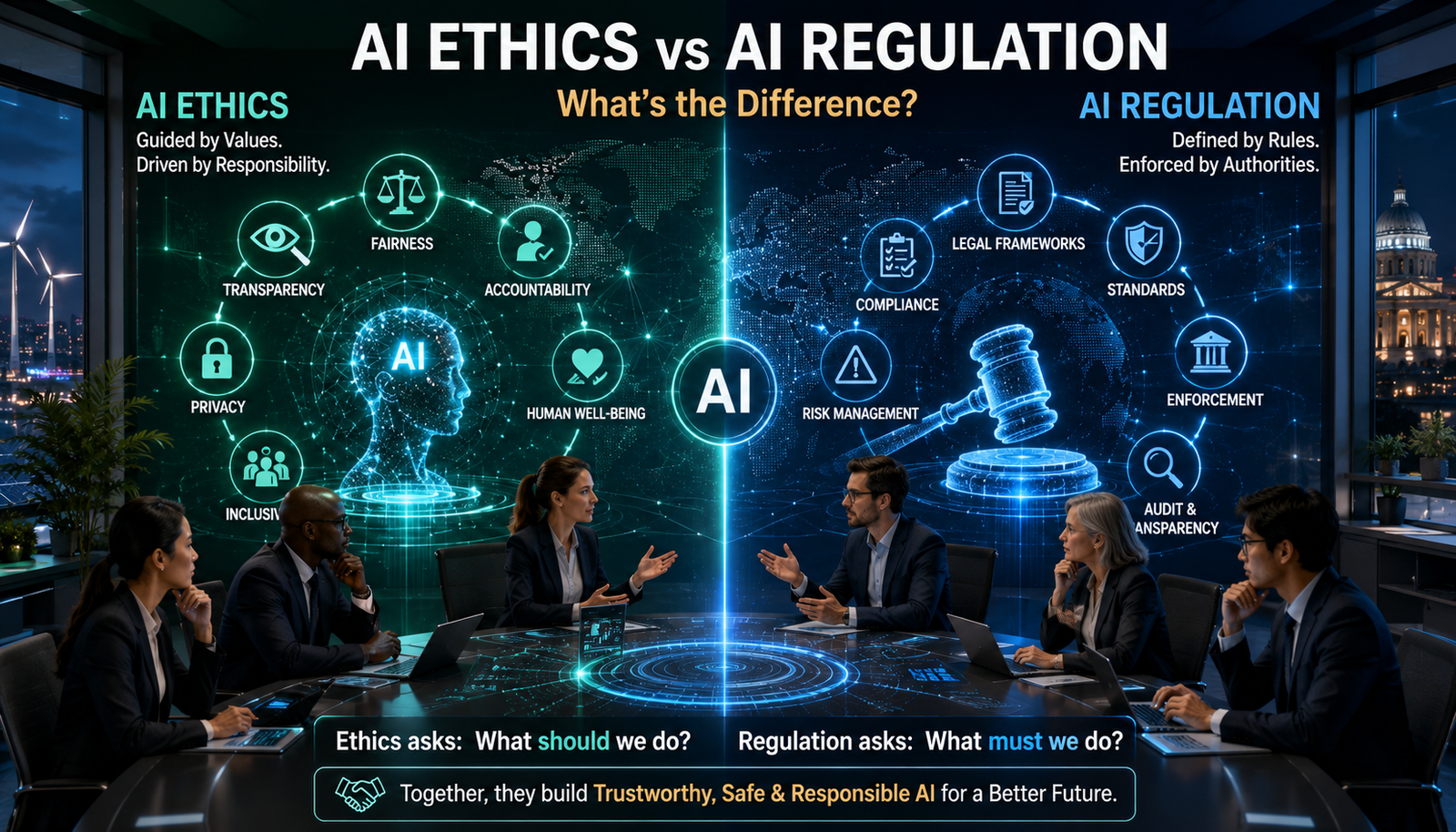
The Growing Importance of AI Ethics
Beyond legal requirements, AI ethics is becoming a competitive advantage.
Customers increasingly expect AI systems to be transparent, fair, accountable, and respectful of privacy.
Businesses that demonstrate responsible AI practices often build stronger customer trust, improve regulatory relationships, and reduce long-term legal risks.
Ethics is gradually shifting from a voluntary initiative into an essential business strategy.
What the Future Could Look Like
As artificial intelligence continues evolving, governments are unlikely to regulate it in isolation.
International cooperation may eventually lead to shared principles governing AI safety, cybersecurity, transparency, intellectual property, and cross-border data use.
Organizations such as the G7, G20, OECD, and the United Nations continue encouraging dialogue around global AI governance.
Although complete regulatory alignment remains unlikely, greater international coordination could reduce compliance complexity while promoting safer AI innovation.
Final Thoughts
Artificial intelligence is transforming nearly every industry, but regulation will ultimately shape how that transformation unfolds.
The United States continues championing innovation, the European Union leads in comprehensive legal oversight, China emphasizes state-controlled governance, and India pursues balanced growth through gradual policy development.
For businesses, understanding these differences is no longer optional. Regulatory awareness is becoming as important as technological expertise itself.
As AI becomes more deeply integrated into society during 2026 and beyond, companies that embrace responsible innovation, adapt to evolving regulations, and prioritize ethical development will be best positioned for long-term success.










Leave a Reply