

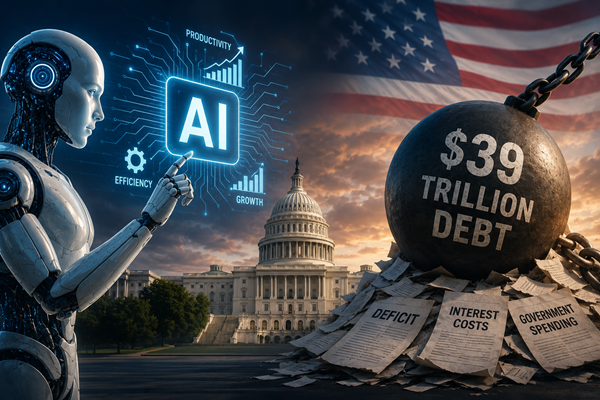
AI Is Being Viewed as a Potential Economic Game-Changer
As artificial intelligence continues to reshape industries, economists are exploring whether the technology could also help address one of the biggest financial challenges facing the United States—its nearly $39 trillion national debt. The idea is that AI could significantly increase productivity, accelerate economic growth, and strengthen government finances over the long term.
Higher Productivity Could Drive Faster Economic Growth
One of AI’s biggest advantages is its ability to automate repetitive tasks, streamline business operations, and improve workforce efficiency. If companies become more productive with AI, they can generate greater output without proportionally increasing costs. This productivity boost could translate into stronger GDP growth, creating a larger economy and increasing government tax revenues.
A Growing Economy Can Reduce the Debt Burden
Rather than focusing solely on the total amount of debt, economists often measure debt relative to a country’s Gross Domestic Product (GDP). If AI helps the economy expand at a faster pace, the debt-to-GDP ratio could gradually decline even if the overall debt continues to rise. A stronger economy also gives governments greater flexibility to manage borrowing and public spending.
AI Alone Cannot Eliminate the Debt Problem
While AI offers promising economic benefits, experts caution that it is not a complete solution to America’s debt crisis. The national debt is influenced by several factors, including government spending, tax policies, interest payments, and budget deficits. Without broader fiscal reforms, AI-driven growth alone is unlikely to erase the country’s massive debt burden.
Automation Could Create New Economic Challenges
The widespread adoption of AI may automate certain jobs, leading to workforce disruption in some sectors. Governments could face additional costs through unemployment benefits, job retraining programs, and other social support measures. These expenses may reduce some of the financial gains generated by higher productivity.
Changing Tax Revenue Could Affect Government Finances
As businesses increasingly rely on AI and automation, governments may collect less revenue from payroll and income taxes if fewer workers are employed in traditional roles. Policymakers may need to modernize tax systems to ensure government revenues remain sustainable in an AI-driven economy.
The Benefits of AI Will Take Time to Materialize
AI adoption is still in its early stages across many industries. Businesses must invest in technology, integrate AI into their operations, and train employees before realizing its full productivity potential. As a result, the economic impact of AI is expected to unfold gradually over several years rather than providing an immediate solution.
Looking Ahead
Artificial intelligence has the potential to become a powerful driver of economic growth by improving productivity and expanding business output. However, while these gains could make America’s growing debt more manageable, AI is not a standalone answer to the country’s fiscal challenges. Long-term debt reduction will likely require a combination of technological innovation, responsible fiscal policy, and sustained economic growth.












Leave a Reply