

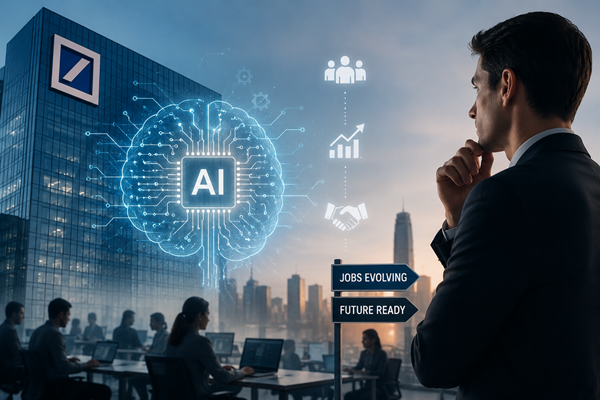
AI Will Boost Productivity, But Change Won’t Happen Overnight
Artificial intelligence is expected to become one of the biggest drivers of productivity in the coming years. However, according to Deutsche Bank’s Global Head of Macro and Thematic Research, Jim Reid, the economic impact of AI will take time to unfold. Businesses must first integrate AI into their operations, redesign workflows, and help employees adapt before meaningful productivity gains are reflected across the wider economy.
Historical Trends Shape His View on AI and Employment
Reid believes concerns about AI eliminating large numbers of jobs should be viewed in the context of history. He explained that his perspective is influenced by previous technological revolutions, which also sparked widespread fears of unemployment. Despite those concerns, past innovations ultimately created new industries, generated fresh employment opportunities, and reshaped the workforce rather than permanently reducing it.
Technology Has Repeatedly Changed the Workforce
From the Industrial Revolution to the rise of computers and the internet, major technological breakthroughs have transformed the nature of work. While automation replaced certain roles, it also created demand for new skills and occupations. Reid argues that AI is likely to follow a similar pattern, bringing significant changes to the labor market without necessarily causing long-term mass unemployment.
Businesses Need Time to Fully Harness AI
According to Reid, organizations are still in the early stages of adopting AI technologies. Companies need to invest in implementation, employee training, and operational changes before AI can deliver its full economic potential. As a result, productivity improvements are expected to emerge gradually rather than immediately.
AI Will Reshape Jobs More Than Replace Them
Rather than eliminating work altogether, AI is expected to automate repetitive tasks and improve efficiency across industries. This shift could allow employees to focus on higher-value responsibilities while creating demand for new roles centered on AI management, data analysis, and emerging technologies. Reid believes workforce adaptation will play a crucial role in determining how successfully economies benefit from AI.
The Debate Around AI and Jobs Continues
Reid’s comments come as governments, economists, and business leaders continue to debate AI’s long-term impact on employment. While some experts warn that rapid automation could disrupt millions of jobs, others believe AI will become a powerful tool for economic growth and innovation. Reid’s view aligns with the latter, suggesting that history offers reasons for optimism even as the transition may involve short-term challenges.
Looking Ahead
As AI adoption accelerates across industries, its influence on productivity and employment will remain under close observation. Although the technology is expected to reshape how people work, historical evidence suggests economies have consistently adapted to transformative innovations. According to Reid, AI is likely to become another chapter in that ongoing evolution rather than an unprecedented threat to employment.






Leave a Reply