

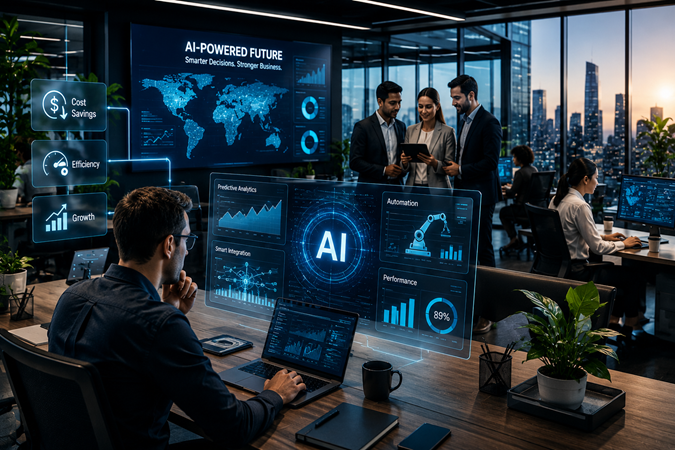
Businesses Are Switching to AI Software Faster Than Experts Expected
Only a few years ago, many companies viewed artificial intelligence as a future technology — promising, powerful, but still too experimental for large-scale adoption.
That assumption has changed dramatically.
In 2026, businesses across nearly every major industry are adopting AI software at a pace that has surprised even technology analysts and market researchers.
What began as isolated experiments with chatbots and automation tools has evolved into a widespread operational transformation affecting finance, healthcare, manufacturing, logistics, retail, cybersecurity, marketing, customer service, and software development.
Companies are no longer asking whether they should use AI.
Instead, most are now asking:
- How quickly can AI be integrated?
- Which workflows should be automated first?
- How can businesses remain competitive during rapid AI adoption?
The speed of the transition is remarkable because large businesses traditionally adopt new technologies slowly due to cost, security concerns, training requirements, and operational complexity.
But AI adoption is accelerating much faster than earlier digital revolutions such as cloud computing, mobile transformation, or enterprise automation.
Several factors are driving the shift simultaneously:
- Generative AI breakthroughs
- Falling software costs
- Cloud-based AI tools
- Competitive pressure
- Labor shortages
- Productivity demands
At the same time, the rapid rise of AI software is reshaping how companies operate, how employees work, and how entire industries compete.
Here is why businesses are switching to AI software faster than experts expected — and what this means for the future of the global economy.
AI Has Become Easier to Use Than Earlier Enterprise Technologies
One major reason AI adoption accelerated so quickly is accessibility.
Previous generations of enterprise software often required:
- Large IT departments
- Expensive infrastructure
- Long implementation timelines
- Specialized technical expertise
Modern AI tools are significantly easier to deploy.
Cloud-based platforms now allow businesses to integrate AI capabilities through:
- APIs
- Subscription software
- AI assistants
- No-code automation platforms
- Workflow integrations
Many AI systems can be implemented within days rather than months.
This dramatically lowers the barrier to adoption for both large enterprises and small businesses.
Generative AI interfaces using natural language have also made AI accessible to non-technical employees.
Workers no longer need advanced programming skills to use powerful AI systems.
Generative AI Triggered a Massive Shift in Business Strategy
The release of advanced generative AI systems in the early 2020s fundamentally changed business attitudes toward AI.
Large language models demonstrated capabilities that many executives had not expected to arrive so quickly.
Businesses suddenly realized AI could:
- Write reports
- Generate marketing content
- Analyze data
- Assist coding
- Handle customer support
- Summarize documents
- Automate administrative tasks
Executives increasingly saw AI not as a niche technical tool, but as a broad productivity platform capable of affecting nearly every department.
This triggered what many analysts describe as an AI adoption race.
Companies fear competitors gaining major efficiency advantages through AI-driven operations.
As a result, businesses are deploying AI software aggressively to avoid falling behind.
Businesses Are Using AI to Reduce Operational Costs
Cost reduction remains one of the biggest drivers behind rapid AI adoption.
Businesses face increasing pressure from:
- Inflation
- Economic uncertainty
- Rising labor costs
- Global competition
AI software offers companies opportunities to automate repetitive workflows and reduce operational expenses.
Organizations increasingly use AI for:
- Data entry
- Customer support
- Scheduling
- Invoice processing
- Content creation
- Inventory management
- Internal reporting
Even modest productivity gains can produce enormous financial savings at enterprise scale.
For many companies, AI adoption is no longer viewed as optional innovation. It is increasingly viewed as an operational necessity.
Customer Service Is Becoming AI-Driven
Customer support has become one of the fastest-changing areas of business operations.
Modern AI-powered support systems are far more sophisticated than earlier chatbots.
Today’s AI customer agents can:
- Understand natural language
- Handle complex requests
- Provide multilingual support
- Resolve common issues automatically
- Operate continuously 24/7
Businesses increasingly deploy AI systems to manage high volumes of routine customer interactions.
This allows human support staff to focus on:
- Escalated cases
- Emotional interactions
- Complex problem-solving
- Relationship management
AI-driven customer support significantly reduces wait times and operational costs while improving scalability.
As AI language systems continue improving, many companies expect even larger portions of customer service operations to become automated.
AI Is Transforming Software Development
Software engineering is experiencing one of the fastest AI-driven productivity shifts.
AI coding assistants now help developers:
- Generate code
- Debug software
- Automate testing
- Write documentation
- Suggest optimizations
This significantly accelerates software development workflows.
Small teams can now build products faster than before, while larger organizations improve engineering efficiency.
AI-assisted coding also lowers barriers for startups and smaller companies competing with larger firms.
Many experts believe AI-enhanced software development may permanently reshape the structure of the tech industry.
Marketing Departments Are Rapidly Adopting AI
Marketing has become another major area of AI adoption.
Businesses increasingly use AI systems to:
- Create content
- Analyze audiences
- Generate advertisements
- Optimize campaigns
- Personalize customer experiences
AI allows marketing teams to produce content at massive scale while analyzing consumer behavior in real time.
Companies can now automate:
- Email campaigns
- Social media scheduling
- Product recommendations
- SEO optimization
- Advertising analytics
Businesses view AI-driven marketing as a major competitive advantage in increasingly crowded digital markets.
AI Is Changing How Executives Make Decisions
Executives increasingly rely on AI-driven analytics systems for strategic planning and operational management.
AI tools now help leaders analyze:
- Market trends
- Financial forecasts
- Consumer behavior
- Operational risks
- Supply chain disruptions
Machine learning systems can process enormous datasets much faster than traditional reporting methods.
This allows companies to react to changing market conditions more quickly.
Some organizations now integrate AI directly into executive dashboards and planning systems.
However, experts warn that businesses still require human oversight because AI systems can produce errors, hallucinations, or biased outputs.
Supply Chains Are Becoming AI-Powered
Global supply chains remain vulnerable to disruptions caused by:
- Geopolitical tensions
- Climate disasters
- Shipping delays
- Economic instability
Businesses increasingly use AI software to improve supply chain resilience and forecasting.
AI systems can:
- Predict demand
- Optimize inventory
- Monitor shipping routes
- Forecast disruptions
- Improve warehouse operations
Some warehouses now use AI-powered robotics capable of handling logistics operations with minimal human supervision.
Companies believe AI-driven supply chains will become critical competitive advantages in global commerce.
Smaller Businesses Are Adopting AI Faster Than Expected
One surprising trend is how rapidly small businesses are adopting AI software.
In earlier technology revolutions, advanced enterprise systems were often limited to large corporations with major budgets.
Today, affordable cloud-based AI tools allow smaller businesses to access powerful capabilities previously available only to large enterprises.
Small companies now use AI for:
- Customer support
- Marketing automation
- Website creation
- Data analysis
- Content generation
- Business operations
This democratization of AI is increasing competition across many industries.
Small teams can now operate with efficiency levels once requiring much larger organizations.
Employees Are Increasingly Working Alongside AI
Rather than replacing all workers immediately, many businesses are redesigning workflows around human-AI collaboration.
Employees increasingly use AI systems as productivity assistants for:
- Research
- Writing
- Analysis
- Task management
- Decision support
This is changing workplace expectations rapidly.
Companies increasingly seek workers with:
- AI literacy
- Data analysis skills
- Critical thinking abilities
- Adaptability
Many experts believe future workplaces will involve continuous interaction between human employees and AI systems.
Businesses Fear Falling Behind Competitors
Competitive pressure is one of the strongest forces accelerating AI adoption.
Executives increasingly worry that companies using AI more effectively could gain major advantages in:
- Productivity
- Customer experience
- Pricing
- Innovation speed
- Operational efficiency
This creates powerful incentives for rapid implementation.
Even organizations uncertain about long-term AI impacts often feel pressured to adopt AI quickly because competitors are doing the same.
Some analysts compare the current AI race to the early internet era, where businesses feared becoming irrelevant if they failed to adapt.
Cybersecurity and Regulation Are Growing Concerns
The rapid rise of AI software is also creating serious challenges.
Businesses increasingly worry about:
- Data privacy
- Cybersecurity threats
- AI-generated misinformation
- Intellectual property risks
- Regulatory uncertainty
Governments worldwide are debating rules involving:
- AI transparency
- Bias prevention
- Consumer protection
- Employment impacts
- National security
At the same time, cybercriminals are increasingly using AI for phishing attacks, fraud, and automated cybercrime.
This is turning cybersecurity into one of the most important aspects of enterprise AI adoption.
AI Adoption Is Happening Faster Than Earlier Technology Revolutions
Experts increasingly believe AI may represent one of the fastest enterprise technology adoption cycles in modern history.
Several factors explain the acceleration:
Cloud Infrastructure
Businesses no longer need massive infrastructure investments.
Natural Language Interfaces
AI systems became easier for non-technical users.
Remote Work Digitalization
The pandemic accelerated digital workflow adoption.
Competitive Pressure
Companies fear losing market share to faster adopters.
Falling Costs
AI software continues becoming cheaper and more scalable.
Together, these forces are driving AI adoption at unprecedented speed.
The Future of Business Operations May Never Look the Same
Businesses are rapidly transitioning from experimental AI usage toward deeply integrated AI-driven operations.
Entire workflows are increasingly becoming automated or AI-assisted.
Industries that adapt quickly may gain enormous productivity advantages.
Those that move too slowly risk falling behind competitors using AI more effectively.
At the same time, the rapid shift raises important societal questions involving:
- Employment
- Economic inequality
- Digital dependence
- Human oversight
- Long-term workforce transformation
The full impact of widespread AI adoption may take years to fully understand.
Conclusion
Businesses are switching to AI software faster than experts expected because the technology has become more powerful, accessible, and economically valuable at extraordinary speed.
Generative AI, automation platforms, cloud infrastructure, and machine learning systems are fundamentally reshaping how companies operate.
Organizations increasingly use AI to:
- Reduce costs
- Improve productivity
- Enhance customer experiences
- Accelerate decision-making
- Scale operations more efficiently
At the same time, rapid AI adoption is transforming labor markets, workplace structures, cybersecurity, and global competition.
In 2026, one reality is becoming increasingly impossible for businesses to ignore:
Artificial intelligence is no longer a future business trend — it is rapidly becoming the operational foundation of the modern economy.


Leave a Reply