

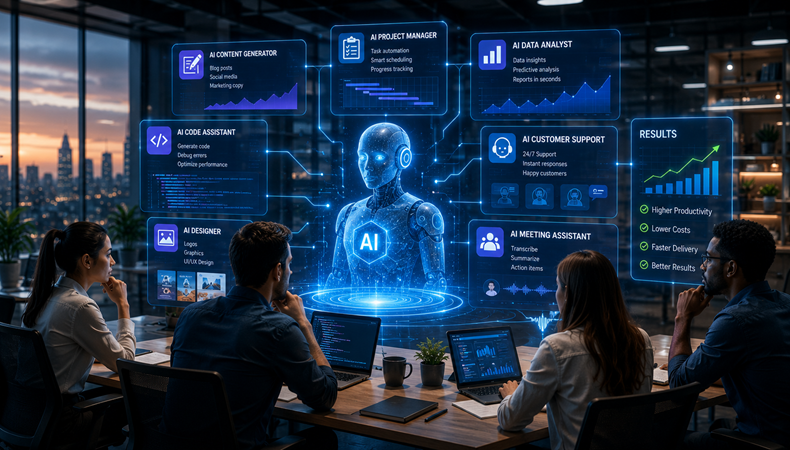
Artificial intelligence apps are evolving so quickly that many businesses are struggling to keep up.
In 2026, the most advanced AI applications are no longer limited to answering questions or generating simple text. Modern AI systems can now perform complex workflows that previously required entire teams of employees working across multiple departments.
Some AI apps can:
- Write reports
- Analyze massive datasets
- Create marketing campaigns
- Generate software code
- Conduct research
- Automate workflows
- Manage meetings
- Handle customer support
- Design visuals
- Coordinate projects
The speed of improvement has surprised even many AI experts.
What once required specialized software suites, multiple employees, and long production cycles can now often be completed by a single person working alongside powerful AI tools.
Businesses are increasingly restructuring operations around AI-powered workflows because these apps offer:
- Faster execution
- Lower operational costs
- Scalable productivity
- 24/7 availability
- Advanced automation
At the same time, the rapid rise of AI applications is reshaping industries, changing workforce expectations, and creating major debates about the future of human work.
Here are the most powerful AI apps right now — and why they can do more than many traditional teams.
ChatGPT Has Become a Multi-Purpose Business Engine
ChatGPT remains one of the most versatile AI applications available in 2026.
What began primarily as a conversational chatbot has evolved into a powerful productivity platform capable of handling a wide range of business functions.
Companies and professionals use ChatGPT for:
- Writing reports
- Generating marketing content
- Research and analysis
- Coding assistance
- Data interpretation
- Workflow planning
- Presentation creation
- Customer communication
Modern versions integrate:
- Voice interaction
- Image generation
- Document analysis
- Web search
- Code execution
- Custom AI agents
Many businesses now use ChatGPT as an operational assistant across multiple departments simultaneously. :contentReference[oaicite:0]{index=0}
Some employees report that AI-assisted workflows allow them to complete tasks that previously required entire support teams.
Claude Is Becoming a Research and Writing Powerhouse
Claude, developed by Anthropic, has become especially popular among professionals handling complex reasoning, long-form writing, and document-heavy workflows.
Claude is widely known for:
- High-quality writing
- Long-context analysis
- Structured reasoning
- Large document processing
- Coding support
Its massive context window allows users to analyze:
- Entire contracts
- Research papers
- Large codebases
- Business reports
- Lengthy meeting transcripts
Professionals increasingly use Claude for tasks that once required analysts, editors, researchers, or consultants working together. :contentReference[oaicite:1]{index=1}
Anthropic has also expanded enterprise AI capabilities, including security-focused tools designed for large organizations. :contentReference[oaicite:2]{index=2}
Microsoft Copilot Is Embedding AI Into Everyday Office Work
Microsoft 365 Copilot is transforming how businesses use traditional office software.
Instead of employees manually managing spreadsheets, emails, presentations, and meeting notes, Copilot automates many workplace workflows directly inside Microsoft applications.
Copilot can:
- Summarize meetings
- Analyze spreadsheets
- Generate PowerPoint presentations
- Draft emails
- Create reports
- Automate document workflows
Because it integrates directly into tools employees already use daily, businesses are adopting it rapidly. :contentReference[oaicite:3]{index=3}
Microsoft researchers report that AI copilots are increasingly handling higher-level cognitive tasks rather than simple automation. :contentReference[oaicite:4]{index=4}
For many organizations, Copilot is reducing administrative workloads across entire departments.
Perplexity Is Changing Online Research
Perplexity AI has emerged as one of the most influential AI-powered research tools.
Unlike traditional search engines that provide lists of links, Perplexity delivers:
- Direct research summaries
- Cited answers
- Real-time web analysis
- Multi-source synthesis
- Research assistance
Researchers, analysts, journalists, consultants, and business professionals increasingly use Perplexity to accelerate information gathering and market analysis.
The platform’s ability to synthesize complex information quickly allows individuals to perform research tasks that previously consumed hours of manual investigation. :contentReference[oaicite:5]{index=5}
Some analysts believe AI-powered research assistants could eventually disrupt traditional search engines and research workflows across many industries.
Cursor AI Is Transforming Software Development
Cursor AI has become one of the fastest-growing AI coding environments in the world.
Unlike earlier coding assistants that primarily generated snippets of code, Cursor can:
- Understand large codebases
- Perform multi-file edits
- Refactor software
- Debug applications
- Assist with architecture planning
- Coordinate coding workflows
Some developers now describe AI coding environments as “AI engineering partners” rather than simple assistants.
Cursor’s agent-first architecture allows multiple AI agents to work simultaneously across projects. :contentReference[oaicite:6]{index=6}
This dramatically increases developer productivity and allows smaller teams to build complex software faster than before.
Research studies increasingly show measurable productivity gains from AI-assisted software development. :contentReference[oaicite:7]{index=7}
Notion AI Is Becoming a Team Knowledge System
Notion AI combines note-taking, project management, documentation, and AI automation into a unified workspace.
Businesses increasingly use Notion AI for:
- Meeting summaries
- Knowledge management
- Task generation
- Content drafting
- Project coordination
- Internal documentation
Instead of manually organizing company information across disconnected systems, AI-powered knowledge tools centralize and automate large parts of operational coordination.
Some startups now operate with extremely lean management structures because AI-powered collaboration platforms reduce administrative overhead. :contentReference[oaicite:8]{index=8}
AI Meeting Assistants Are Replacing Administrative Work
AI meeting assistants have become essential productivity tools for many businesses.
Platforms such as:
- Otter.ai
- Fireflies.ai
- Zoom AI Companion
can now:
- Transcribe meetings
- Generate summaries
- Create action items
- Track follow-ups
- Analyze conversations
- Organize meeting records
This replaces many repetitive administrative workflows that once required dedicated coordination staff.
AI meeting tools are increasingly integrated directly into broader enterprise productivity systems. :contentReference[oaicite:9]{index=9}
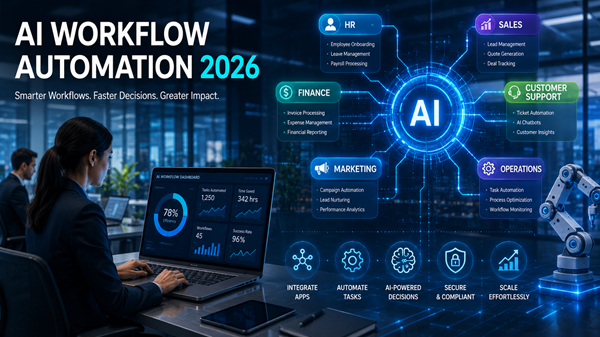
AI Automation Platforms Can Coordinate Entire Workflows
Modern AI automation systems are becoming capable of managing complex operational processes.
Platforms like:
- Zapier AI
- Make
- n8n
- Workato
allow businesses to automate workflows across dozens of software applications simultaneously.
These systems can:
- Move data between platforms
- Trigger automated actions
- Generate reports
- Coordinate tasks
- Manage customer workflows
- Handle operational processes
Many companies are now replacing repetitive operational coordination work with AI-driven automation systems.
The rise of “agentic AI” is accelerating this trend even further. :contentReference[oaicite:10]{index=10}
AI Design Tools Are Replacing Parts of Creative Teams
AI creative tools are transforming design, marketing, and content production workflows.
Apps such as:
- Midjourney
- DALL·E
- Runway AI
- Canva AI
- Adobe Firefly
can now generate:
- Images
- Videos
- Presentations
- Social media graphics
- Brand assets
- Marketing visuals
Tasks that once required multiple designers and editors can increasingly be completed by smaller creative teams working alongside AI systems.
Businesses now produce visual content at scales that were previously difficult or expensive to achieve.
AI Apps Are Becoming Enterprise Operating Systems
One of the biggest changes in 2026 is that AI apps are no longer isolated tools.
Increasingly, businesses are integrating AI systems across entire organizations.
Modern enterprise AI platforms now combine:
- Communication
- Research
- Automation
- Analytics
- Workflow management
- Security
- Knowledge systems
Some companies are even allowing employees to build internal AI agents capable of performing specialized workflows autonomously. :contentReference[oaicite:11]{index=11}
This marks a major shift from traditional software toward AI-centered operational systems.
Why These AI Apps Are Advancing So Quickly
Several factors explain why AI apps are improving faster than many experts expected.
Massive Computing Power
Cloud infrastructure and AI chips have dramatically increased model capabilities.
Large Language Model Breakthroughs
Modern AI systems can reason, summarize, generate content, and process multimodal inputs.
Enterprise Investment
Businesses are investing billions into AI deployment and infrastructure.
Competitive Pressure
Technology companies are competing aggressively to dominate the AI market.
Data Scale
AI systems now train on enormous datasets involving text, images, code, audio, and video.
Together, these forces are creating one of the fastest software revolutions in history.
AI Apps Still Have Serious Limitations
Despite their impressive capabilities, modern AI apps are far from perfect.
AI systems can still:
- Generate false information
- Misinterpret context
- Produce biased outputs
- Struggle with complex judgment calls
- Fail unpredictably in unusual situations
Businesses also face growing concerns involving:
- Data privacy
- Cybersecurity
- Regulatory compliance
- Intellectual property
- Overreliance on automation
Researchers increasingly emphasize the importance of human oversight and AI governance systems. :contentReference[oaicite:12]{index=12}
The Future Workplace Could Look Very Different
The rise of powerful AI apps is changing how companies think about productivity and workforce structure.
Instead of expanding teams linearly, businesses increasingly scale operations through AI-assisted workflows.
Employees increasingly focus on:
- Strategic decision-making
- Creative oversight
- Human relationships
- AI supervision
- Workflow orchestration
Some experts believe future organizations may operate with much smaller teams supported by highly capable AI systems.
Others warn rapid AI adoption could create significant labor market disruption.
Either way, AI apps are already reshaping how modern work gets done.
Conclusion
The most powerful AI apps right now can perform tasks that previously required entire teams of employees across research, marketing, software development, operations, customer support, administration, and creative production.
Platforms like ChatGPT, Claude, Microsoft Copilot, Perplexity, Cursor AI, and Notion AI are becoming central operating systems for modern productivity.
Businesses increasingly rely on AI apps to:
- Increase efficiency
- Reduce operational costs
- Accelerate workflows
- Scale output rapidly
- Enhance decision-making
At the same time, the rise of these systems is transforming workforce expectations, management structures, and the global economy itself.
In 2026, one thing is becoming increasingly clear:
The most advanced AI apps are no longer simple software tools — they are evolving into digital workforces capable of reshaping entire industries.



Leave a Reply