

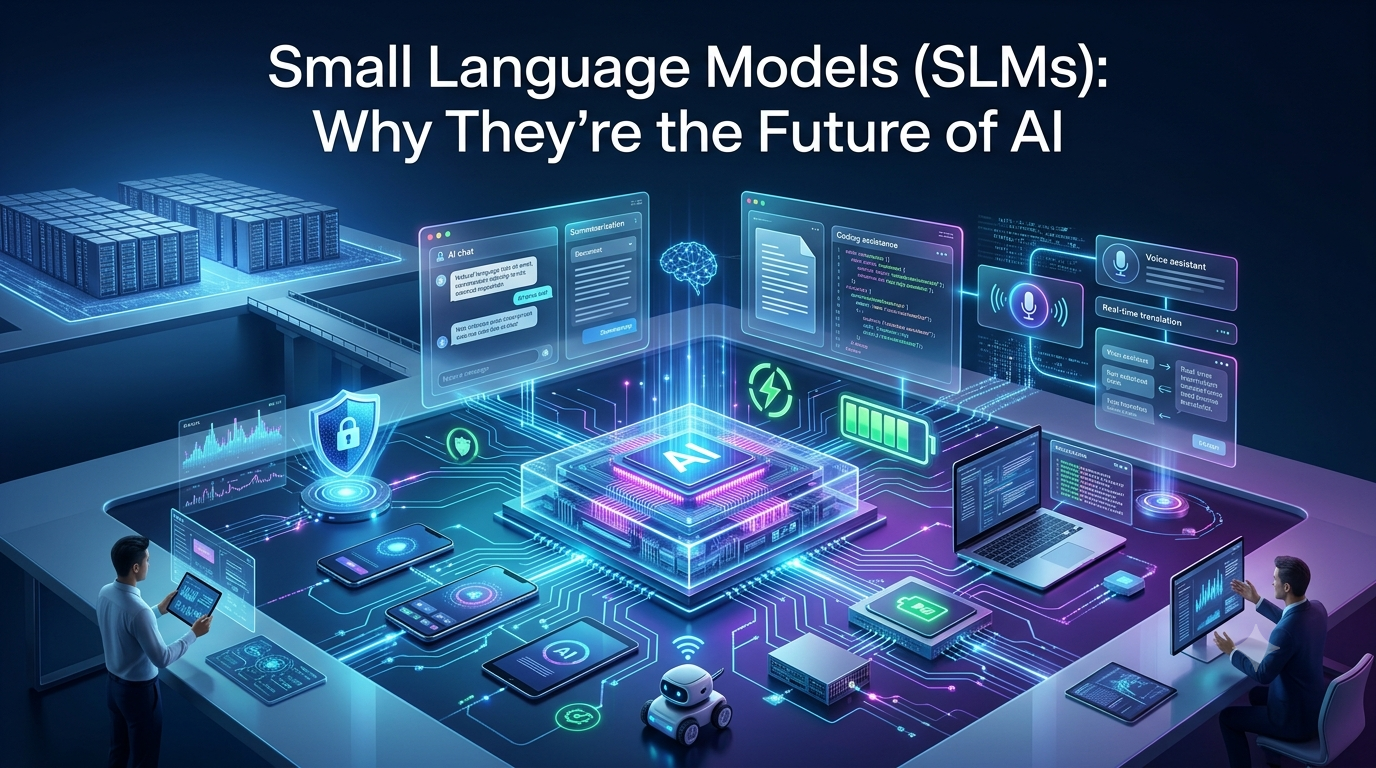
For years, the artificial intelligence industry followed one simple idea: bigger AI models create better results. Companies invested billions of dollars into developing increasingly large language models with billions or even trillions of parameters. These models transformed the way people write, code, research, analyze information, and interact with technology.
However, as AI adoption grows, a major challenge has become clear. The biggest models are not always the most practical choice.
Large AI models require expensive infrastructure, powerful GPUs, massive data centers, high energy consumption, and continuous cloud connectivity. For many real-world applications, businesses do not need an AI model that knows everything. They need an AI system that performs a specific task quickly, securely, and efficiently.
This shift has created demand for Small Language Models (SLMs).
Small Language Models are lightweight artificial intelligence models designed to deliver strong performance while using significantly fewer computing resources than traditional Large Language Models (LLMs). They can run on laptops, smartphones, edge devices, private servers, and business systems while offering faster responses, lower costs, and improved privacy.
In 2026, SLMs are becoming one of the most important developments in artificial intelligence because they make AI more accessible, practical, and deployable. Instead of relying only on massive cloud-based models, organizations are exploring smaller specialized AI systems that can perform specific tasks with greater efficiency.
From powering private business assistants and AI agents to enabling offline smartphone intelligence and smart devices, Small Language Models are changing how AI is built and deployed.
This complete guide explains what Small Language Models are, how they work, SLM vs LLM differences, why businesses are adopting them, popular SLMs in 2026, real-world applications, their role in AI agents, challenges, and why they could become the foundation of future AI systems.
What Are Small Language Models (SLMs)?
Small Language Models (SLMs) are artificial intelligence models designed with fewer parameters and lower computational requirements compared to Large Language Models.
Parameters are the internal values within an AI model that help it learn patterns, understand language, and generate responses. Large Language Models contain massive numbers of parameters because they are designed to handle a wide variety of tasks across different domains.
Small Language Models take a different approach. Instead of trying to become a general-purpose intelligence system, they are optimized for efficiency and specialization.
An SLM can perform many useful AI tasks, including:
- Text generation
- Summarization
- Question answering
- Translation
- Classification
- Document analysis
- Coding assistance
- Data extraction
- AI assistant functions
The main goal of SLM development is not simply creating a smaller version of a large model. The goal is building an AI system that provides the right level of intelligence for a specific purpose.
For example, a company creating an internal customer support assistant may not need a huge general AI model. A smaller model trained specifically on company documentation may provide faster and more accurate results while keeping sensitive information private.
Why Is AI Moving From Large Models to Small Language Models?
The rapid growth of AI has exposed several limitations of extremely large models.
Large AI systems are powerful, but they are expensive and complex to operate. Every request requires significant computing resources, which increases operational costs for companies using AI at scale.
For businesses, running millions of AI interactions every day using large models can become extremely expensive.
Another challenge is privacy. Many organizations cannot send confidential information, such as financial documents, medical records, legal files, or internal company data, to external cloud AI services.
Small Language Models solve many of these problems by bringing AI closer to where data is created.
Instead of sending information to remote servers, organizations can run AI locally on their own infrastructure.
This creates several advantages:
- Lower operational costs
- Faster response times
- Better privacy protection
- Easier customization
- More control over AI systems
The future of AI is moving away from the idea that one giant model should handle everything. Instead, the industry is moving toward specialized AI systems designed for specific tasks.
How Do Small Language Models Work?
Although SLMs are smaller than LLMs, they use many of the same fundamental AI technologies.
They are based on neural network architectures, especially transformer-based models, which allow AI systems to understand relationships between words, concepts, and information.
However, SLM developers use several optimization techniques to make these models smaller and more efficient.
Knowledge Distillation
Knowledge distillation allows developers to create smaller models by training them using knowledge from larger models.
A large AI model acts as a teacher, transferring its capabilities to a smaller student model.
The smaller model learns important patterns without needing the same size or complexity as the original model.
Quantization
Quantization reduces the amount of memory required by a model.
Instead of storing information using high-precision numbers, quantization converts model values into smaller formats.
This reduces hardware requirements and allows AI models to run on devices with limited memory.
Model Pruning
Pruning removes unnecessary connections within an AI model.
By eliminating less important information, developers can reduce model size while maintaining useful performance.
Fine-Tuning
Small models can be customized for specific tasks through fine-tuning.
For example, a business can train an SLM using internal documents to create an AI assistant that understands company-specific information.
These optimization methods allow modern SLMs to achieve impressive results despite having fewer parameters.
Small Language Models vs Large Language Models (SLMs vs LLMs)
Small Language Models and Large Language Models are designed for different purposes.
Large Language Models focus on broad intelligence. They are trained on enormous datasets and are capable of handling complex reasoning, creative writing, research, and advanced problem-solving.
Small Language Models focus on efficiency, specialization, and practical deployment.
| Feature | Small Language Models (SLMs) | Large Language Models (LLMs) |
|---|---|---|
| Model size | Smaller | Much larger |
| Computing requirements | Lower | Higher |
| Speed | Faster response time | Slower in many cases |
| Cost | Lower operational cost | More expensive |
| Privacy | Easier local deployment | Usually cloud-based |
| Customization | Easier for specific tasks | More complex |
| Best use cases | Specialized applications | General intelligence tasks |
The future will not be about choosing one over the other.
Instead, businesses will use both.
Large Language Models will handle complex reasoning and broad knowledge tasks, while Small Language Models will manage specialized workflows, local AI applications, and real-time tasks.
Why Small Language Models Are Becoming Important in 2026
1. Lower AI Deployment Costs
One of the biggest advantages of SLMs is affordability.
Large AI models require expensive hardware, powerful servers, and significant cloud computing resources.
Small Language Models can run on:
- Personal computers
- Smartphones
- Edge devices
- Private servers
- Enterprise systems
This allows smaller companies and developers to adopt AI without investing heavily in infrastructure.
Businesses can create practical AI solutions without paying large cloud AI costs for every interaction.
2. Better Privacy and Data Security
Privacy is becoming a major factor in AI adoption.
Many industries work with sensitive information that cannot easily be transferred to external platforms.
Healthcare providers, financial institutions, legal companies, and government organizations often require greater control over their data.
Because SLMs can run locally, organizations can process information inside their own environment.
This creates opportunities for secure AI applications where data remains private.
3. Faster AI Performance
Smaller models require fewer computing resources, which allows them to respond faster.
This is especially important for applications that require real-time decisions.
Examples include:
- Voice assistants
- Smart devices
- Customer service systems
- Industrial machines
- Mobile applications
A faster AI system creates a smoother user experience.
4. AI on Edge Devices
One of the biggest trends in technology is edge AI.
Instead of sending information to cloud servers, edge AI processes data directly on the device.
Small Language Models make this possible.
Future devices such as smartphones, smart cameras, vehicles, wearables, and industrial equipment will increasingly use lightweight AI models.
This enables intelligent features even without constant internet connectivity.
5. Easier AI Customization
Businesses often need AI systems trained for specific workflows.
A general AI model may provide broad knowledge, but a specialized SLM can perform better for a focused task.
Examples include:
- A legal document assistant
- A medical information assistant
- An internal company chatbot
- A financial analysis tool
Because SLMs are smaller, they are easier and cheaper to customize.
Popular Small Language Models in 2026
1. Microsoft Phi Series
Microsoft Phi models have become some of the most recognized small language models available.
The Phi family demonstrates that smaller models can deliver strong reasoning capabilities while maintaining efficiency.
They are designed for developers and researchers who need lightweight AI systems.
Best uses include:
- Local AI assistants
- Research projects
- Education tools
- Lightweight applications
2. Google Gemma
Google Gemma is a family of lightweight open models created for developers and researchers.
Gemma provides strong performance while remaining efficient enough for local deployment.
It is useful for:
- AI experiments
- Personal projects
- Business applications
- Developer tools
3. Meta Llama Small Models
Meta’s Llama ecosystem includes smaller models that allow developers to build flexible AI applications without requiring massive infrastructure.
These models are popular for:
- Chatbots
- AI assistants
- Content applications
- Research
4. Qwen Small Models
Alibaba’s Qwen models include efficient versions designed for strong multilingual performance.
They are useful for:
- Translation
- Business automation
- Multilingual applications
- Coding tasks
5. Mistral Small Models
Mistral AI focuses on efficient models that balance performance and resource usage.
They are commonly used for:
- AI assistants
- Business workflows
- Developer applications
Real-World Applications of Small Language Models
Small Language Models are becoming valuable because many real-world AI tasks do not require the complexity of the largest available models. Businesses and developers increasingly prefer smaller, specialized AI systems that can complete specific jobs faster, more securely, and at a lower cost.
1. Personal AI Assistants
One of the biggest future applications of SLMs is personal AI assistants that operate directly on user devices.
Instead of sending every request to cloud servers, smartphones and computers can run lightweight AI models locally.
These assistants can help with:
- Managing schedules
- Writing messages
- Summarizing documents
- Answering personal questions
- Organizing information
- Providing offline assistance
Local AI assistants powered by SLMs can offer better privacy because personal data does not need to leave the device.
2. Business Chatbots and Customer Support
Customer service is one of the strongest use cases for Small Language Models.
Companies can use specialized SLM-powered chatbots to answer common customer questions, retrieve information, and handle routine requests.
For example, an online store can deploy an AI assistant trained on:
- Product information
- Return policies
- Shipping details
- Customer support documents
Because the model is specialized, it can provide faster and more consistent answers compared to a general-purpose AI system.
3. Healthcare AI Applications
Healthcare organizations require AI systems that are powerful but also secure.
SLMs can support healthcare workflows by assisting with:
- Medical document analysis
- Administrative tasks
- Patient communication
- Internal knowledge systems
- Healthcare information retrieval
Since healthcare data is highly sensitive, the ability to run AI locally is a major advantage.
Small Language Models can help organizations improve efficiency while maintaining better control over private information.
4. Financial Services
The financial industry handles large amounts of sensitive information, making privacy and reliability essential.
SLMs can support financial organizations through:
- Document processing
- Compliance assistance
- Report generation
- Customer support
- Internal knowledge management
A financial company can create a specialized AI assistant trained on internal policies and financial documents without exposing confidential information to external systems.
5. Education and Personalized Learning
Education is another area where SLMs can create new possibilities.
Small AI models can power personalized learning assistants that help students understand concepts, answer questions, and provide feedback.
Schools and universities can use customized AI tutors trained on specific educational materials.
Because these models can operate with lower costs, AI-powered education tools become more accessible.
6. Coding Assistants
Developers are increasingly using smaller AI models for programming support.
Local coding assistants powered by SLMs can help with:
- Code completion
- Debugging
- Documentation generation
- Explaining programming concepts
- Reviewing code quality
Running coding models locally also provides privacy benefits for developers working with proprietary software.
7. Smart Devices and IoT
The growth of smart devices requires AI that can operate with limited resources.
SLMs can bring intelligence to:
- Smart appliances
- Security cameras
- Wearable devices
- Industrial equipment
- Automotive systems
Instead of depending completely on cloud processing, devices can make decisions locally.
This improves speed, reliability, and privacy.
Small Language Models and AI Agents
One of the most important developments in artificial intelligence is the rise of AI agents.
AI agents are systems that can understand goals, make decisions, use tools, and complete tasks automatically.
Many people assume AI agents always require the largest possible language models. However, this is not always practical.
Real-world AI agents often perform repeated, specialized tasks where efficiency matters more than general intelligence.
This is where Small Language Models become extremely valuable.
For example, an AI customer support agent may need different models for different tasks:
A small model can identify the customer’s intention.
Another model can search company documents.
A specialized model can classify the request.
A larger model may only be used for complex conversations that require advanced reasoning.
This approach creates a more efficient AI system.
Instead of using one expensive model for everything, companies can combine multiple specialized models to create smarter and more affordable AI agents.
Why SLMs Could Become the Engine Behind Agentic AI
The future of AI is expected to move toward multi-model systems where different AI models work together.
Large Language Models are excellent at:
- Complex reasoning
- Creative tasks
- Strategic planning
- General knowledge
Small Language Models are better suited for:
- Fast decisions
- Repetitive tasks
- Classification
- Data extraction
- Workflow automation
This creates a powerful combination.
A future AI agent may use a large model as a central decision-maker while using several smaller models to complete individual tasks.
For example, a marketing AI agent could include:
- Research model for collecting information
- Writing model for creating content
- SEO model for optimization
- Analytics model for performance tracking
This approach reduces costs while improving efficiency.
Small Language Models for Enterprise AI
Businesses are increasingly looking beyond simple AI chatbots.
They want AI systems that can integrate with existing workflows, understand company information, and automate daily operations.
SLMs are attractive for enterprises because they provide:
Lower Infrastructure Costs
Companies can deploy AI without depending entirely on expensive cloud computing.
Better Data Control
Sensitive business information can remain within company systems.
Custom AI Solutions
Organizations can create AI tools designed specifically for their needs.
Faster Deployment
Smaller models are easier to test, customize, and integrate.
For many businesses, a specialized SLM can deliver more practical value than a larger general-purpose AI model.
Small Language Models vs Traditional Automation
Traditional automation systems follow fixed rules.
For example:
“If a customer fills out a form, send an email.”
These systems work well for predictable processes but struggle with complex information.
SLMs introduce intelligence into automation.
They can understand:
- Human language
- Customer requests
- Documents
- Context
- User intent
This allows organizations to automate workflows that previously required human judgment.
Examples include:
- Sorting customer inquiries
- Analyzing documents
- Processing applications
- Generating reports
This combination of AI and automation is expected to become a major business trend.
Challenges of Small Language Models
Although Small Language Models provide many advantages, they also have limitations.
Limited General Knowledge
Because SLMs are smaller, they may not contain the same broad knowledge capabilities as large models.
They may struggle with highly complex questions requiring extensive reasoning.
Lower Performance on Advanced Tasks
Tasks such as scientific research, complex programming, and deep analysis may still require larger AI systems.
Training Challenges
Creating a high-quality small model requires careful optimization.
Developers must balance:
- Model size
- Accuracy
- Speed
- Hardware requirements
Maintenance Requirements
Organizations deploying private AI models must manage updates, security, and performance improvements.
However, improvements in AI optimization continue reducing these challenges.
Small Language Models vs Tiny AI Models
While Small Language Models are smaller than traditional LLMs, another category is emerging: Tiny AI models.
Tiny AI models are designed for extremely limited environments such as:
- Sensors
- Microcontrollers
- Wearable devices
- Embedded systems
The future AI ecosystem may include three layers:
Large Language Models
Used for:
- Advanced reasoning
- Research
- Creative work
Small Language Models
Used for:
- Business applications
- AI assistants
- Workflow automation
Tiny AI Models
Used for:
- IoT devices
- Sensors
- Embedded intelligence
Together, these models will create a more distributed AI ecosystem.
The Future of Small Language Models
The future of artificial intelligence will not simply be about creating bigger models.
It will be about creating smarter, more efficient, and more specialized AI systems.
Small Language Models are expected to become increasingly important because they solve many challenges associated with large AI models.
Future developments will likely include:
- More powerful local AI assistants
- AI running directly on smartphones and computers
- Better edge AI applications
- More private enterprise AI systems
- Specialized AI agents
- Hybrid AI systems combining multiple models
As hardware becomes more powerful and AI techniques improve, advanced AI capabilities will become available on everyday devices.
The next generation of AI will not only exist inside massive data centers. It will also exist inside phones, laptops, vehicles, appliances, and business systems.
Are Small Language Models the Future of AI?
Small Language Models are not replacing Large Language Models. Instead, they are solving a different problem.
Large models provide broad intelligence, while smaller models provide efficiency and specialization.
The future of AI will likely involve a combination of both.
A company may use a large model for strategic reasoning while using smaller models for daily operations.
A smartphone may use an SLM for personal assistance while connecting to larger models only when additional intelligence is required.
This hybrid approach will make AI faster, cheaper, and more accessible.
Conclusion
Small Language Models represent one of the most important shifts in artificial intelligence development.
For years, the AI industry focused on building increasingly larger models. However, real-world adoption requires more than intelligence. Businesses and users need AI systems that are affordable, private, fast, and practical.
SLMs solve these challenges by bringing powerful AI capabilities to laptops, smartphones, edge devices, and private business environments.
From customer support and healthcare to coding assistants, smart devices, and AI agents, Small Language Models are expanding where artificial intelligence can operate.
The future of AI will not be controlled only by the largest models. It will be shaped by a combination of large, small, and specialized AI systems working together.
As AI continues evolving in 2026 and beyond, Small Language Models are expected to become a foundation of everyday intelligence, making advanced AI more accessible to individuals, developers, and businesses worldwide.




Leave a Reply