

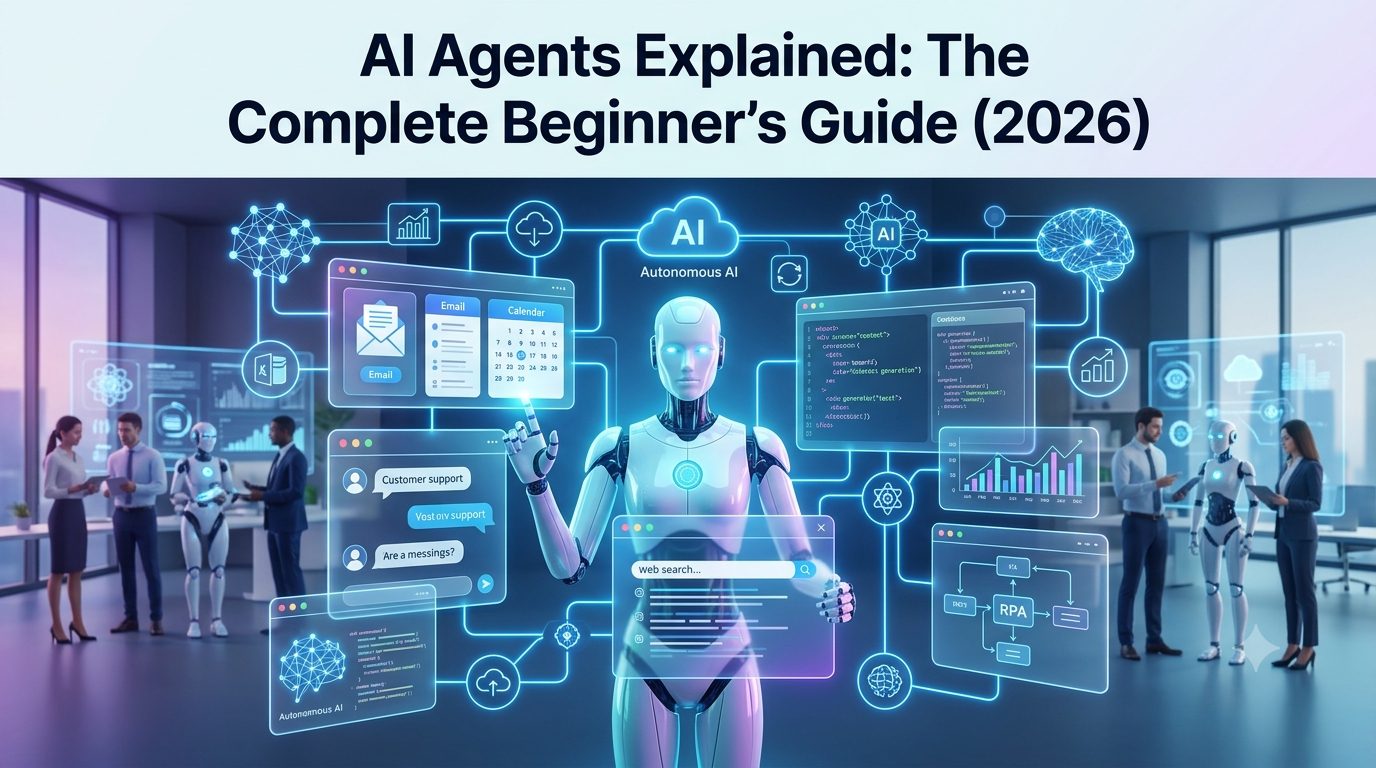
Artificial intelligence has evolved at an extraordinary pace over the past few years. What began as AI chatbots capable of answering questions and generating content has now transformed into intelligent systems that can reason, plan, use software tools, and complete complex tasks with minimal human guidance. In 2026, these intelligent systems are known as AI agents, and they represent one of the most significant advancements in modern AI.
Businesses of every size are rapidly adopting AI agents to automate repetitive work, improve customer experiences, increase productivity, and reduce operational costs. From startups managing marketing campaigns to enterprises automating customer support, research, software development, and business operations, AI agents are becoming an essential part of everyday workflows.
Unlike traditional AI assistants that respond to one prompt at a time, AI agents can work toward a broader objective. They understand goals, create plans, gather information, use external tools, evaluate results, and adapt their actions until the task is completed. Instead of simply generating answers, AI agents are capable of taking meaningful actions.
For example, imagine asking an AI to “plan a product launch.” Rather than just writing marketing copy, an AI agent can research competitors, identify target audiences, generate promotional content, create an email campaign, organize project timelines, analyze market trends, and provide regular progress updates—all while working toward the same objective.
This shift from conversational AI to action-oriented AI is transforming industries worldwide. As organizations increasingly embrace automation, understanding AI agents is becoming valuable for students, developers, entrepreneurs, marketers, business leaders, and anyone interested in the future of technology.
In this comprehensive beginner’s guide, you’ll learn what AI agents are, how they work, their key components, different types, real-world applications, benefits, limitations, future trends, and how businesses are using them to transform the way work gets done in 2026.
What Are AI Agents?
An AI agent is an intelligent software system designed to achieve specific goals by observing information, making decisions, planning actions, using digital tools, and completing tasks with limited human involvement.
Unlike traditional AI chatbots that primarily answer questions or generate text, AI agents can independently perform a sequence of actions to accomplish an objective. They combine reasoning, planning, memory, and tool usage to solve real-world problems more effectively.
Think of an AI chatbot as a knowledgeable assistant who answers your questions whenever you ask. An AI agent, on the other hand, behaves more like a capable coworker. Once you assign a goal, it determines the necessary steps, executes them, evaluates progress, and continues working until the objective is achieved.
For instance, instead of asking AI to summarize a single document, you could ask an AI agent to research an industry, compare competitors, analyze customer reviews, prepare a presentation, and generate a strategic report. The agent manages each step automatically while keeping the overall objective in mind.
This ability to reason, act, and adapt makes AI agents one of the most exciting developments in artificial intelligence.
Why AI Agents Matter in 2026
The growing popularity of AI agents is driven by the increasing demand for intelligent automation. Businesses are no longer looking for AI that simply generates text—they need AI that can complete meaningful work.
Organizations today manage enormous volumes of emails, customer inquiries, reports, meetings, documents, and repetitive administrative tasks. AI agents help automate these activities, allowing employees to focus on creative thinking, innovation, and strategic decision-making.
Several technological advancements have accelerated the rise of AI agents, including more capable large language models (LLMs), improved reasoning abilities, long-term memory systems, better integration with external software, and access to APIs that enable AI to interact with real business applications.
As a result, AI agents are now assisting with software development, customer support, marketing, finance, human resources, healthcare, education, cybersecurity, legal research, and countless other business functions.
Many experts believe that AI agents represent the next major evolution of artificial intelligence, following generative AI. Instead of merely producing content, they actively participate in completing work, making them significantly more valuable in professional environments.
What Is Agentic AI?
A term that has become increasingly common in 2026 is Agentic AI. While many people use it interchangeably with AI agents, Agentic AI refers to the broader concept of AI systems capable of acting independently to achieve goals.
Traditional generative AI focuses on producing outputs such as text, images, code, or videos in response to prompts. Agentic AI extends these capabilities by adding planning, reasoning, memory, decision-making, and autonomous execution.
In simple terms, generative AI creates content, while Agentic AI completes tasks.
For example, a generative AI model can write a marketing email. An AI agent powered by Agentic AI can research customer preferences, personalize the message, schedule its delivery, monitor engagement metrics, and recommend improvements for future campaigns.
This shift toward goal-oriented intelligence is transforming AI from a passive assistant into an active digital collaborator.
How Do AI Agents Work?
AI agents combine multiple artificial intelligence technologies into a unified system capable of solving complex problems.
Although different AI platforms use different architectures, most AI agents follow a similar workflow.
Step 1: Understanding the Goal
Every AI agent begins by receiving a clearly defined objective.
Instead of asking a single question, users typically assign a broader task.
For example:
“Research the best project management software for small businesses and prepare a comparison report.”
The AI first interprets what success looks like before taking action.
Step 2: Breaking the Goal into Smaller Tasks
Large objectives are divided into manageable subtasks.
For the example above, the AI agent may decide to:
- Identify leading project management platforms.
- Collect pricing information.
- Compare features.
- Analyze customer reviews.
- Evaluate strengths and weaknesses.
- Recommend suitable options.
Planning allows the AI agent to approach problems systematically rather than attempting everything at once.
Step 3: Gathering Information
Once a plan is created, the AI agent begins collecting relevant information.
Depending on its available permissions, it may search the web, analyze internal documents, access company databases, retrieve CRM records, examine spreadsheets, or read research papers.
Unlike traditional AI assistants that rely primarily on existing knowledge, AI agents often retrieve fresh information to improve accuracy.
Step 4: Using External Tools
One of the defining characteristics of AI agents is their ability to interact with software beyond simple conversation.
Modern AI agents can connect with:
- Search engines
- Email platforms
- Calendars
- Project management software
- CRM systems
- Cloud storage
- Databases
- APIs
- Productivity applications
- Analytics dashboards
For example, instead of reminding you to schedule a meeting, an AI agent can actually check calendars, identify available time slots, send invitations, and update everyone’s schedule automatically.
Step 5: Reasoning and Decision-Making
As new information becomes available, the AI evaluates multiple possibilities before deciding what to do next.
If the results do not fully satisfy the original objective, the agent adjusts its strategy, gathers additional information, or performs new actions.
This reasoning process allows AI agents to adapt rather than simply following fixed instructions.
Step 6: Delivering Results
After completing all required tasks, the AI agent generates a final output.
Depending on the objective, this could include a detailed report, completed workflow, software update, customer response, research summary, marketing campaign, or business recommendation.
The ability to complete entire workflows rather than isolated tasks is what distinguishes AI agents from conventional AI assistants.
The AI Agent Lifecycle
Although different AI systems use different implementations, most AI agents follow a continuous decision-making cycle.
Perceive → Plan → Act → Observe → Reflect → Improve
First, the agent gathers information from its environment. It then develops a strategy for completing the assigned goal. After executing one or more actions, it observes the results and evaluates whether the objective has been achieved. If improvements are needed, it adjusts its approach and repeats the cycle.
This continuous feedback loop enables AI agents to solve increasingly complex problems while adapting to changing conditions.
Core Components of an AI Agent
Behind every capable AI agent are several essential components working together.
Goal
Every agent requires a clearly defined objective. Without a goal, the AI cannot determine what actions should be prioritized.
Large Language Model (LLM)
The language model serves as the reasoning engine of the AI agent. It understands instructions, analyzes information, generates responses, and helps make informed decisions.
Memory
Memory enables AI agents to retain previous conversations, completed tasks, user preferences, and important contextual information.
Instead of treating every interaction as completely new, memory allows AI agents to provide more personalized and consistent assistance over time.
Planning Engine
Planning enables the AI to divide complicated projects into smaller, manageable steps.
Rather than solving everything simultaneously, the planning engine creates an organized workflow that increases efficiency and accuracy.
Tool Integration
Modern AI agents become significantly more powerful when connected to external applications.
These integrations allow them to search the internet, retrieve documents, send emails, update spreadsheets, generate reports, schedule meetings, and perform countless business tasks automatically.
Reasoning
Reasoning helps AI evaluate different approaches before selecting the most effective solution.
Instead of blindly following instructions, reasoning allows the AI to compare alternatives, recognize problems, and improve decision-making.
Feedback Loop
Every completed action provides new information.
AI agents continuously evaluate outcomes, identify errors, and refine their strategies until the desired objective is achieved.
Security and Guardrails
Organizations often implement permissions and safety controls to ensure AI agents only access authorized information and perform approved actions.
These guardrails reduce risks while allowing businesses to confidently automate important workflows.
AI Agents vs AI Chatbots vs AI Assistants
Many people use the terms AI chatbot, AI assistant, and AI agent interchangeably, but they represent different levels of intelligence and automation.
An AI chatbot is primarily designed for conversations. It answers questions, provides information, and responds to prompts. Most chatbots require users to guide every interaction and cannot independently complete complex tasks.
An AI assistant goes a step further by helping users perform productivity-related activities such as drafting emails, summarizing documents, creating presentations, or scheduling meetings. However, it still depends heavily on user instructions.
An AI agent is much more autonomous. It can understand an objective, create a plan, interact with external software, make decisions within defined boundaries, and complete multi-step workflows without requiring constant human input.
| Feature | AI Chatbot | AI Assistant | AI Agent |
|---|---|---|---|
| Answers Questions | ✓ | ✓ | ✓ |
| Understands Goals | Limited | Moderate | Advanced |
| Plans Tasks | ✗ | Limited | ✓ |
| Uses External Tools | Limited | ✓ | ✓ |
| Multi-Step Workflows | ✗ | Partial | ✓ |
| Long-Term Memory | Limited | Limited | ✓ |
| Autonomous Actions | ✗ | Limited | ✓ |
| Business Automation | Limited | Moderate | Extensive |
Simply put, chatbots answer questions, assistants help users complete individual tasks, while AI agents work toward achieving entire objectives.
Types of AI Agents
Different AI agents are built for different levels of intelligence, autonomy, and decision-making. Understanding these categories helps beginners appreciate how AI systems have evolved.
1. Simple Reflex Agents
Simple reflex agents respond immediately to predefined conditions without considering previous actions or future consequences.
For example, an email spam filter automatically blocks suspicious messages based on specific rules.
These agents are fast but cannot adapt to changing situations.
2. Model-Based Agents
Model-based agents maintain an internal understanding of their environment before making decisions.
Instead of reacting to every situation independently, they use stored information to make more informed choices.
Self-driving vehicles use similar concepts by continuously updating their understanding of surrounding traffic.
3. Goal-Based Agents
Goal-based agents evaluate multiple possible actions before selecting the one most likely to achieve a desired outcome.
Most modern AI productivity tools and business assistants belong to this category.
4. Utility-Based Agents
Utility-based agents compare several possible solutions and choose the one offering the greatest overall benefit.
These systems are commonly used in optimization problems involving logistics, finance, manufacturing, and resource allocation.
5. Learning Agents
Learning agents continuously improve their performance by analyzing previous experiences, user feedback, and historical outcomes.
The more they interact with users, the better they become at understanding preferences and delivering useful results.
Multi-Agent Systems Explained
One of the biggest trends in 2026 is the rise of multi-agent systems.
Instead of relying on one AI agent to complete every task, organizations now deploy multiple specialized agents that collaborate to achieve complex objectives.
For example, a software company might use:
- A Research Agent to gather requirements.
- A Planning Agent to organize development tasks.
- A Coding Agent to generate source code.
- A Testing Agent to identify software bugs.
- A Documentation Agent to prepare technical guides.
- A Review Agent to verify quality before deployment.
Each agent specializes in a specific role while sharing information with the others. This collaborative approach often produces more accurate and efficient results than relying on a single general-purpose agent.
What Is Model Context Protocol (MCP)?
As AI agents become more capable, they need reliable ways to connect with external tools and data sources. One emerging standard helping make this possible is the Model Context Protocol (MCP).
MCP provides a standardized method for AI models to securely access applications, databases, files, APIs, and business systems. Instead of building separate integrations for every tool, developers can use MCP-compatible connections that simplify communication between AI agents and software.
For businesses, this means AI agents can more easily interact with customer relationship management (CRM) platforms, project management tools, cloud storage, enterprise databases, and other workplace applications while maintaining consistency and security.
Although many users never interact with MCP directly, it plays an important role in making modern AI agents more useful, connected, and scalable.
Real-World Applications of AI Agents
AI agents are transforming almost every industry by automating repetitive work and assisting with complex decision-making.
1. Customer Support
Businesses use AI agents to answer customer questions, resolve support tickets, process returns, escalate complex issues, and provide assistance 24 hours a day.
2. Software Development
Developers rely on AI agents to write code, review pull requests, detect bugs, generate documentation, automate testing, and improve software quality.
3. Marketing
Marketing teams use AI agents to research competitors, generate blog posts, optimize SEO strategies, schedule social media campaigns, create advertisements, and analyze campaign performance.
4. Sales
Sales professionals use AI agents to qualify leads, prepare personalized outreach emails, update CRM systems, forecast revenue, and recommend follow-up actions.
5. Healthcare
Healthcare organizations use AI agents to simplify administrative tasks, schedule appointments, summarize medical records, assist with research, and improve operational efficiency.
6. Finance
Banks and financial institutions use AI agents to detect fraudulent activity, generate reports, analyze transactions, monitor risks, and automate customer service.
7. Human Resources
HR departments use AI agents to screen resumes, schedule interviews, answer employee questions, prepare onboarding documents, and manage internal knowledge bases.
8. Education
Teachers and students use AI agents for personalized tutoring, lesson planning, grading assistance, research support, language learning, and content creation.
9. E-commerce
Online retailers use AI agents to recommend products, manage inventory, respond to customer inquiries, optimize pricing strategies, and automate order processing.
10. Cybersecurity
Security teams use AI agents to detect suspicious activities, analyze threats, monitor networks, and respond to incidents more quickly.
Popular AI Agent Platforms in 2026
Several leading technology companies now offer AI agent capabilities for businesses and developers.
1. OpenAI
OpenAI provides advanced AI models capable of powering intelligent agents that can reason, use tools, automate workflows, and complete complex business tasks.
2. Anthropic
Anthropic focuses on building AI systems with strong reasoning capabilities and enterprise-grade safety features suitable for business automation.
3. Google
Google continues expanding AI agent functionality across its productivity applications, cloud services, and developer ecosystem.
4. Microsoft
Microsoft integrates AI agents into workplace productivity through Microsoft Copilot, enabling automation across documents, spreadsheets, meetings, and business applications.
5. Salesforce
Salesforce offers AI-powered agents that help organizations automate customer relationship management, sales processes, and service operations.
6. Amazon
Amazon provides AI-powered business assistants through AWS that support developers and enterprise customers with automation and cloud operations.
How Businesses Are Using AI Agents
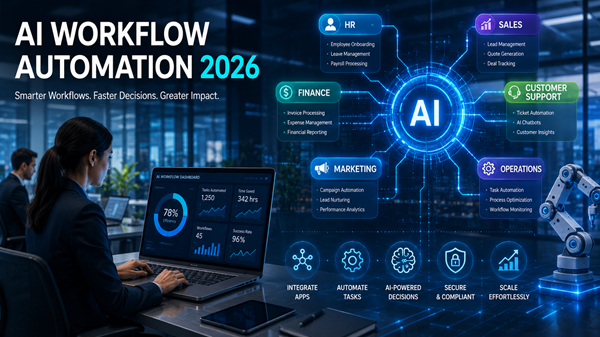
Businesses are increasingly adopting AI agents to improve productivity across departments.
Some common implementations include:
- Automating customer support operations.
- Managing internal knowledge bases.
- Processing invoices and financial documents.
- Conducting competitor research.
- Preparing weekly performance reports.
- Managing social media campaigns.
- Generating marketing content.
- Monitoring cybersecurity threats.
- Assisting software development teams.
- Automating employee onboarding.
Instead of replacing employees, AI agents often serve as digital coworkers that handle repetitive work while humans focus on strategic decision-making.
How to Build Your First AI Agent
Building an AI agent is becoming easier thanks to modern AI platforms and low-code tools.
A typical process involves:
Step 1: Define Your Objective
Clearly identify the problem your AI agent should solve.
Step 2: Choose an AI Model
Select a capable language model that provides reasoning and tool-use capabilities.
Step 3: Connect Required Tools
Give the AI secure access to the software and information it genuinely needs.
Step 4: Add Memory
Allow the agent to remember previous interactions where appropriate to improve continuity.
Step 5: Test Different Scenarios
Evaluate how the AI performs under different situations and refine its prompts and workflows.
Step 6: Monitor Performance
Continuously review outputs, improve instructions, and adjust permissions to ensure reliable results.
Benefits of AI Agents
AI agents offer significant advantages for both individuals and organizations.
1. Increased Productivity
They automate repetitive tasks, allowing people to focus on higher-value work.
2. Faster Decision-Making
AI agents can analyze large amounts of information in minutes and generate useful recommendations.
3. Significant Time Savings
Complex workflows that once required hours or days can often be completed much more quickly.
4. Improved Accuracy
When properly configured and supervised, AI agents reduce manual errors and improve consistency.
5. Continuous Availability
Unlike human workers, AI agents can operate around the clock without fatigue.
6. Better Collaboration
Teams can delegate repetitive administrative work to AI agents while concentrating on innovation and problem-solving.
Challenges and Limitations of AI Agents
Despite their impressive capabilities, AI agents are not perfect.
1. Accuracy
AI-generated information should always be reviewed before making important business or personal decisions.
2. Hallucinations
Large language models may occasionally generate incorrect or fabricated information.
3. Privacy
Organizations must ensure confidential information is handled securely.
4. Security Risks
Agents connected to business systems require strong authentication, permissions, and monitoring.
5. Prompt Injection and Tool Misuse
Poorly designed workflows can expose AI agents to malicious instructions or unintended actions.
6. Cost
Advanced AI agents often require premium subscriptions, enterprise software, or cloud computing resources.
7. Human Oversight
AI agents should assist humans—not replace critical judgment in areas such as healthcare, finance, legal advice, or public safety.
Best Practices for Using AI Agents
To achieve the best results:
- Define clear objectives before assigning work.
- Provide sufficient context and relevant information.
- Grant only the permissions the AI genuinely needs.
- Verify important outputs before taking action.
- Monitor performance and continuously refine workflows.
- Protect sensitive business and customer data.
- Begin with simple automation before expanding to larger processes.
Will AI Agents Replace Human Jobs?
AI agents will undoubtedly automate many repetitive and time-consuming tasks, but they are unlikely to replace human workers entirely.
Roles requiring creativity, emotional intelligence, leadership, ethical judgment, negotiation, and complex decision-making will continue to depend heavily on people.
Instead of eliminating jobs, AI agents are expected to reshape them. Professionals who understand how to collaborate with AI agents will likely become more productive and valuable in the modern workplace.
The future belongs not to humans or AI alone, but to effective collaboration between both.
The Future of AI Agents
AI agents are still in the early stages of development, and their capabilities are expected to grow rapidly over the coming years.
Future AI agents are likely to:
- Collaborate in teams of specialized agents.
- Handle increasingly complex long-term projects.
- Develop stronger reasoning and planning abilities.
- Better understand user preferences through improved memory.
- Integrate seamlessly with thousands of software applications.
- Support robotics and Internet of Things (IoT) devices.
- Power autonomous business operations across multiple departments.
- Deliver more personalized and proactive assistance.
As AI models continue improving, AI agents will become central to how businesses operate, how professionals work, and how individuals manage everyday tasks.
Conclusion
AI agents represent one of the most important advancements in artificial intelligence. Unlike traditional chatbots that simply answer prompts, AI agents can understand goals, create plans, reason through problems, use external tools, and execute multi-step workflows with minimal human intervention.
From customer support and software development to marketing, healthcare, finance, education, and enterprise automation, AI agents are helping individuals and organizations work more efficiently than ever before. Their ability to automate repetitive processes while supporting better decision-making is transforming the modern workplace.
Although challenges such as accuracy, security, privacy, and human oversight remain important, the benefits of AI agents continue to drive rapid adoption across industries. As technologies like Agentic AI, multi-agent systems, and standardized integrations evolve, these intelligent systems will become even more capable and deeply integrated into our daily lives.
Whether you’re a student exploring AI, a developer building intelligent applications, a marketer looking to automate campaigns, or a business leader seeking greater efficiency, learning how AI agents work today will prepare you for the next generation of digital productivity. In 2026 and beyond, AI agents are no longer a futuristic concept—they are practical tools that are reshaping the way people work, collaborate, and innovate.




Leave a Reply