

Software development has changed dramatically over the past few years. Writing every line of code manually, searching documentation for hours, debugging complex errors, and switching between multiple tabs has slowly become a thing of the past. In 2026, developers are increasingly working alongside AI coding assistants that understand natural language, generate high-quality code, explain complex functions, detect bugs, optimize performance, and even help design complete applications.
What once sounded futuristic is now part of the daily workflow for millions of developers around the world. Whether you’re building a mobile app, developing enterprise software, creating APIs, designing websites, or learning your first programming language, an AI coding assistant can significantly improve your productivity.
However, not every AI programmer performs the same. Some excel at code completion, while others specialize in debugging, documentation, refactoring, or full-stack application development. Choosing the right tool depends on your programming language, development environment, workflow, and project requirements.
In this comprehensive comparison, we’ll explore the best AI coding assistants for developers in 2026, highlighting their strengths, ideal users, and how each platform can help you write cleaner, faster, and more reliable code.
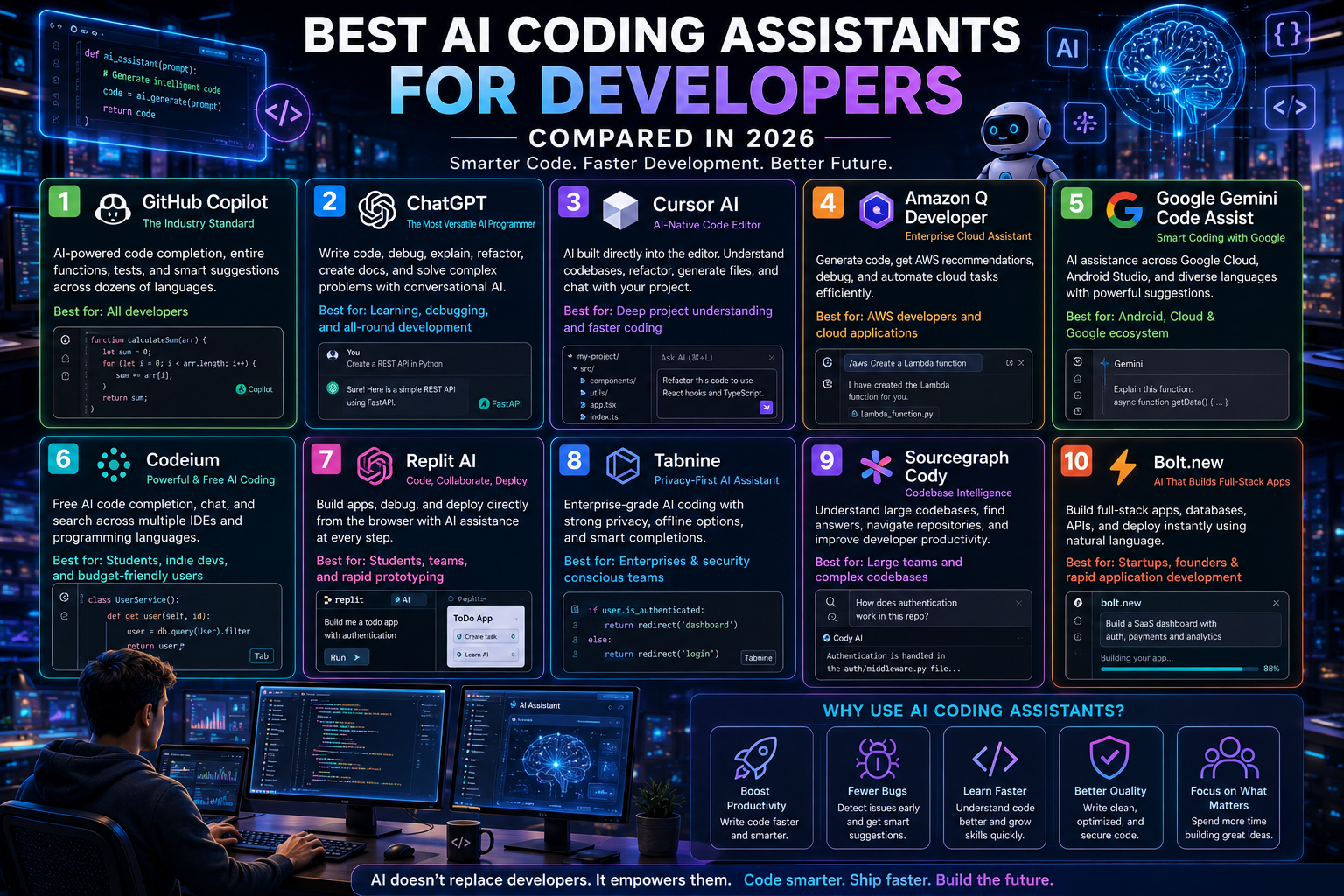
1. GitHub Copilot
The Industry Standard AI Coding Assistant
GitHub Copilot continues to dominate the AI coding assistant market in 2026. Built specifically for developers, it integrates seamlessly into popular code editors like Visual Studio Code, JetBrains IDEs, and Visual Studio.
Its greatest advantage is intelligent code completion. As you type, Copilot predicts entire functions, classes, algorithms, and repetitive code patterns with remarkable accuracy.
Developers working with Python, JavaScript, TypeScript, Java, C#, Go, PHP, Rust, Ruby, and many other languages benefit from its extensive language support.
Beyond simple suggestions, GitHub Copilot understands project context, making its recommendations increasingly relevant as development progresses. It can generate unit tests, explain unfamiliar code, suggest optimizations, and reduce repetitive coding tasks significantly.
For professional software developers, GitHub Copilot remains one of the most reliable AI programmer tools available today.
2. ChatGPT
The Most Versatile AI Programmer
ChatGPT has become much more than a conversational AI. It has evolved into a powerful programming assistant capable of writing code, debugging applications, explaining algorithms, reviewing architecture, and teaching programming concepts.
Unlike traditional autocomplete tools, ChatGPT explains why code works, making it especially valuable for beginners and experienced developers alike.
Developers frequently use ChatGPT to generate SQL queries, build REST APIs, create frontend components, optimize backend logic, write documentation, automate repetitive scripts, and troubleshoot complex bugs.
One of its biggest strengths is handling entire development conversations rather than isolated code snippets. It can guide developers from project planning to deployment while adapting its responses based on ongoing discussions.
Its versatility makes it an indispensable companion for freelancers, software engineers, students, and technical teams.
3. Cursor AI
AI-Native Code Editor Built for Productivity
Cursor AI has quickly become one of the fastest-growing AI development environments.
Rather than adding AI as an extension, Cursor is built around artificial intelligence from the ground up. Developers can ask questions directly inside the editor, generate code, modify existing files, refactor large codebases, and navigate projects using natural language.
Its contextual understanding allows developers to reference multiple files simultaneously, making it highly effective for large software projects.
Many programmers appreciate Cursor because it reduces the need to constantly switch between documentation, browser tabs, and coding environments.
Its AI-first approach has made it particularly popular among startups and independent developers.
4. Amazon Q Developer
Enterprise AI Coding for Cloud Development
Amazon Q Developer focuses on improving productivity for developers building applications on cloud infrastructure.
It provides intelligent code generation, AWS service recommendations, security guidance, infrastructure automation, and debugging assistance.
Teams working extensively with cloud computing benefit from its ability to understand AWS architectures and recommend best practices during development.
For organizations building scalable cloud-native applications, Amazon Q Developer offers a highly specialized AI coding experience.
5. Google Gemini Code Assist
Smart Coding Across Google’s Ecosystem
Google Gemini Code Assist leverages Google’s advanced AI capabilities to help developers write, understand, and improve software more efficiently.
Its integration with Google Cloud, Android Studio, and modern development environments makes it particularly attractive for developers building Android applications and cloud-based services.
The assistant provides intelligent code suggestions, documentation generation, error explanations, and optimization recommendations across multiple programming languages.
Its ability to understand large codebases helps development teams maintain consistency while accelerating project delivery.
6. Codeium
Powerful Free AI Coding Assistant
Codeium has earned a strong reputation for offering one of the best free AI coding assistants available.
Supporting dozens of programming languages and numerous IDEs, Codeium provides intelligent code completion, autocomplete, search capabilities, and AI-powered chat features without requiring expensive subscriptions.
Students, hobbyists, freelancers, and startup developers often choose Codeium because it delivers impressive functionality while remaining budget-friendly.
Its continuous improvements throughout 2025 and 2026 have positioned it as one of the strongest alternatives to premium coding assistants.
7. Replit AI
Coding, Collaboration, and Deployment in One Platform
Replit AI combines cloud development with intelligent programming assistance.
Developers can generate applications, debug errors, explain unfamiliar code, and deploy projects directly from the browser without configuring local development environments.
Its collaborative features make it especially useful for educators, students, remote teams, and developers working on rapid prototypes.
The ability to code, test, and publish applications from virtually any device has contributed to Replit’s growing popularity.
8. Tabnine
Privacy-Focused AI Programming
Tabnine has remained a trusted AI coding assistant by emphasizing security and enterprise privacy.
Organizations handling sensitive code appreciate its deployment flexibility, allowing AI models to operate in private environments while maintaining strict security standards.
Tabnine generates context-aware code completions, predicts repetitive patterns, and assists developers without exposing proprietary source code unnecessarily.
For enterprise software companies, privacy often matters as much as productivity, making Tabnine an attractive solution.
9. Sourcegraph Cody
Understanding Large Codebases
Modern software projects often contain millions of lines of code spread across hundreds of files.
Sourcegraph Cody specializes in helping developers understand these large codebases quickly.
Instead of manually searching through documentation or navigating countless files, developers can ask natural language questions about project architecture, dependencies, functions, and implementation details.
Its contextual understanding dramatically reduces onboarding time for new developers joining existing projects.
Large engineering teams particularly benefit from Cody’s deep repository awareness.
10. Bolt.new
AI That Builds Full-Stack Applications
Bolt.new represents the next generation of AI-assisted software development.
Instead of simply suggesting code, it helps generate complete full-stack web applications using natural language instructions.
Developers can describe an application idea, and Bolt.new creates frontend interfaces, backend logic, database structures, authentication systems, and deployment-ready projects within minutes.
For startups, entrepreneurs, and rapid prototyping teams, this dramatically shortens the journey from concept to working software.
As AI continues advancing, tools like Bolt.new demonstrate how development workflows are becoming increasingly automated.
How AI Coding Assistants Are Transforming Software Development
The rise of AI coding assistants is not replacing developers—it is changing how they work.
Junior programmers now spend less time searching documentation and more time understanding programming concepts.
Senior developers automate repetitive coding tasks, review large codebases faster, and focus on architecture, system design, and innovation.
Development teams use AI to accelerate testing, generate documentation, improve code quality, identify security vulnerabilities, and reduce technical debt.
Companies launching products under tight deadlines benefit from faster development cycles while maintaining high coding standards.
The result is greater productivity without sacrificing creativity or engineering quality.
Choosing the Right AI Programmer
The ideal AI coding assistant depends largely on your workflow.
Developers seeking the most mature autocomplete experience often choose GitHub Copilot.
Those wanting conversational programming guidance frequently rely on ChatGPT.
Developers building modern applications inside AI-first environments increasingly prefer Cursor AI.
Enterprise cloud teams benefit from Amazon Q Developer and Google Gemini Code Assist.
Budget-conscious developers often select Codeium, while organizations requiring maximum privacy choose Tabnine.
Teams managing large repositories appreciate Sourcegraph Cody, and startup founders looking to build products rapidly are embracing Bolt.new.
Each platform solves different development challenges, making it important to match the assistant with your specific coding needs.
The Future of AI Coding Assistants
Artificial intelligence is rapidly becoming an essential part of software engineering. During 2026, AI coding assistants are evolving beyond autocomplete into intelligent development partners capable of planning applications, reviewing architecture, detecting security vulnerabilities, generating automated tests, and even managing deployment workflows.
Future AI programmers will understand entire software ecosystems rather than individual files, enabling them to provide deeper insights and smarter recommendations throughout the development lifecycle.
Rather than replacing developers, these assistants allow programmers to focus on creativity, problem-solving, and innovation while AI handles repetitive implementation tasks.
For developers willing to embrace these technologies, AI coding assistants represent one of the biggest productivity breakthroughs in modern software development. Learning how to collaborate effectively with AI will increasingly become a core skill for programmers across every industry.




Leave a Reply