

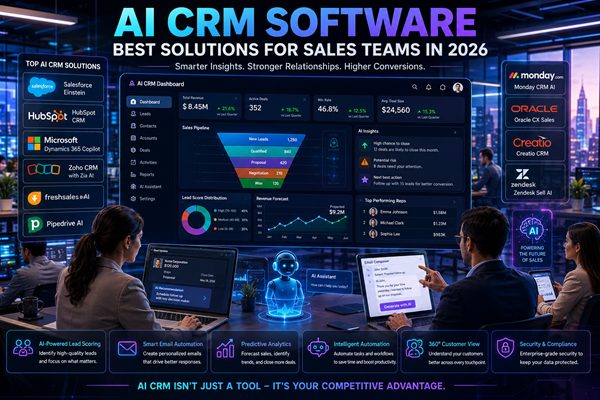
Customer relationships have always been at the heart of successful businesses, but managing those relationships has become increasingly complex. Sales teams today handle thousands of leads, multiple communication channels, personalized marketing campaigns, follow-up schedules, customer support requests, and detailed performance analytics. Relying on spreadsheets or traditional CRM software is no longer enough to stay competitive.
This is where AI CRM software is changing the game. Instead of simply storing customer information, modern AI-powered CRM platforms actively assist sales teams by predicting buying behavior, prioritizing leads, automating repetitive tasks, generating personalized emails, analyzing customer conversations, and providing actionable insights that help close more deals.
Throughout 2025 and into 2026, artificial intelligence has become a core feature of nearly every leading CRM platform. Sales representatives spend less time on administrative work and more time building meaningful customer relationships. Managers gain better visibility into pipeline performance, while businesses improve forecasting accuracy and customer satisfaction.
In this comprehensive guide, we’ll compare the best AI CRM software solutions for sales teams in 2026, exploring their strengths, standout AI features, ideal business sizes, and how each platform helps organizations sell smarter and grow faster.
1. Salesforce Einstein
The Most Powerful Enterprise AI CRM
Salesforce has long been recognized as one of the world’s leading CRM platforms, and Salesforce Einstein takes its capabilities to an entirely new level through artificial intelligence.
Einstein analyzes massive amounts of customer data to identify buying patterns, predict sales opportunities, recommend next actions, and automate repetitive workflows. Instead of manually reviewing every opportunity, sales teams receive AI-driven suggestions that help prioritize the most promising leads.
Another major advantage is predictive forecasting. Managers gain real-time visibility into pipeline health while AI identifies deals that may require immediate attention before they are lost.
For large enterprises managing complex sales operations across multiple regions, Salesforce Einstein delivers one of the most comprehensive AI CRM experiences available in 2026.
2. HubSpot CRM AI
Best AI CRM for Growing Businesses
HubSpot continues to be a favorite among startups, small businesses, and mid-sized organizations because of its intuitive interface and generous free CRM offering.
Its AI-powered features simplify email writing, automate customer communication, summarize meetings, generate reports, and assist sales representatives throughout the customer journey.
The platform also combines marketing, sales, customer service, and content management within one ecosystem, reducing the need for multiple disconnected software solutions.
Businesses looking for an easy-to-use AI CRM without a steep learning curve often find HubSpot to be the perfect balance between functionality and simplicity.
3. Microsoft Dynamics 365 Copilot
AI Across Sales, Marketing, and Customer Service
Microsoft has integrated Copilot directly into Dynamics 365, transforming the platform into an intelligent business assistant.
Sales professionals use Copilot to generate personalized emails, summarize customer interactions, analyze sales trends, prepare meeting notes, and receive AI-powered recommendations for the next best action.
Organizations already using Microsoft 365 benefit from seamless integration with Outlook, Teams, Excel, and Word, creating a unified productivity environment.
The platform is particularly valuable for medium and large enterprises seeking strong AI capabilities within Microsoft’s ecosystem.
4. Zoho CRM with Zia AI
Affordable AI CRM for Small Businesses
Zoho CRM has built a strong reputation by offering enterprise-level functionality at a competitive price.
Its AI assistant, Zia, predicts sales opportunities, detects anomalies, analyzes customer sentiment, recommends workflows, and automates everyday sales activities.
Sales representatives appreciate Zia’s conversational interface, which allows them to retrieve reports, customer information, and business insights using simple natural language queries.
For businesses seeking affordable AI-powered customer relationship management, Zoho CRM remains one of the strongest options available.
5. Freshsales AI
Smarter Lead Management and Sales Automation
Freshsales combines ease of use with intelligent automation, making it particularly attractive for fast-growing sales teams.
Its AI engine automatically scores leads, predicts customer engagement, recommends follow-up timing, and tracks communication across multiple channels.
Sales representatives spend less time organizing data and more time focusing on high-value customer interactions.
Its clean interface and efficient workflow make Freshsales an excellent choice for organizations wanting rapid implementation without sacrificing advanced functionality.
6. Pipedrive AI
Sales Pipeline Management Made Smarter
Pipedrive has always focused on pipeline visibility, and its AI-powered enhancements have made opportunity management even more effective.
The platform identifies deals most likely to close, suggests optimal follow-up activities, highlights inactive opportunities, and provides personalized sales recommendations.
Managers benefit from detailed forecasting dashboards while individual sales representatives receive intelligent guidance that improves daily productivity.
Its visual pipeline design makes it especially popular among sales-focused organizations that prioritize deal management.
7. Monday CRM AI
Flexible CRM for Modern Teams
Monday CRM combines project management, workflow automation, and customer relationship management within a highly customizable platform.
Its AI capabilities assist with email generation, customer summaries, workflow automation, meeting preparation, and task prioritization.
Businesses appreciate the platform’s flexibility because it adapts easily to different industries, sales processes, and organizational structures.
Whether managing customer onboarding, lead nurturing, or long-term account relationships, Monday CRM provides a modern AI-assisted workspace.
8. Oracle CX Sales
Enterprise Intelligence at Scale
Oracle CX Sales is designed for organizations managing extensive customer data across global markets.
Its artificial intelligence analyzes historical customer interactions, predicts future buying behavior, recommends pricing strategies, and improves opportunity forecasting.
Large enterprises benefit from AI-driven analytics capable of identifying revenue trends that might otherwise remain hidden.
Organizations operating complex international sales operations frequently choose Oracle for its scalability and advanced business intelligence capabilities.
9. Creatio CRM
No-Code AI CRM Automation
Creatio distinguishes itself by combining AI-powered CRM with no-code workflow automation.
Businesses can automate approvals, customer communication, sales processes, and lead management without requiring extensive technical expertise.
Its AI recommendations help improve customer engagement while reducing manual administrative work.
Organizations seeking maximum workflow flexibility often appreciate Creatio’s low-code and no-code approach to CRM customization.
10. Zendesk Sell AI
Better Customer Relationships Through AI
Zendesk Sell extends traditional customer relationship management by combining sales intelligence with customer support insights.
Its AI capabilities automatically organize customer conversations, summarize interactions, prioritize follow-ups, and recommend engagement strategies based on customer behavior.
Companies emphasizing long-term customer satisfaction alongside sales growth often benefit from Zendesk’s integrated approach.
The platform helps ensure every customer interaction contributes to stronger relationships and higher retention.
How AI CRM Software Is Transforming Sales Teams
The role of CRM software has fundamentally changed.
Instead of functioning as a digital address book, AI CRM platforms actively guide sales representatives throughout every stage of the customer journey.
Lead scoring has become more accurate because AI analyzes historical conversions rather than relying solely on manual evaluation.
Sales forecasting has improved as machine learning models identify patterns hidden within thousands of customer interactions.
Routine administrative work—including data entry, email writing, meeting summaries, and scheduling—is increasingly automated, allowing sales professionals to dedicate more time to building trust with customers.
Managers also gain deeper insights into team performance, enabling better coaching and more informed business decisions.
As a result, AI CRM software is helping organizations increase productivity while delivering more personalized customer experiences.
Choosing the Right AI CRM Solution
Selecting the ideal AI CRM depends on your organization’s size, industry, budget, and sales process.
Large enterprises with global operations often benefit from Salesforce Einstein, Microsoft Dynamics 365 Copilot, or Oracle CX Sales due to their advanced analytics and scalability.
Growing businesses frequently choose HubSpot CRM because of its ease of use, integrated marketing capabilities, and strong AI features.
Budget-conscious organizations often prefer Zoho CRM or Freshsales because they deliver powerful AI functionality at competitive pricing.
Sales-driven companies focused on pipeline management appreciate Pipedrive, while organizations seeking flexible workflow automation frequently select Monday CRM or Creatio.
Businesses placing equal importance on customer service and sales often find Zendesk Sell to be an excellent long-term solution.
Understanding your team’s workflow and future growth plans is essential before making a CRM investment.
The Future of AI CRM Software
Artificial intelligence is transforming customer relationship management from passive record-keeping into proactive business intelligence.
Throughout 2026, AI CRM platforms are becoming increasingly capable of predicting customer needs, generating personalized communication, automating complex workflows, and providing real-time strategic recommendations.
Future systems will likely combine conversational AI, voice assistants, predictive analytics, customer sentiment analysis, and autonomous workflow management into unified business platforms.
Rather than replacing sales professionals, AI enables them to focus on what matters most—building genuine relationships, understanding customer needs, and delivering exceptional value.
Organizations that successfully combine human expertise with intelligent AI automation will be better positioned to compete in an increasingly data-driven marketplace.
For businesses looking to improve productivity, customer satisfaction, and revenue growth, adopting AI CRM software is no longer simply an advantage—it is quickly becoming a competitive necessity.


Leave a Reply