

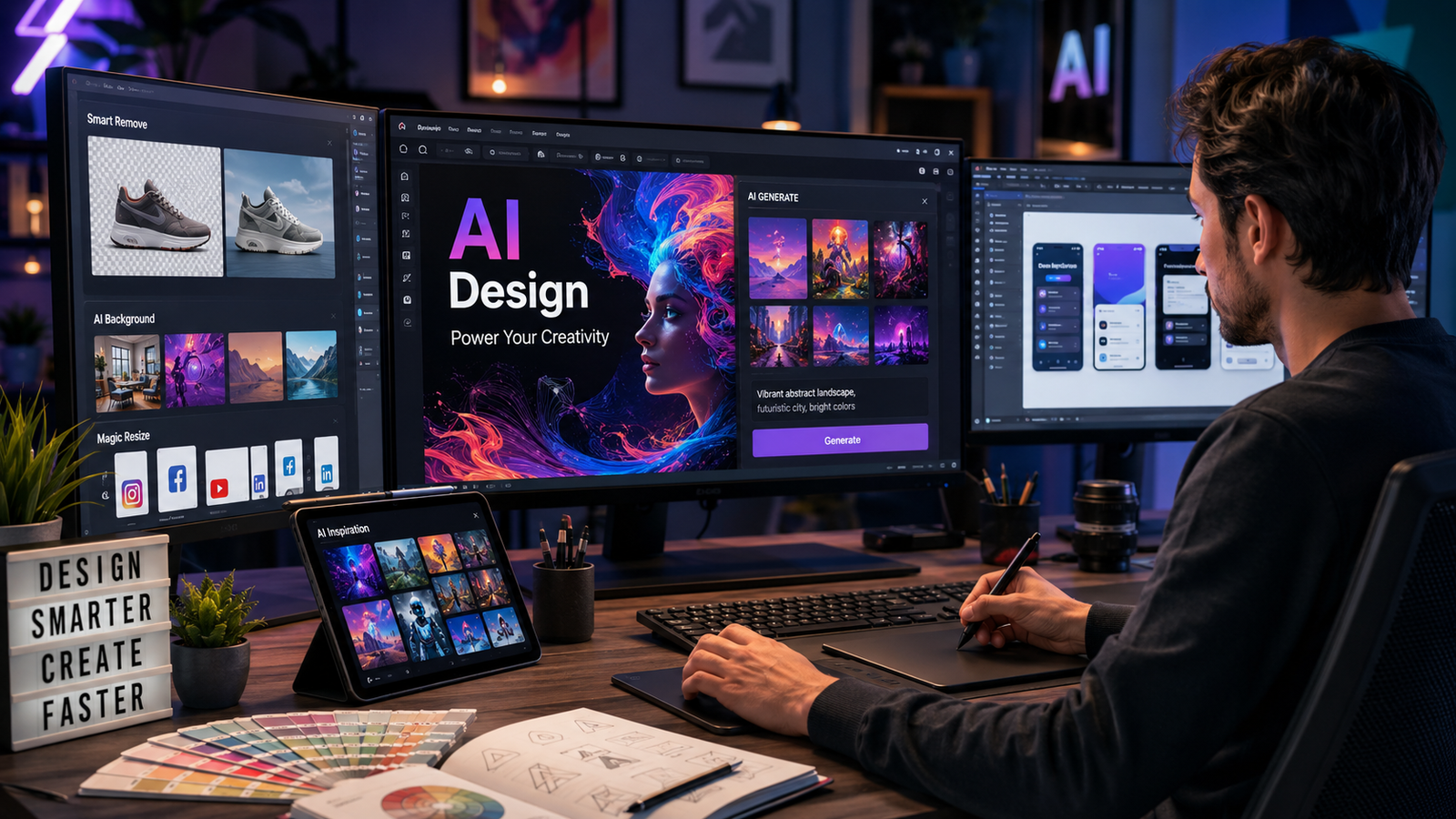
Graphic design has always been a blend of imagination, technical skill, and endless experimentation. But in 2026, artificial intelligence has completely transformed the creative process. Instead of replacing designers, AI has become a powerful creative partner that speeds up repetitive tasks, generates fresh ideas, enhances images, and helps professionals focus on what truly matters—creating exceptional designs.
Whether you’re designing social media graphics, marketing campaigns, brand identities, website interfaces, or digital illustrations, AI design software can significantly improve productivity without sacrificing creativity. Modern AI-powered design tools can remove backgrounds in seconds, generate illustrations from text prompts, suggest color palettes, create realistic mockups, and even help brainstorm entirely new visual concepts.
The growing demand for faster content production has made AI an essential part of every designer’s workflow. Businesses expect high-quality visuals delivered quickly, and designers who embrace AI are finding themselves better equipped to meet those expectations.
If you’re wondering which AI design software deserves a place in your toolkit, this guide explores the best options available in 2026 and explains how each one can elevate your creative work.
1. Why AI Design Software Has Become Essential for Graphic Designers
Just a few years ago, designers spent hours manually editing photos, creating variations of layouts, or searching for inspiration. Today, AI can handle many of these repetitive tasks within minutes.
Rather than replacing artistic talent, AI enhances it by acting like a creative assistant. It allows designers to experiment with multiple ideas faster, automate tedious editing, and spend more time refining the final product.
For freelance designers, agencies, marketing teams, and businesses alike, AI tools have become valuable investments because they reduce production time while maintaining professional quality.
Another major advantage is accessibility. Even beginners can create polished graphics using AI-powered templates and smart suggestions, making professional-quality design more achievable than ever before.
2. Adobe Firefly – The Professional Designer’s AI Companion
Among all AI design software available today, Adobe Firefly remains one of the strongest choices for professional designers.
Integrated directly into Adobe Creative Cloud, Firefly allows users to generate images from text prompts, expand images beyond their original boundaries, replace backgrounds, recolor vector artwork, and apply advanced generative editing.
What makes Firefly particularly attractive is its commercially safe AI model. Adobe trains Firefly on licensed and public-domain content, giving businesses greater confidence when using AI-generated assets for commercial projects.
For designers already working with Photoshop, Illustrator, and Express, Firefly creates a seamless workflow where AI becomes a natural extension of traditional editing rather than a separate tool.
In 2026, Adobe continues adding smarter generative features, making Firefly one of the most trusted AI design platforms available.
Why Designers Love Adobe Firefly
Professional-quality image generation.
Excellent Photoshop integration.
Commercially friendly AI outputs.
Fast background replacement.
Powerful generative fill capabilities.
3. Canva Magic Studio – Simplicity Meets AI Innovation
Canva has evolved far beyond a beginner-friendly design platform.
Its Magic Studio suite combines AI writing, image generation, presentation creation, photo editing, object removal, background generation, and automatic resizing into one intuitive interface.
Designers who frequently produce marketing materials appreciate Canva because it dramatically reduces production time without requiring advanced editing knowledge.
Whether creating Instagram posts, YouTube thumbnails, brochures, advertisements, presentations, or business proposals, Canva’s AI features help users generate polished designs within minutes.
In 2026, Canva continues expanding its AI capabilities, making it an excellent option for freelancers, small businesses, educators, and content creators.
Best Features of Canva Magic Studio
AI-generated graphics.
Smart photo editing.
Automatic brand consistency.
Magic Resize for multiple platforms.
AI-powered presentations.
4. Figma AI – Transforming UI and UX Design
User interface designers are increasingly relying on Figma AI to accelerate website and app design.
Instead of starting every project from scratch, designers can generate layouts, create interface components, organize design systems, and receive intelligent suggestions using AI.
Collaboration remains one of Figma’s biggest strengths. Teams can work simultaneously while AI assists with repetitive interface design tasks, allowing everyone to focus on user experience rather than manual adjustments.
As digital products continue growing in complexity throughout 2026, Figma AI has become an indispensable productivity tool for UX professionals.
5. Midjourney – Turning Imagination into Stunning Visuals
Sometimes, designers need inspiration before beginning a project.
This is where Midjourney truly excels.
Instead of producing standard stock-style images, Midjourney generates artistic, imaginative, and visually striking artwork from simple text prompts.
Creative agencies frequently use Midjourney for mood boards, concept art, campaign visualization, fantasy illustrations, advertising concepts, packaging ideas, and branding inspiration.
The software has become especially popular among professionals who want unique imagery that stands apart from conventional templates.
In 2026, Midjourney continues producing some of the highest-quality AI-generated artwork available.
Ideal Use Cases
Creative concept development.
Advertising campaigns.
Book covers.
Brand identity exploration.
Digital illustration.
6. Microsoft Designer – AI for Everyday Marketing Graphics
Microsoft Designer has grown into a practical solution for professionals who need attractive visuals quickly.
Powered by advanced AI models, it can automatically generate banners, social media graphics, invitations, promotional materials, and presentations from short text descriptions.
Designers working with Microsoft 365 appreciate the platform’s seamless integration with Word, PowerPoint, and other productivity applications.
For marketing teams managing large volumes of visual content, Microsoft Designer significantly reduces production time while maintaining consistent quality.
7. Leonardo AI – Professional Image Creation for Creative Projects
Leonardo AI has rapidly become one of the most respected AI image generation platforms.
Unlike general-purpose generators, Leonardo offers fine-grained control over style, lighting, texture, composition, and artistic direction.
Graphic designers use Leonardo AI to produce marketing visuals, game assets, product illustrations, website graphics, architectural concepts, and branding materials.
Its ability to maintain visual consistency across multiple generated images makes it particularly valuable for large commercial projects.
As AI image quality continues improving throughout 2026, Leonardo AI remains a favorite among professionals seeking greater creative control.
8. Pixlr AI – Fast Editing Without Complex Software
Not every design project requires heavyweight software.
Pixlr AI offers an accessible cloud-based editing platform capable of removing backgrounds, enhancing image quality, generating visuals, eliminating unwanted objects, and applying creative effects with minimal effort.
Its browser-based workflow makes it perfect for freelancers, students, and businesses that need professional editing without installing resource-intensive applications.
Pixlr demonstrates how AI has made advanced image editing accessible to nearly everyone.
9. Runway – Where Graphic Design Meets AI Video Creation
Modern designers rarely work exclusively with static images.
Brands increasingly expect motion graphics, short-form videos, animated advertisements, and social media reels.
Runway bridges this gap by offering AI-powered video editing alongside image generation.
Designers can remove backgrounds, generate video clips, edit scenes, replace objects, and create cinematic content using simple prompts.
For creative professionals expanding into multimedia design, Runway has become one of the industry’s most exciting AI platforms.
10. How to Choose the Right AI Design Software
Selecting the ideal AI design software depends entirely on your creative goals.
If you’re a professional branding designer, Adobe Firefly offers deep integration with industry-standard software.
If you focus on marketing materials and social media content, Canva Magic Studio delivers remarkable speed and simplicity.
UI and UX professionals benefit most from Figma AI’s collaborative environment.
Artists seeking unique visual inspiration often prefer Midjourney or Leonardo AI.
Meanwhile, designers creating multimedia campaigns should seriously consider Runway for its advanced AI video capabilities.
The good news is that many designers no longer rely on a single platform. Instead, they combine multiple AI tools to build highly efficient workflows that maximize creativity while minimizing repetitive work.
The Future of AI Design in 2026 and Beyond
Artificial intelligence is no longer a futuristic concept in graphic design—it is an everyday creative partner.
The best designers understand that AI isn’t replacing human creativity. Instead, it’s amplifying it by removing repetitive tasks, accelerating experimentation, and opening doors to ideas that might have taken hours or even days to explore manually.
As AI continues evolving, we’ll likely see smarter collaboration between designers and machines. Personalized design assistants, real-time brand consistency, intelligent asset generation, and advanced creative automation will become standard features rather than premium additions.
Those who embrace these technologies today will be better positioned to deliver faster results, produce higher-quality work, and remain competitive in an increasingly digital creative industry.
Ultimately, the most successful graphic designers of the future won’t be those who avoid AI. They’ll be the professionals who learn how to combine human imagination with AI-powered efficiency to create designs that are not only visually stunning but also strategically impactful.


Leave a Reply